A typical car tire and rim weigh about 40 to 60 pounds together, but the exact weight can range from about 30 to 90+ pounds depending on the tire size, rim material, and vehicle.
If you need to know how much a car tire and rim weigh, you are probably checking a replacement wheel, planning shipping, lifting a wheel, or comparing a lighter wheel setup.
I’ve worked with tires and wheels for years, and one thing I’ve learned is that two wheels with the same diameter can have very different weights. A small 16-inch alloy wheel with a passenger tire can be much lighter than a 16-inch steel wheel with a heavy-duty tire.
This guide breaks down typical tire and rim weights by vehicle type, explains what makes a wheel heavier, and shows you how to measure the actual weight of your own wheel.
Quick answer: Most passenger-car tire and wheel combinations weigh 40 to 60 pounds per wheel. SUVs and trucks often weigh 50 to 90+ pounds per wheel.
How Much Does a Car Tire and Rim Weigh?
The easiest way to understand wheel weight is to separate the tire from the rim.
The tire is made from rubber, steel belts, fabric, and other materials. The rim, also called the wheel, is usually made from steel or aluminum alloy.
When mounted together, their combined weight is called the wheel-and-tire assembly weight.
Here are useful general ranges:
| Vehicle type | Tire weight | Rim weight | Combined weight |
|---|---|---|---|
| Compact car | 18–22 lbs | 12–20 lbs | 30–42 lbs |
| Midsize sedan | 20–24 lbs | 15–24 lbs | 35–48 lbs |
| SUV/crossover | 25–35 lbs | 18–30 lbs | 45–65 lbs |
| Light truck | 30–50+ lbs | 20–40+ lbs | 50–90+ lbs |
| Performance car | 20–35+ lbs | 15–30+ lbs | 35–65+ lbs |
These are general ranges, not exact specifications. The same vehicle can have different wheel weights depending on the tire model, wheel construction, size, and optional equipment.
For an exact number, weigh the complete wheel and tire assembly or check the specifications from the tire and wheel manufacturers.

What Makes a Car Tire and Rim Heavier?
Several factors can change how much a car tire and rim weigh. Wheel diameter is only one part of the answer.
1. Tire size
A larger tire normally uses more rubber and internal material.
For example, a wide 20-inch SUV tire will usually weigh more than a narrow 16-inch passenger-car tire.
Tire width matters too. A wider tire has more material across its tread and sidewalls.
2. Rim size
Larger rims often weigh more because they contain more metal.
Moving from a 16-inch wheel to an 18-, 19-, or 20-inch wheel can increase the weight of the wheel assembly. However, construction matters, so diameter alone does not tell you the exact weight.
3. Rim material
Steel and aluminum alloy wheels have different weights.
Steel wheels are often heavier but are commonly used because they are durable and relatively inexpensive.
Aluminum alloy wheels can be lighter, although their exact weight depends on the design and how much material is used.
Some performance wheels use forged construction to reduce weight while maintaining strength.
4. Tire construction
The type of tire also matters.
A normal touring tire may be fairly light, while a run-flat, off-road, reinforced, or heavy-duty tire can add several pounds.
Run-flat tires, for example, use stronger sidewall construction so the vehicle can continue moving for a limited distance after a loss of pressure.
5. Tire profile
A low-profile tire does not automatically mean the entire wheel assembly is lighter.
A low-profile setup is often paired with a larger wheel. The tire may have less sidewall material, but the larger rim can add weight.
6. Extra wheel components
The complete assembly can also include:
- TPMS sensor
- Valve stem
- Wheel weights
- Lug nuts
- Wheel locks
- Hub-centric rings or similar hardware
Each item is small, but the total can add to the final weight.
Average Car Tire and Rim Weight by Vehicle Type
If you are asking how much does a car tire and rim weigh for a particular type of vehicle, these ranges are a useful starting point.
Compact cars: about 30 to 42 pounds
Small cars usually use smaller tires and wheels.
A typical compact-car setup may look like:
- Tire: 18–22 pounds
- Alloy rim: 12–20 pounds
- Total: about 30–42 pounds
A compact car with larger aftermarket wheels can weigh considerably more.
Midsize sedans: about 35 to 48 pounds
Midsize sedans often use 16- to 19-inch wheels.
A typical setup may weigh:
- Tire: 20–24 pounds
- Rim: 15–24 pounds
- Total: about 35–48 pounds
Performance trims can fall outside this range.
SUVs and crossovers: about 45 to 65 pounds
SUVs generally use larger and wider tires than passenger cars.
A typical SUV or crossover wheel assembly may weigh:
- Tire: 25–35 pounds
- Rim: 18–30 pounds
- Total: about 45–65 pounds
Large SUVs with all-terrain tires can be considerably heavier.
Pickup trucks: about 50 to 90+ pounds
Truck tires are often heavier because they need to carry greater loads and handle tougher conditions.
A light-truck setup may weigh:
- Tire: 30–50+ pounds
- Rim: 20–40+ pounds
- Total: about 50–90+ pounds
Heavy-duty trucks can exceed this range.
Sports and performance cars: about 35 to 65+ pounds
Performance vehicles are more difficult to generalize.
Some use lightweight forged wheels and performance tires. Others use large wheels and wide tires that add substantial weight.
The final number depends heavily on the specific tire and wheel combination.
How to Measure a Tire and Rim Weight
If you want the exact answer for your vehicle, measuring the complete assembly is better than relying on an average.
Method 1: Use a professional wheel scale
A tire shop can weigh the complete wheel and tire assembly.
The basic process is:
- Remove the wheel from the vehicle.
- Place the complete assembly on a suitable scale.
- Record the weight.
- If needed, remove the tire from the rim and weigh each part separately.
This gives you the most useful number when you need accurate shipping or handling information.
Method 2: Use a floor or platform scale
You can also weigh a mounted wheel at home if you have a suitable scale.
Place the wheel-and-tire assembly carefully on the scale and make sure the entire weight is supported.
Do not use a small household scale if the wheel is too heavy or unstable for it.
What should be included?
If you want the real-world weight of the complete assembly, leave the normal components installed:
- Tire
- Rim
- TPMS sensor
- Valve stem
- Wheel weights
If you are comparing aftermarket wheels, use the same measurement method for every setup.
Why Tire and Rim Weight Matters
The weight of a wheel and tire is not just useful when you are lifting it.
It can also affect how the vehicle feels on the road.
Acceleration and response
Heavy wheels and tires increase the amount of mass the vehicle has to move and rotate.
A lighter wheel-and-tire setup can make steering and acceleration feel more responsive.
This is one reason performance drivers often pay close attention to wheel weight.
Suspension response
Wheels and tires are part of the vehicle’s unsprung mass.
A heavier assembly can make it harder for the suspension to control wheel movement over bumps. The effect depends on the vehicle, suspension design, tire, and road surface.
That does not mean every heavier wheel will create a major problem. It simply means wheel weight is one factor in overall suspension behavior.
Fuel economy
Extra vehicle weight can affect fuel use, but the actual effect from changing wheel weight alone is usually smaller than many drivers expect.
Do not assume that saving a few pounds per wheel will create a dramatic fuel-economy improvement.
Driving style, tire pressure, vehicle weight, aerodynamics, and road conditions can have much larger effects.
For tire maintenance and correct inflation, the NHTSA Tire Safety guidance recommends using the vehicle manufacturer’s recommended cold tire pressure shown on the tire and loading information label or in the owner’s manual.
Braking and handling
Wheel and tire weight can also influence braking response and handling.
However, tire grip, tread condition, brake condition, suspension setup, alignment, and road conditions all matter.
That is why you should not choose a wheel only because it is lighter.
Wheel Weight vs. Tire Weight: Which Is Heavier?
There is no single rule.
On some passenger cars, the tire may weigh more than the rim. On another vehicle, a large or heavy-duty rim may weigh as much as or more than the tire.
For example:
Light setup
- Tire: 20 lbs
- Rim: 15 lbs
- Total: 35 lbs
Heavy SUV setup
- Tire: 35 lbs
- Rim: 28 lbs
- Total: 63 lbs
Heavy truck setup
- Tire: 45 lbs
- Rim: 35 lbs
- Total: 80 lbs
This is why the best way to answer how much does a car tire and rim weigh is to look at the exact tire and wheel specifications.
How Much Does a Steel Rim and Tire Weigh?
A steel rim and tire can commonly weigh around 45 to 75 pounds, although smaller passenger-car combinations can weigh less and heavy truck combinations can weigh much more.
Steel wheels are often heavier than comparable alloy wheels.
For example, if a tire weighs 25 pounds and the steel wheel weighs 22 pounds, the complete assembly is about 47 pounds.
If you are replacing steel wheels with alloy wheels, compare the actual published weights instead of assuming every alloy wheel is lighter.
How Much Does an Alloy Rim and Tire Weigh?
An alloy wheel and tire can commonly fall in the 35- to 65-pound range for many passenger vehicles and SUVs.
The exact number depends on:
- Wheel diameter
- Wheel width
- Wheel design
- Alloy construction
- Tire size
- Tire construction
- Vehicle type
A forged performance wheel may be surprisingly light, while a large cast wheel can still be fairly heavy.
Does a Bigger Rim Always Weigh More?
No.
A larger rim often has more material, but construction can make a major difference.
For example, a lightweight forged 19-inch wheel could weigh less than a heavy cast 18-inch wheel.
The tire also changes the final result.
So if you are comparing a 17-inch and 19-inch setup, compare the complete tire-and-wheel weight, not just the rim diameter.
Does a Heavier Tire and Rim Affect Driving?
It can.
A heavier wheel-and-tire assembly may make the vehicle feel less responsive, especially when compared with a much lighter setup.
You may notice differences in:
- Steering response
- Acceleration feel
- Ride response
- Suspension movement
- Braking feel
But the effect varies from one vehicle to another.
If you are changing wheels because of vibration or handling problems, also check tire balance, pressure, alignment, and suspension condition.
For example, if you notice steering vibration at highway speeds, our guide on Steering Wheel Shaking at Highway Speeds explains several common tire, wheel, brake, and suspension causes.
How to Choose the Right Tire and Rim Weight
Don’t choose a wheel simply because it is light.
First, make sure the wheel and tire are correct for your vehicle.
Check:
- Tire size
- Wheel diameter
- Wheel width
- Bolt pattern
- Offset
- Center bore
- Tire load index
- Wheel load rating
- Speed rating
- Manufacturer compatibility
NHTSA explains that the vehicle’s tire and loading information label provides the original tire sizes and recommended cold tire pressure.
The tire load index is also important because it indicates the load a tire is designed to carry.
When mounting a tire, the tire and rim must also be compatible in size and load capacity. NHTSA guidance specifically stresses proper tire-and-wheel matching.
Tips for Handling Heavy Wheels Safely
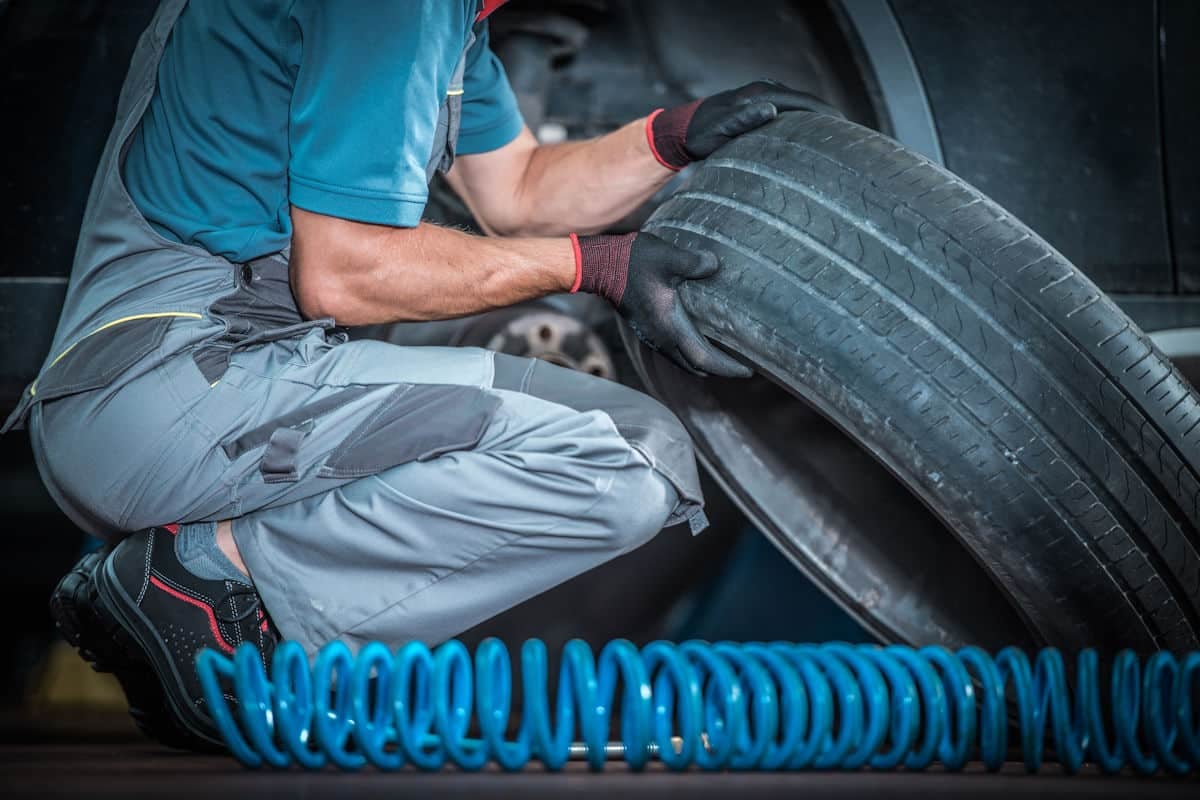
A complete SUV or truck wheel can be surprisingly heavy.
Use these simple precautions:
- Lift with your legs instead of your back.
- Keep the wheel close to your body when carrying it.
- Ask for help with very heavy wheels.
- Use a wheel dolly when available.
- Do not try to catch a falling wheel.
- Use proper jack stands when working under a vehicle.
- Torque the lug nuts to the vehicle manufacturer’s specification.
If you’re removing a wheel for brake work, use proper support equipment. Our guide on How to Replace Brake Pads Yourself covers safe wheel removal and jack-stand use during brake service.
Tire and Rim Weight for Shipping
Knowing the wheel weight is especially useful when shipping tires and rims.
Before requesting a shipping quote, weigh the actual package rather than guessing.
Remember that shipping weight can include:
- Tire
- Rim
- Box
- Cardboard
- Packing material
- Protective wrap
Four wheels that weigh 50 pounds each already represent about 200 pounds of wheel-and-tire weight, before packaging.
If you are shipping only the rims, weigh the rims separately.
If you are shipping complete mounted wheels, use the complete packaged weight for the most accurate quote.
My Experience With Wheel Weight
One mistake I see often is assuming that wheel diameter tells you everything.
It doesn’t.
I have handled wheels that looked similar in size but felt very different when lifting them. The tire construction, wheel design, width, and materials all made a difference.
I also learned that a lighter wheel is not automatically the right wheel.
For a daily driver, I would first make sure the wheel has the correct fitment and load rating. After that, weight becomes another factor to compare.
For performance driving, reducing unnecessary wheel-and-tire weight can be useful. For trucks and towing applications, strength and load capacity can be more important than saving a few pounds.
Common Mistakes When Comparing Tire and Rim Weight
Mistake 1: Comparing only rim diameter
Two 18-inch wheels can have very different weights.
Better approach: Compare the actual wheel weight and complete tire weight.
Mistake 2: Ignoring tire weight
Drivers often compare two rims but forget that the tire can add a significant amount of weight.
Better approach: Compare the complete mounted assembly.
Mistake 3: Choosing the lightest wheel without checking load rating
A lightweight wheel is not useful if it is not approved for your vehicle.
Better approach: Check wheel load rating and vehicle compatibility first.
Mistake 4: Assuming all alloy wheels are light
Alloy does not automatically mean lightweight.
Better approach: Look for the manufacturer’s actual wheel weight.
Mistake 5: Using tire sidewall pressure as your normal target
The maximum pressure printed on the tire is not necessarily the correct pressure for your vehicle.
Better approach: Follow the vehicle manufacturer’s recommended cold tire pressure. NHTSA specifically notes that the correct vehicle pressure is found on the vehicle label or in the owner’s manual.

Frequently Asked Questions
How much does a car tire and rim weigh?
A typical passenger-car tire and rim weigh about 40 to 60 pounds together. Smaller compact-car setups can be around 30 to 42 pounds, while large SUVs and trucks can weigh 50 to 90+ pounds per wheel.
How much does a tire weigh by itself?
Many passenger-car tires weigh roughly 18 to 30 pounds, while larger SUV, truck, off-road, and performance tires can weigh 30 to 50+ pounds.
The exact weight depends on tire size and construction.
How much does a rim weigh by itself?
A typical passenger-car rim may weigh around 12 to 25 pounds, while larger SUV and truck wheels can weigh 20 to 40+ pounds.
Steel, cast alloy, and forged alloy wheels can all have different weights.
Do tires or rims weigh more?
Either one can be heavier.
A normal passenger tire may weigh more than a lightweight alloy rim. A heavy-duty or large rim can weigh more than the tire.
You need the actual specifications to know for sure.
How much does a steel rim and tire weigh?
A steel rim with a tire often weighs around 45 to 75 pounds, depending on size and construction. Heavy-duty truck combinations can weigh more.
How much does a 20-inch tire and rim weigh?
A 20-inch tire and rim can commonly weigh around 50 to 80+ pounds, but there is no fixed number.
The tire width, tire construction, rim material, rim width, and vehicle type all affect the final weight.
Are lighter rims better?
Lighter rims can reduce wheel-and-tire mass and may improve steering response and acceleration feel. But weight should not be the only factor.
Always check fitment, load rating, tire compatibility, and manufacturer specifications before choosing a wheel.
Can I safely use lighter rims on my car?
Yes, if the wheels are properly designed and rated for your vehicle.
Check the correct bolt pattern, offset, center bore, wheel load rating, tire size, and other manufacturer requirements before installation.
How can I weigh a tire and rim at home?
Remove the complete wheel from the car and use a suitable platform or floor scale that can safely support its weight.
For the most accurate number, weigh the complete mounted assembly with the normal TPMS sensor, valve stem, and wheel weights installed.
Does wheel weight affect fuel economy?
It can, but the effect from wheel weight alone is usually modest.
Vehicle weight, tire pressure, tire type, driving habits, aerodynamics, and road conditions can have larger effects on fuel use.
Does wheel weight affect handling?
Yes. Wheel and tire mass is part of the vehicle’s unsprung mass and can affect steering response and suspension behavior.
The size of the effect depends on the vehicle and the difference between the old and new setup.
Final Answer: How Much Does a Car Tire and Rim Weigh?
So, how much does a car tire and rim weigh?
For many passenger cars, expect roughly 40 to 60 pounds per complete wheel and tire.
A useful guide is:
- Compact cars: 30–42 pounds
- Midsize sedans: 35–48 pounds
- SUVs/crossovers: 45–65 pounds
- Light trucks: 50–90+ pounds
- Performance cars: about 35–65+ pounds
These numbers are only general ranges. Your actual wheel weight can be very different because tire size, wheel diameter, width, construction, material, and load rating all matter.
If you need an exact number for shipping, lifting, or a wheel upgrade, weigh your actual wheel-and-tire assembly or check the manufacturer’s specifications.
And remember: the lightest wheel is not always the right wheel. Correct fitment, load capacity, tire compatibility, and safe installation should come first.
For routine tire care, use the vehicle manufacturer’s recommended pressure and check your tires regularly. NHTSA Tire Safety and Maintenance Guide
Related AutoAdvises guides:
How Much Does Car Tire Pressure Change With Temperature?
Steering Wheel Shaking at Highway Speeds
Brake Vibration at Highway Speed
How to Replace Brake Pads Yourself