The best OBD2 scanners for Volkswagen vehicles make fault checks faster, clearer, and less costly.
A warning light can turn a calm drive into a guessing game. You may wonder if your Volkswagen has a loose gas cap, a weak sensor, or a serious engine fault. I tested the most useful features to find the best OBD2 scanners for Volkswagen vehicles, with focus on code reading, live data, ease of use, and value. These scanners can help you understand many engine and emissions faults before visiting a shop. Still, most basic OBD2 tools cannot scan every Volkswagen module, such as ABS, airbag, or transmission systems.
ANCEL AD310 Classic OBD2 Scanner

The ANCEL AD310 is a simple, corded scanner for reading and clearing common check engine codes. It supports standard OBD2 protocols used by most Volkswagen vehicles sold in the United States from model year 1996 onward. The small screen shows the code, a short code description, and key fault details. I like its direct design because you do not need a phone, app, battery, or wireless setup.
This scanner can display freeze-frame data and help check I/M readiness monitors before an emissions test. Its four-button layout feels easy to learn, even if you have never used an OBD2 reader. The cable is long enough for most driver-seat diagnostic ports, though I still suggest sitting safely with the car parked. For basic engine fault checks, the AD310 is one of the best OBD2 scanners for Volkswagen vehicles when low cost and simple operation matter most.
Pros:
- Simple plug-and-play operation
- Reads and clears many check engine codes
- Works with standard OBD2 vehicles from 1996 onward
- Shows freeze-frame information
- Checks emissions readiness status
- Does not need a phone or wireless app
- Compact size fits easily in a glove box
Cons:
- Does not provide advanced Volkswagen module coding
- Small screen limits the amount of data shown at once
- Limited live-data functions compared with higher-priced scanners
My Recommendation
I recommend the ANCEL AD310 for Volkswagen owners who want a basic home code reader. It suits drivers who mainly need to identify a check engine fault, clear a repaired code, or check readiness before an emissions test. It can also help a new car owner avoid an unnecessary trip to a repair shop for a minor fault.
This is not the right choice for someone who needs ABS, airbag, transmission, body-control, or manufacturer-specific service functions. A Volkswagen can store faults outside the engine computer, and a basic OBD2 reader may not see them. For simple engine diagnostics at a very low price, however, the AD310 offers strong value and remains widely available.
FOXWELL NT301 Live Data OBD2 Scanner

The FOXWELL NT301 adds live data to the basic code-reading tools found on entry-level scanners. It can show sensor readings while the engine runs, including values that may help explain a check engine light. The color display makes the data easier to view than a tiny monochrome screen. Its built-in code definitions also reduce the need to search every code on a separate device.
I find the NT301 useful for checking whether a fault looks steady, random, or linked to a changing sensor value. It supports freeze-frame data, oxygen sensor information, and emissions readiness checks on supported vehicles. The tool connects through the vehicle’s diagnostic port, so it draws power from the car and does not need charging. For drivers who want more insight than a simple code number, this model is among the best OBD2 scanners for Volkswagen vehicles in its price range.
Pros:
- Clear color screen improves data viewing
- Displays live engine sensor information
- Reads and clears common diagnostic trouble codes
- Provides built-in code definitions
- Shows freeze-frame data for fault review
- Checks I/M emissions readiness monitors
- Includes a dedicated design for hands-on use
Cons:
- Does not replace a full Volkswagen dealer scan tool
- Some advanced data may depend on vehicle support
- It uses a cable rather than wireless phone access
My Recommendation
The FOXWELL NT301 is best for a Volkswagen owner who wants to learn more than the fault code alone. It makes sense for a home mechanic who checks sensor behavior, monitors readiness, and wants a larger display. I would choose it over a basic scanner when I need live information during a careful troubleshooting session.
Keep your expectations realistic. Live data can point toward a problem, but it does not prove that one part has failed. For example, a fuel-trim value may suggest an air leak, weak fuel delivery, or a sensor issue. Still, the NT301 gives you a better starting point than a reader that only says “code stored.” It is a practical pick among the best OBD2 scanners for Volkswagen vehicles for everyday engine diagnosis.
Innova 5210 OBD2 Scanner and Battery Tester

The Innova 5210 combines engine code reading with battery and charging-system tests. That combination can help when a Volkswagen shows strange warning lights after a weak start or a low battery event. It reads and clears many standard powertrain codes and can display live data on supported vehicles. The handheld design feels more like a shop tool than a tiny emergency reader.
One useful feature is its ability to help review battery voltage and alternator performance. It also includes service functions such as oil reset on supported vehicles, although coverage can vary by model and year. The scanner works with a companion repair app, giving some owners another way to understand repair information. For drivers who want a broader home diagnostic kit, the Innova 5210 is one of the best OBD2 scanners for Volkswagen vehicles with useful battery-test support.
Pros:
- Reads and clears many engine fault codes
- Includes battery and charging-system testing
- Offers live data for supported vehicles
- May support oil reset functions on certain models
- Has a clear handheld display
- Works with a repair information app
- Useful for tracking low-voltage problems
Cons:
- Service coverage can vary by Volkswagen model and year
- Some app features may require a compatible phone
- It does not provide full factory-level module access
My Recommendation
I suggest the Innova 5210 for Volkswagen owners who want one tool for both code checks and basic electrical tests. It is a good match for an older VW, a vehicle with starting trouble, or a car that has shown several warning lights at once. A weak battery can create confusing electronic symptoms, so the built-in battery test adds real value.
This scanner is also a reasonable choice for a careful DIY owner who wants more than a check engine reader. Before buying, check whether the exact oil reset or service feature supports your Volkswagen’s year and engine. Standard OBD2 coverage is not the same as complete VW-specific coverage. Even so, its mix of code reading, live data, and battery testing makes it a strong option among the best OBD2 scanners for Volkswagen vehicles.
VDIAGTOOL VD10 OBD2 Code Reader
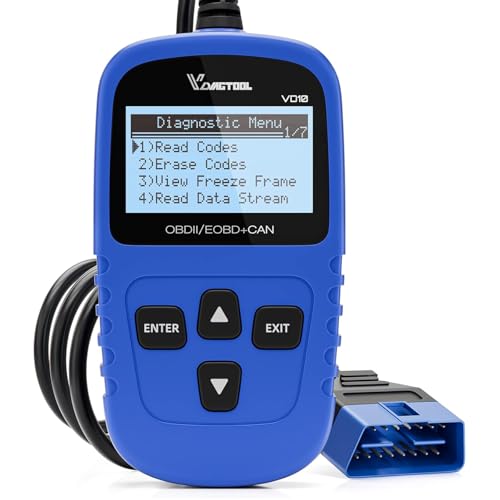
The VDIAGTOOL VD10 is a compact OBD2 code reader built for common engine fault checks. It can read and clear trouble codes, show freeze-frame details, and review emissions readiness. The tool supports standard OBD2 protocols, which makes it suitable for many Volkswagen vehicles sold in the United States. Its simple layout helps new users move from the diagnostic port to the code screen without much effort.
The VD10 can be useful before a smog or emissions inspection because it displays monitor status. It can also help confirm whether a repair has cleared a stored fault, but clearing a code should never replace fixing the cause. The reader receives power through the OBD2 port, so there is no battery to maintain. If you want a budget tool for occasional checks, the VD10 deserves a place on a list of the best OBD2 scanners for Volkswagen vehicles.
Pros:
- Compact and easy to store
- Reads and clears standard engine codes
- Displays freeze-frame information
- Checks I/M readiness status
- Works without a phone or app
- Uses vehicle power through the diagnostic port
- Useful for basic pre-purchase checks
Cons:
- Limited advanced live-data functions
- Does not scan every Volkswagen control module
- May provide less repair detail than premium tools
My Recommendation
The VD10 is best for occasional users who want a small, low-cost scanner in the glove box. It can help a Volkswagen driver check a warning light, review readiness monitors, and confirm whether a repaired engine fault remains stored. It also makes a useful second tool for a household that already owns a more advanced scanner.
I would not select it for coding, adaptations, or deep Volkswagen electrical diagnosis. Those tasks usually require a VW-capable scan platform with access to manufacturer-specific modules. For routine engine and emissions checks, however, the VD10 offers a simple path from warning light to useful information. It is one of the best OBD2 scanners for Volkswagen vehicles when ease and low price come first.
What Makes a Good Volkswagen OBD2 Scanner?
Choosing a scanner for a Volkswagen requires more care than choosing a generic code reader. Every modern car has an OBD2 diagnostic connector, but the connector does not mean every scanner can access every system. A basic reader usually focuses on the engine and emissions computer. A full Volkswagen scan tool may also reach the transmission, ABS, airbag, climate, body, and comfort modules.
I always begin with the owner’s real need. If the check engine light is on, a standard OBD2 reader may be enough to read a powertrain code. If the airbag light is on, a low-cost engine scanner may show nothing useful. Buying the wrong type of tool can feel like bringing a flashlight to a wiring job. It works, but it cannot reach the problem.
Code Reading and Clearing
All four scanners in this review can read common OBD2 fault codes. Many can also clear codes after a repair. That feature is helpful, but I do not clear a code before writing it down and saving the freeze-frame details. The stored data may show engine speed, temperature, load, or other conditions present when the fault occurred.
Clearing a code does not repair the car. It only removes the warning from the computer until the fault returns or the system completes its checks. If you clear codes before an emissions test, the monitors may become “not ready.” The vehicle may then fail an inspection even if the check engine light stays off.
Live Data
Live data gives you a moving view of what the engine computer sees. Depending on the Volkswagen model, useful values may include engine coolant temperature, engine speed, throttle position, oxygen sensor readings, fuel trims, and vehicle speed. A reader such as the FOXWELL NT301 can make this information easier to watch.
Live data needs context. One number rarely proves that a part has failed. For example, a high fuel-trim value can come from an intake leak, low fuel pressure, an exhaust leak, or a sensor issue. Use live data as a clue, then test the related system before buying parts.
Freeze-Frame Information
Freeze-frame data is a snapshot saved when the computer records a fault. It can show whether the car was cold, warm, idling, accelerating, or under load. This detail may explain why a code appears only on a highway trip or only during the first start of the day.
I consider freeze-frame support essential for useful home diagnosis. It turns a vague warning into a small story about what happened. The ANCEL AD310, FOXWELL NT301, and VDIAGTOOL VD10 all make this type of review easier for standard OBD2 faults.
Emissions Readiness
OBD2 readiness monitors check systems such as oxygen sensors, catalytic converters, evaporative emissions, and engine misfire. A scanner can show whether the tests have completed. This feature matters if you recently disconnected the battery, cleared codes, or repaired an emissions fault.
Readiness rules vary by state and vehicle age. Some monitors may be allowed to remain incomplete, while others must be ready. Check your local inspection rules. A scanner can report readiness, but it cannot guarantee that your car will pass the test.
Battery and Voltage Testing
Low voltage can create a chain of odd electrical events in a Volkswagen. A weak battery may cause hard starting, warning messages, communication faults, or lost settings. The Innova 5210 adds battery and charging checks, which can help separate an engine fault from a power problem.
A scanner voltage reading is useful, but it is not a complete battery load test in every situation. Battery age, temperature, cable condition, and alternator output also matter. If the voltage looks wrong, confirm it with a quality multimeter or a professional battery tester.
Generic OBD2 Versus Volkswagen-Specific Diagnosis
The phrase “OBD2 scanner” covers many tool types. A generic scanner reads standardized emissions data. This includes many powertrain codes that trigger the check engine light. It is the most affordable path for routine engine checks.
Volkswagen-specific tools go deeper. They may access manufacturer codes and modules that generic readers cannot see. Depending on the tool, they may support service resets, basic settings, adaptations, output tests, coding, or electronic parking brake functions. These features vary by platform, model, year, region, and software version.
The scanners in this review are best viewed as general OBD2 tools. They can be very useful, but I would not promise that they can diagnose every Volkswagen warning light. Always check compatibility for your exact model before purchase. A 2012 Jetta, 2018 Tiguan, and 2024 ID.4 may use different systems and support different functions.
Electric Volkswagen models also need special care. A standard OBD2 reader is not a complete high-voltage diagnostic tool. Never work on high-voltage components unless you have the correct training and safety equipment. For electric drive faults, use an approved service center or a properly rated diagnostic system.
How I Would Use an OBD2 Scanner on a Volkswagen
First, I park on a safe, level surface and switch off the engine. I locate the OBD2 port under the dashboard near the driver’s knees. I plug in the scanner before turning the ignition on, unless the tool’s instructions say otherwise.
Next, I record all codes before clearing anything. I read the code description, save freeze-frame data, and note whether the light is steady or flashing. A flashing check engine light can indicate a severe misfire that may damage the catalytic converter. In that case, I avoid driving and seek professional help.
Then I inspect simple causes. I check the fuel cap, battery connections, visible hoses, intake pipes, and fluid levels. I do not replace a sensor just because its code name appears on the screen. The code points to a system or condition, not always the failed part.
After a repair, I clear the code only when appropriate. I take a short test drive under safe conditions and scan again. I also check readiness status if an emissions inspection is coming soon. This process is slow and calm, but it saves money. Guessing is expensive; testing is cheaper.
Best Features at a Glance
| Best for | Why |
|---|---|
| Lowest-cost basic code checks | ANCEL AD310 offers simple code reading, clearing, freeze-frame data, and readiness checks. |
| Live engine data | FOXWELL NT301 gives a clearer view of supported sensor readings during diagnosis. |
| Battery and charging checks | Innova 5210 combines engine scanning with useful electrical system tests. |
The VDIAGTOOL VD10 is also worth considering for a small emergency reader. It has a straightforward design and focuses on common engine and emissions tasks. The best choice depends on whether you value live data, battery testing, or the lowest purchase cost.
Tips for Buying the Best OBD2 Scanners for Volkswagen Vehicles
Check the Model Year
Most gasoline and diesel vehicles sold in the United States from 1996 onward use standard OBD2 emissions communication. That does not guarantee full function coverage. Always confirm that the scanner supports your exact Volkswagen year and engine.
Know Which Warning Light Is On
A check engine light is the most likely target for a generic OBD2 scanner. An ABS, airbag, steering, or transmission light may need a more advanced tool. Read the product description carefully instead of assuming that every scanner reads every system.
Choose a Corded or Wireless Design
Corded scanners are ready when plugged in and do not need an app. They are often simple and reliable. Wireless adapters can offer richer graphs and repair data, but they depend on a phone, software, and a stable connection.
Do Not Pay for Features You Will Not Use
A home driver may only need code reading and readiness checks. A DIY mechanic may want live data, battery tests, service resets, and graphing. Make a list before shopping. The best OBD2 scanners for Volkswagen vehicles are not always the most expensive models; they are the ones that match the job.
Look for Clear Instructions
A scanner should explain what its screen means. Built-in code definitions are helpful, especially when you are beside the road. Still, no device can replace a repair manual, wiring diagram, or trained technician when the fault is complex.
Common Volkswagen Faults an OBD2 Scanner May Help With
A scanner may help identify misfire codes, oxygen sensor faults, evaporative emissions leaks, catalytic converter efficiency issues, throttle faults, and some air-fuel mixture problems. It may also show low-voltage or communication codes after a weak battery. The exact code list depends on the vehicle and engine computer.
Some Volkswagen engines have common issues tied to intake leaks, ignition coils, carbon buildup, sensors, or emissions parts. A code can narrow the search, but it does not confirm the repair. For example, a misfire code may come from a plug, coil, injector, compression problem, or wiring fault.
I recommend using the scan result with a visual check and a basic test. Look for cracked hoses, loose plugs, oil in a spark plug well, damaged wiring, or a weak battery. If the fault returns quickly, stop replacing random parts. At that point, a proper diagnostic test may cost less than continued guessing.
Safety and Accuracy Advice
Never scan or clear codes while driving. Pull over in a safe place before using the tool. Keep the cable away from pedals, the steering column, and hot engine parts.
Do not ignore a flashing check engine light, overheating warning, low oil warning, brake warning, or airbag warning. These signs can involve immediate safety or engine damage. A scanner is an information tool, not a substitute for safe driving decisions.
Use the vehicle service schedule and repair information for final guidance. Product support and vehicle coverage can change, so check current details before buying. The manufacturer, a qualified technician, or a trusted repair database can confirm procedures that a generic scanner cannot.
FAQs Of the best obd2 scanners for volkswagen vehicles
Can a basic OBD2 scanner read all Volkswagen faults?
No. A basic scanner usually reads standard engine and emissions faults. It may not access ABS, airbag, transmission, climate, body, or comfort modules. Those systems may require a Volkswagen-capable scan tool.
Will these scanners work with older Volkswagen cars?
They should work with many U.S.-market Volkswagen vehicles that use standard OBD2 communication. Support can vary by year, engine, and diagnostic protocol. Check the exact vehicle fit before ordering.
Can I clear a Volkswagen check engine light with these scanners?
Yes, these tools can clear many standard OBD2 engine codes. Clear a code only after recording it and checking the cause. If the fault remains, the light will usually return.
Which scanner is best for live data?
The FOXWELL NT301 is the strongest choice in this group for basic live engine data. It can show supported sensor values and help you watch changes during a test. Live data should still be interpreted with proper testing.
Can an OBD2 scanner reset Volkswagen service lights?
Some scanners support certain service functions on selected models. Coverage is not universal. Confirm the exact year, engine, and function before buying, especially for oil, electronic parking brake, or inspection resets.
Final Verdict: Which Should You Buy?
I would choose the FOXWELL NT301 for most DIY owners because its live data and clear screen make fault checks easier. The ANCEL AD310 costs less, while the Innova 5210 adds battery testing. The VD10 suits simple, occasional checks.
The best OBD2 scanners for Volkswagen vehicles can save time and reduce guesswork. Choose one that matches your warning light, model year, and repair skill.