The best portable car battery jump starters combine strong starting power, safe cables, useful lights, and easy charging.
A dead battery can turn a quick trip into a cold wait beside the road. I know how stressful that feels, especially when no nearby car is available for a jump. A good portable jump starter keeps that problem from becoming a crisis. I reviewed power ratings, engine coverage, safety features, charging options, size, and useful extras to help you choose the best portable car battery jump starters for daily driving, road trips, trucks, and emergency kits.
S ZEVZO ET03 4000A Jump Starter

The S ZEVZO ET03 is a strong all-around choice for drivers who want a compact jump box with a high peak current. Its 4000-amp rating is designed for engines up to 8.0 liters of gas or 7.0 liters of diesel. That range covers most cars, SUVs, pickups, vans, and many recreational vehicles. Its 74Wh battery also gives it enough reserve power for repeated starting attempts when used correctly.
I like the clear LCD display because it makes the charge level easy to check before a trip. The built-in USB ports let the pack charge a phone or other small device during an emergency. A storage case helps keep the cables and unit together in a trunk or garage. The LED light adds useful support at night, although I would still carry a separate flashlight for longer repairs.
Pros:
- 4000A peak output for many large gas and diesel engines
- 74Wh capacity provides useful emergency reserve
- LCD screen shows battery status at a glance
- USB ports can power phones and small devices
- LED light helps with nighttime battery work
- Storage case keeps the jump kit organized
Cons:
- Large output rating does not replace a fully charged battery pack
- The case and cables add some trunk space
- It is more power than a small commuter car may need
JOLTEKON 4500A Jump Starter with Air Compressor
 compressor
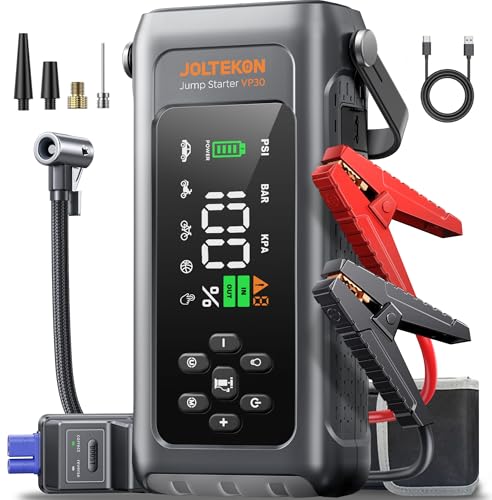
The JOLTEKON combines a jump starter and tire inflator in one useful roadside tool. Its 4500A peak rating supports engines up to 9 liters of gas or 8 liters of diesel. That makes it a practical match for larger SUVs, trucks, work vehicles, and family vans. The built-in 150 PSI compressor can help refill a low tire without searching for a gas station.
The auto-shutoff feature is one of its most useful details. I prefer an inflator that stops at the selected pressure because it reduces the chance of overfilling a tire. The unit also includes jumper cables, an emergency light, and a power bank function. It is not a replacement for a full air compressor, but it can be a very helpful backup during a slow leak or sudden pressure loss.
Pros:
- 4500A output suits many large gas and diesel vehicles
- 150 PSI air compressor adds roadside value
- Auto-shutoff helps prevent overinflation
- Jump cables are included for quick setup
- Built-in light improves visibility after dark
- Power bank feature can charge personal devices
Cons:
- An inflator needs more time for a fully flat truck tire
- The combined design is heavier than a basic jump pack
- Users should check tire pressure with a trusted gauge
OXILAM 6000A High-Power Jump Starter

The OXILAM 6000A is aimed at drivers who want a large power margin. Its listed coverage reaches all gas engines and diesel engines up to 12 liters, so it is especially appealing for heavy-duty trucks, large SUVs, vans, and equipment with demanding starting loads. A high peak number alone does not guarantee every start, but it gives this unit a strong position for difficult conditions. It is one of the best portable car battery jump starters for users who value broad engine coverage.
The front LED display makes the remaining charge easy to monitor. USB and USB-C ports add modern charging options for phones, tablets, and other small electronics. The LED light can serve as a work lamp or emergency signal when the vehicle stops at night. Because the unit is built for high output, I would store it in a secure, dry place and recharge it on a regular schedule.
Pros:
- 6000A peak rating offers substantial starting power
- Supports diesel engines up to 12 liters according to its listing
- USB and USB-C ports support newer devices
- LED display makes charge checks simple
- Emergency light adds safety during roadside stops
- Good fit for trucks and other large vehicles
Cons:
- High output may be unnecessary for a small sedan
- Heavy-duty packs can take longer to recharge
- Always confirm the vehicle uses a compatible 12V system
NOCO Boost GB20 500A Jump Starter
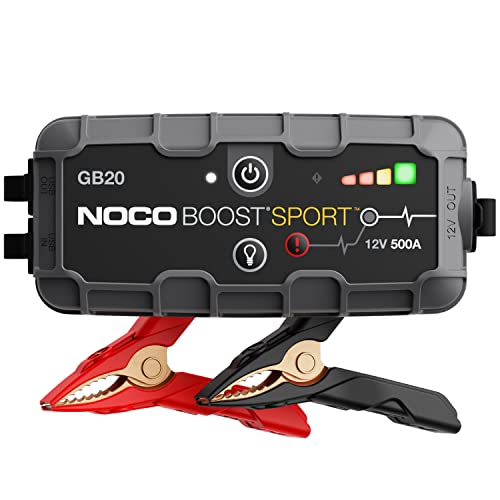
The NOCO Boost GB20 takes a simpler approach to emergency starting. Its 500A rating is intended for 12V vehicles with smaller gas engines, making it a sensible choice for compact cars, commuter sedans, motorcycles, and lawn equipment that uses a suitable 12V battery. It is small enough to keep in a glove box or a small roadside kit. For many everyday drivers, that convenience matters more than carrying a very large power pack.
NOCO is known for emphasizing safe connection design, and the GB20 includes protection against common mistakes such as reverse polarity and sparks. I still recommend reading the vehicle and jump starter manuals before use. Its built-in light can help in a dark parking lot, while the USB port provides basic device charging. This is not the pack I would choose for a large diesel truck, but it is a neat and practical solution for smaller vehicles.
Pros:
- Compact size fits many glove boxes and small trunks
- 500A output suits many small gas engines
- Safety features help reduce connection mistakes
- Built-in light supports emergency use at night
- USB charging adds extra daily usefulness
- Simple design is easy for new users to understand
Cons:
- Not intended for large diesel engines
- Lower output limits its use with heavy trucks and vans
- Small capacity may require regular charging during storage
M1 7000A Jump Starter with Air Compressor

The M1 7000A jump starter is built for drivers who want one powerful tool for two common problems: a weak battery and a low tire. Its listed support reaches 9.0-liter gas engines and 8.0-liter diesel engines. That makes it suitable for many pickups, SUVs, vans, and larger family vehicles. The 150 PSI air compressor gives it more practical range than a basic battery booster.
The large LED display is useful when checking both power and inflator settings. A built-in light can help locate battery terminals or inspect a tire after dark. The power bank feature also gives the unit a second life on camping trips and long drives. I would view this model as an emergency tool, not as a substitute for routine tire checks or a properly maintained vehicle battery.
Pros:
- 7000A rating provides strong starting capacity
- Supports gas and diesel engines in a broad size range
- 150 PSI compressor handles common low-tire problems
- Large display is easy to read
- LED light helps during roadside work
- Power bank feature supports travel and camping use
Cons:
- It is bulkier than a jump-only unit
- The compressor can use battery power quickly
- Users should verify pressure with a separate gauge
TREKURE 5000A Magnetic Jump Starter

The TREKURE 5000A is a versatile option for drivers who want strong output and a bright work light. It is listed for engines up to 10 liters of gas or 8 liters of diesel. That gives it enough range for many cars, trucks, SUVs, and recreational vehicles. The magnetic build can help keep the unit in place on a suitable metal surface while you work, though I would never place it where it could fall near moving parts.
Its 2000-lumen flashlight is a standout feature for nighttime use. A bright beam can make it easier to find battery posts, read labels, and spot a damaged cable. The power bank function adds value on road trips and outdoor excursions. The unit may appeal to people who want one capable jump box for both normal driving and emergency travel.
Pros:
- 5000A output covers many large vehicles
- Supports up to 10-liter gas engines as listed
- Works with diesel engines up to 8 liters as listed
- 2000-lumen light is useful in dark conditions
- Magnetic design can aid temporary placement
- Power bank feature helps during travel
Cons:
- Magnetic placement does not suit every vehicle surface
- High-brightness lighting can drain the battery faster
- It may be more equipment than a small car owner needs
WOLFBOX 4000A MV24 Jump Starter

The WOLFBOX MV24 is a well-rounded jump starter for drivers who care about fast charging and a readable display. Its 4000A output is listed for engines up to 10 liters of gas or 10 liters of diesel. That makes it a flexible pick for many cars, pickups, SUVs, and diesel vehicles. Its 88.8Wh battery gives it a solid energy reserve for an emergency kit.
The included 65W quick charger is a useful advantage when time matters. A unit that recharges faster is easier to maintain between trips, provided the correct charger and instructions are followed. The LED display shows key battery information, while the built-in light supports roadside work. I see this as a strong choice for frequent travelers who want a capable booster without adding an air compressor.
Pros:
- 4000A peak output supports a wide vehicle range
- Listed for up to 10-liter gas and diesel engines
- 88.8Wh battery offers useful reserve energy
- 65W charger can reduce recharge time
- LED display makes status checks quick
- Built-in light supports emergency repairs
Cons:
- It does not include a tire inflator
- Fast charging depends on using the proper charger
- The larger battery may take more storage space
NOCO Boost GB50 1500A Jump Starter
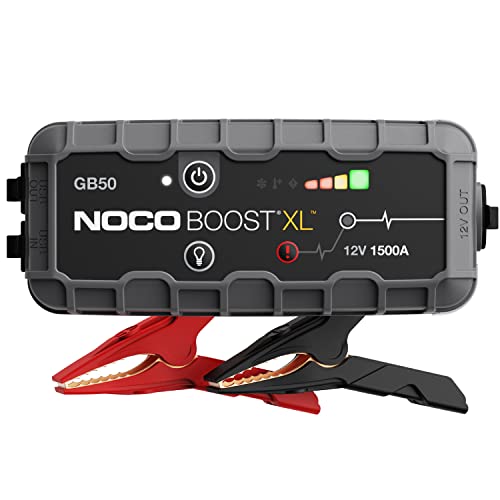
The NOCO Boost GB50 sits between small commuter jump packs and heavy-duty models. Its 1500A rating is intended for 12V gas engines up to 6 liters and diesel engines up to 3 liters, according to its product specifications. That range makes it a good fit for many sedans, crossovers, light trucks, and some smaller diesel vehicles. It is a practical middle ground for people who want more power than the GB20 without moving to a large 4000A or 6000A pack.
The GB50 uses a compact design with safety-focused cable connections. Its light can provide a broad beam for roadside work, and the USB output can charge a phone in an emergency. I like this model for drivers who want a recognized, straightforward unit with enough power for common vehicles. Buyers with large diesel trucks should select a model with a higher listed diesel rating instead.
Pros:
- 1500A output fits many common gas vehicles
- More powerful than an entry-level compact booster
- Safety-focused connection system helps new users
- Portable size works well in a trunk or roadside bag
- Built-in light supports nighttime use
- USB output can provide emergency phone power
Cons:
- Diesel coverage is limited compared with heavy-duty models
- No built-in air compressor is included
- Users must recharge it after storage and use
My Recommendation
After comparing these models, I would choose based on the vehicle first, then the extra features. The NOCO GB20 is a smart compact pick for a small gas car. The NOCO GB50 adds more power for common sedans and light trucks. For larger engines, the S ZEVZO ET03, WOLFBOX MV24, TREKURE, OXILAM, and M1 provide more starting headroom.
If a flat tire is as much of a concern as a dead battery, the JOLTEKON and M1 stand out because they include air compressors. The OXILAM is appealing for heavy-duty users who want a very high listed output. The WOLFBOX is a balanced choice for people who value a large battery and quick charging. In my view, the best portable car battery jump starters are the ones that match your engine size, storage space, and real roadside needs rather than simply having the biggest number.
| Best for | Why |
|---|---|
| Small cars and glove-box storage | NOCO GB20 is compact, simple, and suited to smaller 12V gas engines. |
| Large trucks and diesel vehicles | OXILAM 6000A offers broad listed engine coverage and strong starting power. |
| Battery and tire emergencies | JOLTEKON and M1 combine jump-start power with a built-in air compressor. |
Before buying, check your owner’s manual and confirm the vehicle uses a 12V starting system. Peak amps are useful for comparison, but they do not tell the whole story. Cable quality, battery condition, temperature, charge level, and correct connection all affect performance. I also recommend charging the pack before a long trip and checking it every few months.
How I Evaluated the Best Portable Car Battery Jump Starters
I looked at more than the large amp number printed on the box. A jump starter must be easy to store, simple to connect, and ready when the vehicle fails. I compared listed engine coverage, battery capacity, display quality, cable design, charging ports, lights, and extra tools. I also considered whether each model makes sense for a normal driver instead of treating every buyer like a professional mechanic.
Safety was a major part of the review. A quality jump starter should include clear connection guidance and protection against common errors. Still, built-in protection is not permission to rush. I always inspect the battery for cracks, swelling, leaks, or frost before attempting a jump, and I stop if the battery looks damaged.
I also separated jump-only models from multipurpose tools. An air compressor can be valuable, but it adds weight and uses extra power. A very bright light can help at night, but it can also drain the pack if left on. The best portable car battery jump starters balance these features with the needs of the person carrying them.
What Size Jump Starter Do You Need?
For a small four-cylinder car, a compact 500A to 1000A model may be enough when the battery is weak but not badly damaged. A 1500A unit gives more flexibility for larger sedans, crossovers, and light trucks. Many full-size pickups and SUVs benefit from a 3000A or higher model, especially in cold weather. Always compare the product’s listed gas and diesel engine limits with your vehicle.
Diesel engines often need more starting power because of higher compression and glow plug demands. That does not mean the largest advertised peak current is always best. A model with suitable cables, a healthy internal battery, and a clear manual can be more useful than a huge rating with poor usability. When in doubt, choose a unit with a comfortable power margin.
Cold weather can reduce lithium battery performance. Store the jump starter indoors when possible, rather than leaving it in a freezing trunk for weeks. Do not try to charge a pack that is extremely cold until it warms to the range stated in the manual. These simple habits help the best portable car battery jump starters work when winter gives your car a hard morning.
How to Use a Portable Car Jump Starter Safely
First, park safely and turn off the ignition, lights, radio, and accessories. Put the vehicle in park, set the parking brake, and keep sparks and flames away from the battery. Check the battery and cables for visible damage. Never attempt a jump on a battery that is leaking, cracked, swollen, or frozen.
Next, confirm that the jump starter and vehicle use compatible voltage. Attach the red clamp to the positive battery terminal. Attach the black clamp to the negative terminal or the vehicle’s approved ground point, following the owner’s manual. Keep the clamps from touching each other, then turn on the booster if the instructions require it.
Try to start the engine for only a few seconds at a time. If the engine does not start, wait briefly before trying again. Repeated long cranking can heat cables and drain the jump starter. Once the engine starts, switch off the booster if directed, remove the black clamp first, then remove the red clamp, and recharge the unit after use.
Some modern cars use remote battery terminals or special jump points. In those vehicles, connecting directly to the battery may be wrong. The owner’s manual is the best guide because manufacturers place terminals in different areas. A professional technician should handle a vehicle with unusual wiring, a hybrid system, or a battery that shows damage.
Portable Jump Starter Features That Matter
Peak current is easy to notice, but usable design matters just as much. Look for cables long enough to reach the battery and clamps that grip clean metal. A clear screen can show charge level and connection status. Reverse-polarity protection is especially helpful if you have never used a jump box before.
Battery capacity affects how many starts the unit may support and how often you need to recharge it. Watt-hours can help compare energy storage, but manufacturers may measure performance under different conditions. Treat the number as one useful clue, not a guarantee. A battery pack with a high capacity still needs regular charging.
USB-A and USB-C ports turn a jump starter into an emergency power bank. A bright LED light can help you work beside a dark road. Some lights offer a flashing or signal mode, which may improve visibility. An air compressor is useful for low tires, while a storage case protects cables and keeps the kit tidy.
Charging speed also matters. A quick charger can make it easier to restore the pack before a trip. However, use only the cable and adapter recommended by the manufacturer. Heat, water, and poor storage can shorten lithium battery life, so keep the unit dry and avoid leaving it on a hot dashboard.
Common Mistakes to Avoid
The most common mistake is storing a jump starter without checking its charge. A pack that worked last summer may be empty after months in a drawer. I suggest checking the display every one to three months and topping it up before long travel. This takes less time than waiting for roadside assistance.
Another mistake is choosing by peak amps alone. A small car does not need a massive truck unit, and a diesel truck may not work with a compact commuter model. Buyers should check engine size, fuel type, voltage, and the maker’s stated limits. This short check can prevent a disappointing purchase.
Do not use a jump starter as a battery charger unless the product specifically includes that function. A jump pack provides a starting boost; it does not repair an old battery or alternator. If the vehicle repeatedly needs a jump, have the battery and charging system tested. A portable booster is a safety net, not a cure.
Finally, do not ignore the cable order. Wrong connections can damage electronics, create sparks, or harm the booster. Read the instructions in daylight before an emergency happens. Practicing the basic steps once can make a stressful roadside moment feel much more manageable.
FAQs Of best portable car battery jump starters
Can a portable jump starter start a completely dead battery?
It may start a battery with very low charge if the battery is still healthy. It may not work if the battery is damaged, frozen, shorted, or disconnected internally. Follow the product instructions and stop if the battery shows physical damage.
How long do portable car jump starters hold a charge?
Many lithium jump starters can hold a charge for months, but storage time varies by model and temperature. Check the charge every one to three months. Recharge it after use and before a long trip.
Can I use a jump starter on a diesel truck?
Yes, if the unit lists a suitable diesel engine size and uses the correct voltage. Diesel engines often need more starting power than similar gas engines. Check the manufacturer’s diesel rating before purchase.
Do I need another car to use a jump starter?
No. A portable jump starter contains its own battery, so it can start a compatible vehicle without a second car. You still need to attach the clamps in the correct order and follow the manual.
Are higher peak amps always better?
No. Higher peak amps can provide more starting headroom, but size, cable quality, battery condition, safety controls, and correct storage also matter. Choose a model that fits your engine and your normal use.
Final Verdict: Which Should You Buy?
For most drivers, the WOLFBOX MV24 offers a strong balance of output, engine coverage, battery capacity, and quick charging. Choose the JOLTEKON or M1 if you also want an air compressor. For small cars, the NOCO GB20 remains compact and practical.
The best portable car battery jump starters provide calm when a battery fails. Match the unit to your vehicle, keep it charged, and store it safely for dependable roadside help.