Store a car battery fully charged, clean, dry, cool, and disconnected from the vehicle in a safe place.
Knowing how to store a car battery can help prevent sulfation, corrosion, freezing, and early failure. Whether you are parking a classic car for winter, storing a spare battery, or leaving a vehicle unused for several months, the right steps are simple but important. This guide explains how to store a car battery safely, how often to check it, and which mistakes can shorten its life.
Why Proper Car Battery Storage Matters
A car battery slowly loses charge even when it is not connected to a vehicle. This natural loss is called self-discharge. Heat speeds it up, while a low charge can cause lead sulfate crystals to form on the battery plates.
This condition is known as sulfation. Mild sulfation may reduce battery performance, but heavy sulfation can make the battery difficult or impossible to recharge. Learning how to store a car battery correctly helps slow this process.
A stored battery may also face these risks:
• Corrosion around the terminals
• Cracks caused by freezing temperatures
• Damage from overcharging
• Electrical drain from the vehicle
• Gas buildup in a poorly ventilated space
• Capacity loss after long periods without charging
A battery does not need much care, but it does need the right care. Think of it like storing a water bottle in a freezer. The bottle may look fine at first, but the wrong conditions can cause serious damage over time.
How to Store a Car Battery Step by Step
The safest way to store a car battery is to prepare it before removal, charge it correctly, and keep it in a cool, dry, well-ventilated place.
1. Read the battery label and vehicle manual
Start by checking the battery label. Look for the battery type, voltage, and charging instructions. Most cars use a 12-volt lead-acid, AGM, or enhanced flooded battery.
Some newer vehicles use lithium-ion batteries for special systems or hybrid applications. Lithium batteries need different storage rules, so never assume that instructions for a lead-acid battery apply to every battery type.
The vehicle manual may also explain how to disconnect the battery. Some cars can lose radio codes, window settings, alarm settings, or computer memory when power is removed.
2. Turn off the vehicle and let it cool
Park the vehicle on a level surface. Turn off the engine, lights, radio, climate system, and all accessories. Remove the key and wait several minutes before disconnecting the battery.
This gives the vehicle’s electrical systems time to shut down. It also reduces the chance of sparks when you remove the cable.
3. Wear basic safety gear
Wear safety glasses and gloves when handling a traditional flooded lead-acid battery. Battery acid can burn skin and damage clothing.
Keep cigarettes, flames, and sparks away from the battery. Charging batteries can release hydrogen gas, which is highly flammable in the right concentration.
4. Disconnect the negative cable first
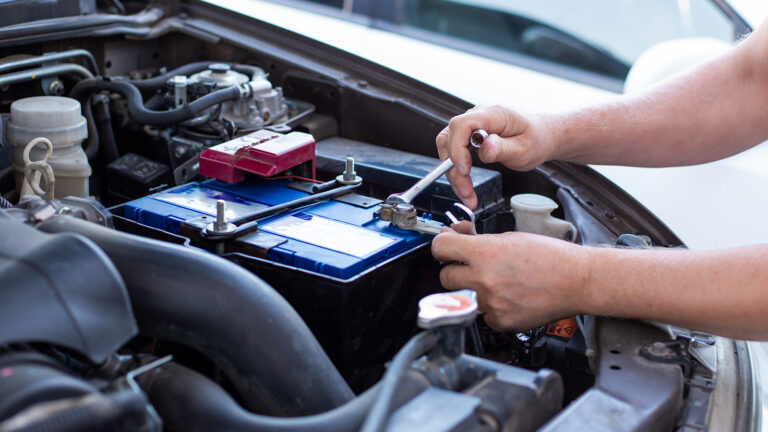
Use the correct wrench to loosen the negative terminal, usually marked with a minus sign or a black cable. Remove the negative cable first, then remove the positive cable.
Removing the negative cable first lowers the chance of creating a short circuit. If your wrench touches the vehicle body while it is on the positive terminal, a connected negative cable can create a dangerous spark.
Never allow the two battery terminals to touch each other through a metal tool.
5. Remove and inspect the battery
Lift the battery with both hands or use its built-in handle. Car batteries are heavy, and their weight can strain your back or damage the battery if it is dropped.
Check for:
• Cracks or bulges in the case
• Wet spots or acid leaks
• Loose or damaged terminals
• Heavy white, blue, or green corrosion
• A swollen case
Do not store or charge a battery that is cracked, leaking, or badly swollen. Take it to an approved battery recycling center.
6. Clean the battery
Clean dirt and corrosion from the top and terminals. A damp cloth can remove surface dust. For terminal corrosion, use a battery terminal brush or a suitable cleaning solution.
Dry the battery fully before storage. Dirt mixed with moisture can create a small path for electrical leakage across the battery case.
7. Charge the battery fully
Use a smart charger designed for the correct battery type. Select the proper setting for flooded lead-acid, AGM, or another approved type.
A full charge is important because a partially charged battery can sulfate more quickly. Do not use a high-power charger unattended, and do not guess the charging time if the battery maker provides specific instructions.
8. Store it in the right place
Place the battery upright on a stable, nonconductive surface. A cool garage, workshop, or storage room is usually suitable.
Avoid direct sunlight, heaters, boilers, open flames, and damp areas. Do not place heavy objects on top of the battery.
These steps explain how to store a car battery with less risk of discharge and physical damage.
The Best Location for Battery Storage
The best storage location is cool, dry, clean, and ventilated. A temperature between about 50°F and 77°F is generally suitable for many lead-acid batteries, although the manufacturer’s instructions should take priority.
A cooler location slows self-discharge. However, extreme cold can freeze a deeply discharged battery. A fully charged lead-acid battery is far more resistant to freezing than a weak or empty one.
Avoid these locations:
• Inside a living area
• Near a furnace or water heater
• In direct sunlight
• In a damp shed
• Next to gasoline or other flammable liquids
• On a wet concrete floor
The common belief that concrete automatically drains a battery is mostly outdated for modern battery cases. Still, a dry plastic tray or wooden shelf is a good choice because it keeps the battery clean and stable.
Ventilation matters during charging. Even sealed AGM batteries should be charged in line with the manufacturer’s safety instructions. Flooded batteries can release gas, so never charge one in a small, closed room.
Should You Leave the Battery in the Car?
You can leave a battery in the car for short storage periods, but disconnecting it is usually safer for long-term storage. Modern vehicles use small amounts of electricity even when parked. Alarm systems, computers, tracking devices, and keyless entry systems can slowly drain the battery.
For storage lasting several weeks or more, consider removing the battery or disconnecting the negative cable. Removing it completely makes inspection and charging easier.
If you leave the battery installed:
• Disconnect the negative cable if the vehicle manual allows it
• Keep the vehicle in a dry, secure place
• Use a charger approved for the battery type
• Do not run an extension cord where it can be damaged
• Check that the charger cannot contact moving or hot engine parts
Some vehicles have battery monitoring systems. Disconnecting the battery may require a reset or special procedure when the vehicle returns to service. Check the manual before removing power.

How to Charge a Battery During Storage
A smart maintainer is often the easiest way to protect a stored battery. Unlike a basic charger, a smart maintainer can reduce or stop charging when the battery reaches the correct voltage. It then monitors the battery and adds power when needed.
Use a maintainer that matches:
• The battery voltage
• The battery chemistry
• The battery capacity
• The manufacturer’s charging requirements
For a standard 12-volt lead-acid battery, many smart maintainers use a charging cycle that includes bulk charging, absorption, and maintenance or float charging. The exact voltage varies by battery type and temperature.
Do not connect a charger backward. Connect the positive clamp to the positive terminal and the negative clamp to the negative terminal or an approved ground point, depending on the charger instructions.
Inspect the charger and cables before each use. Do not use equipment with cracked insulation, loose clamps, or damaged plugs.
If you do not have a maintainer, check the battery with a digital voltmeter every few weeks. A fully charged resting 12-volt lead-acid battery often measures close to 12.6 volts, but readings vary by battery design, temperature, and how long the battery has rested.
Voltage is only a rough guide. A battery can show a normal voltage and still have poor capacity. A professional load test is more useful when you need to confirm battery health.
How Often Should You Check a Stored Car Battery?
Check a stored car battery at least once every four to six weeks if it is not connected to a smart maintainer. Check it more often in hot weather or if the battery is older.
During each inspection:
• Look for leaks, swelling, or cracks
• Check for terminal corrosion
• Measure the resting voltage if possible
• Confirm that the battery remains clean and dry
• Recharge it when the voltage falls below the maker’s recommended level
A battery maintainer still deserves a quick inspection. Make sure its status lights show normal operation and that the cables remain secure.
Do not repeatedly allow the battery to become deeply discharged. Deep discharge is one of the fastest ways to reduce the useful life of a lead-acid battery.
In my own garage work, the easiest mistake to make was connecting a charger and forgetting about it. A smart maintainer solved that problem, but I still check the battery and charger together once a month. A minute of inspection is cheaper than replacing a battery unexpectedly.
How to Store Different Types of Car Batteries
Not all car batteries should be stored in exactly the same way. Identify the battery type before charging or maintaining it.
Flooded lead-acid batteries
These batteries contain liquid electrolyte and may have removable vent caps. Keep them upright to prevent leaks. Charge them in a well-ventilated area and never add anything except distilled water when the manufacturer allows it.
Do not open the caps unless the battery instructions require it. Battery acid is dangerous, and normal maintenance-free batteries should not be opened.
AGM batteries
Absorbent glass mat, or AGM, batteries are sealed lead-acid batteries. They resist vibration and usually have lower self-discharge than older flooded designs.
Use an AGM-compatible charger. A standard charger may not provide the best charging pattern, especially during long-term maintenance.
Gel batteries
Gel batteries use a thickened electrolyte. They require careful voltage control because overcharging can create permanent damage.
Select a charger with a gel setting when available. Follow the battery label rather than using a general lead-acid setting.
Lithium-ion batteries
Lithium batteries need special care. Some should be stored at a partial charge rather than 100 percent, and many require a battery management system.
Never use a lead-acid charger on a lithium battery unless the battery maker specifically approves it. Store lithium batteries away from heat, moisture, and anything flammable. If the battery is swollen, hot, damaged, or has an unusual smell, do not charge it.
Understanding the battery type is a key part of learning how to store a car battery safely.
Common Mistakes to Avoid
Small errors can cause expensive damage. Avoid these common storage mistakes:
• Storing a battery while it is partly discharged
• Leaving the battery connected to a car for many months
• Using the wrong charger setting
• Charging beside a flame or heater
• Placing the battery in a hot attic
• Storing a flooded battery on its side
• Ignoring corrosion or acid leaks
• Covering the battery while it is charging
• Testing a battery by creating a spark
• Letting children or pets near the battery
One mistake I have seen often is putting a battery away without cleaning its top surface. Dust and moisture can create a slow electrical path between the terminals. The battery may not appear to be doing anything, yet its charge gradually falls.
Another mistake is trusting a battery that has been stored for years without testing it. Long storage does not guarantee good condition. Age, heat, and past deep discharges still matter.
How to Prepare the Battery for Use Again
Before reinstalling a stored battery, inspect it carefully. Make sure the case is not cracked or swollen and that no fluid has leaked.
If the battery was disconnected from a vehicle, clean the cable ends and terminal posts. A thin layer of terminal protection can help reduce corrosion, but keep grease away from the contact surfaces unless the product instructions say otherwise.
Install the positive cable first and the negative cable second. Tighten the connections securely, but do not overtighten them.
After installation:
-
Start the vehicle and check that the engine cranks normally.
-
Look for warning lights on the dashboard.
-
Confirm that electrical accessories work.
-
Check the charging system if the battery seems weak.
-
Drive the vehicle long enough for the alternator to replace the starting energy.
An alternator is designed mainly to maintain a battery, not to recover a deeply discharged one. If the battery is very low, charge it with a proper charger before relying on the vehicle’s charging system.
How to Tell If a Stored Battery Is Bad
Storage can reveal a battery’s condition, but it does not always cause the problem. A battery may be near the end of its normal service life before storage begins.
Warning signs include:
• The battery loses charge quickly after charging
• The engine cranks slowly
• The case is swollen or cracked
• The terminals become hot during charging
• A strong rotten-egg smell appears
• The battery fails a load test
• The voltage drops sharply when the engine starts
Stop charging immediately if the battery becomes hot, swells, leaks, or produces a strong odor. Move away from the battery and seek advice from a qualified technician or recycling center.
Many automotive batteries last about three to five years, but climate, driving habits, maintenance, vibration, and vehicle design can change that range. Hot climates often place more stress on batteries than mild climates.
A battery tester can measure starting power, but no home test replaces professional judgment in every case. When safety is uncertain, replacement and proper recycling are better choices than taking a risk.
Safe Disposal and Recycling
Do not place a car battery in household trash. Lead-acid batteries contain lead and corrosive electrolyte, but they are highly recyclable when handled through the right system.
Many auto parts stores, service centers, and recycling facilities accept used car batteries. Some retailers also offer a refundable core charge when you buy a replacement battery.
Transport a lead-acid battery upright in a secure container. Keep it away from metal tools and prevent it from tipping over.
If the battery is leaking, do not carry it casually in your vehicle. Contact a local hazardous-waste or battery recycling service for safe handling instructions.
Recycling protects people, pets, soil, and water. It also allows valuable battery materials to return to manufacturing.
Frequently Asked Questions About How to Store a Car Battery
Can I store a car battery on a concrete floor?
Yes, modern battery cases are not normally drained by concrete. However, a dry shelf or plastic tray is better because it protects the battery from moisture, dirt, and accidental damage.
Should a car battery be fully charged before storage?
Yes, a full charge is usually best for lead-acid batteries. A low charge can increase sulfation and may allow the electrolyte to freeze in very cold weather.
How long can I store a car battery?
A properly maintained battery can remain stored for several months or longer, but it should be checked regularly. Battery age, temperature, chemistry, and charger quality all affect the safe storage period.
Is it better to remove the battery from the car?
For long-term storage, removing the battery is often the safest choice. It prevents the vehicle’s electrical systems from slowly draining the battery and makes inspection easier.
Can I use a trickle charger during storage?
You can use a trickle charger only if it is designed for long-term maintenance and matches the battery type. A basic charger may overcharge the battery, so a smart maintainer is usually safer.
Can a stored car battery freeze?
A fully charged lead-acid battery is unlikely to freeze in normal winter conditions, but a discharged battery can freeze at a much higher temperature. Store it charged and keep it away from extreme cold when possible.
How do I store an AGM car battery?
Store an AGM battery upright in a cool, dry place and use an AGM-compatible smart charger. Inspect it regularly, even if it is connected to a maintenance charger.
Conclusion
Learning how to store a car battery is mostly about controlling four things: charge, temperature, moisture, and safety. Charge the battery fully, disconnect it when practical, keep it upright in a cool and dry place, and use a smart maintainer that matches its chemistry.
Check the battery every few weeks, watch for damage, and recycle it properly when it reaches the end of its life. These simple habits can protect your battery and help your vehicle start when you need it. Use this guide during your next seasonal storage project, and share your own battery care tips in the comments.