No, you cannot use any battery in a car; it must match the vehicle’s size, voltage, power, and terminal layout.
Knowing the answer to “can you use any battery in a car” can save you from a no-start, electrical damage, or a battery that does not fit. The right choice depends on your car’s engine, climate, electrical load, battery group size, and the specifications listed by the vehicle maker.

Can You Use Any Battery in a Car?
No. A car battery is not a one-size-fits-all part. Most gas-powered cars use a 12-volt battery, but that does not mean every 12-volt battery will work safely or reliably.
The battery must meet several requirements:
• Correct physical size
• Correct terminal position
• Enough cold cranking amps, or CCA
• Suitable reserve capacity
• Compatible battery technology
• Correct charging and start-stop system requirements
A small battery may fit inside the tray but fail to start the engine. A larger battery may have enough power but not fit the hold-down bracket. Even a battery with the right size may be wrong if the positive and negative terminals are reversed.
This is why the answer to “can you use any battery in a car” is no. The battery must be compatible with both the vehicle and its electrical system.
Why Car Battery Compatibility Matters
Your car battery does more than start the engine. It also supports the vehicle’s lights, computer modules, alarms, audio system, sensors, and other electronics when the engine is off or the alternator cannot meet the full demand.
Think of the battery as the car’s short-term energy bank. The alternator fills that bank while the engine runs, but the battery must deliver a strong burst of power when you turn the key or press the start button.
Using the wrong battery can cause several problems:
• Slow or failed engine starts
• Battery drain during short trips
• Damage to battery cables or terminals
• Charging problems
• Warning lights on the dashboard
• Reduced battery life
• Start-stop system errors
• Electrical system faults
Modern cars are more sensitive than older vehicles. Many use battery monitoring sensors and smart charging systems. The car may need to know the battery’s type, capacity, and state of charge.
Some vehicles also require battery registration after replacement. This process tells the car’s computer that a new battery has been installed. Without it, the charging system may not manage the battery correctly.

The Main Types of Car Batteries
Before asking “can you use any battery in a car,” you need to know which battery type your vehicle uses.
Conventional flooded lead-acid batteries
These are common in many older cars. They contain liquid electrolyte and use lead plates to store energy. They are often affordable and widely available.
A flooded battery can work well in a standard vehicle without advanced start-stop features. However, it may not be the best choice for a car designed for an AGM battery.
AGM batteries
AGM stands for absorbed glass mat. This battery uses fiberglass separators to hold the electrolyte in place. AGM batteries are more resistant to vibration and can deliver strong starting power.
They are common in vehicles with:
• Start-stop systems
• Heated seats and steering wheels
• High-power audio systems
• Many electronic control modules
• Regenerative braking
• Large electrical loads
An AGM battery can sometimes replace a flooded battery if the vehicle maker allows it. The reverse is often not safe or reliable. Replacing an AGM battery with a basic flooded battery may lead to early failure.
EFB batteries
EFB means enhanced flooded battery. It is stronger than a standard flooded battery but usually less capable than AGM technology.
Some vehicles with basic start-stop systems use EFB batteries. In certain cases, an AGM battery may replace an EFB battery, but you should confirm this in the owner’s manual or with a qualified technician.
Lithium-ion batteries
Some specialty vehicles, hybrid systems, and performance cars use lithium-ion batteries. These batteries are not direct replacements for ordinary lead-acid starter batteries.
Lithium batteries need specific charging controls and safety systems. Never install one simply because it has the same voltage rating.

Battery Voltage: Is Any 12-Volt Battery Safe?
Most conventional cars use a 12-volt electrical system. However, the label “12 volts” only tells you part of the story.
A fully charged lead-acid battery often measures around 12.6 volts when the engine is off. While the engine runs, the alternator may raise system voltage to roughly 13.5 to 14.8 volts, depending on the vehicle and charging strategy.
A 12-volt battery still needs the correct:
• Capacity
• CCA rating
• Battery chemistry
• Dimensions
• Terminal design
• Charging compatibility
Never use a 24-volt battery in a normal 12-volt car. A 24-volt system can damage electronic parts, bulbs, control units, and other equipment.
Hybrid vehicles need extra care. They may contain a 12-volt auxiliary battery and a separate high-voltage battery pack. The small 12-volt battery may look familiar, but the high-voltage system requires trained service procedures.

Understanding Battery Group Size
Battery group size describes the battery’s physical dimensions, terminal layout, and general fit. In the United States, common group sizes include 24F, 35, 47, 48, 49, 51R, and 65.
The group number is important because it helps ensure that the battery will:
• Fit the battery tray
• Connect to the cables
• Sit in the correct position
• Lock down with the factory bracket
• Keep the terminals away from metal parts
A battery with the wrong terminal position can create a serious short circuit. If the positive terminal touches the body or another metal part, sparks and damage may occur.
You can find the correct group size in several places:
- Your owner’s manual
- The label on the old battery
- A vehicle parts catalog
- A trusted battery supplier
- The car manufacturer’s service information
Do not rely only on appearance. Two batteries can look almost identical while having different terminal layouts or power ratings.

CCA, Reserve Capacity, and Amp-Hour Ratings
Cold cranking amps
Cold cranking amps measure how much current a battery can provide at a low temperature for a set period. A higher CCA rating usually helps the engine crank more easily in cold weather.
Your replacement battery should meet or exceed the manufacturer’s recommended CCA rating. A much lower rating may cause hard starting, especially with a large engine or thick winter oil.
Installing a somewhat higher CCA battery is often acceptable if the size, chemistry, and charging system remain compatible. More CCA does not force extra current into the starter. The starter draws the current it needs.
Reserve capacity
Reserve capacity shows how long a fully charged battery can support a set electrical load if the alternator stops working. It matters if you drive at night, use many accessories, or experience an alternator problem.
A higher reserve capacity can provide extra support, but the battery must still fit and match the vehicle’s design.
Amp-hour rating
Amp-hours are more common in deep-cycle and auxiliary battery applications. They are not always the main rating used for a standard starting battery.
Do not compare batteries by amp-hours alone. Starter batteries are designed to deliver a short, powerful burst. Deep-cycle batteries are designed to provide energy over a longer period.

Can You Use a Different Battery Brand?
Yes, you can usually use a different brand if the replacement battery meets the vehicle’s specifications.
Battery brands often sell products with similar group sizes and ratings. The brand name matters less than the battery’s:
• Group size
• CCA rating
• Reserve capacity
• Battery type
• Warranty
• Production date
• Fit and terminal position
A fresh battery from a reliable manufacturer is generally a better choice than an old battery from a famous brand. Lead-acid batteries can lose strength while sitting in storage, especially in hot conditions.
Check the manufacturing date when possible. The exact date code system varies by brand, so ask the seller to explain it if the label is unclear.
In my experience, one common mistake is choosing a battery based only on price. A cheap battery may seem like a bargain, but a poor fit or wrong battery type can lead to repeated no-start problems. The best value is a battery that matches the car and includes a useful warranty.
Can You Use a Larger or Smaller Battery?
Sometimes, but only within the limits approved for the vehicle.
A larger battery may offer more reserve capacity and CCA. However, it may not fit the tray, hold-down, cable reach, or battery box. A loose battery can move during driving and damage its case or cables.
A smaller battery may fit physically but lack enough starting power. It may also wear out quickly because the car’s electrical demands are greater than the battery’s design.
Some vehicles allow more than one group size. For example, a car may accept either a standard flooded battery or an AGM battery of a listed size. Always follow the manufacturer’s approved options rather than guessing.
Battery Compatibility in Start-Stop Vehicles
Start-stop systems turn the engine off when the car stops and restart it when you release the brake or press the accelerator. This can happen many times during one trip.
Because of this repeated cycling, start-stop vehicles need a battery designed for frequent engine restarts. They commonly use EFB or AGM technology.
Using a standard flooded battery in a start-stop vehicle may cause:
• Frequent battery failure
• Start-stop system warnings
• Reduced fuel-saving function
• Poor accessory performance
• Charging system problems
Some start-stop systems can operate with the feature disabled for a short time, but that does not make the wrong battery suitable. The vehicle may still use a charging strategy designed for a stronger battery.
If your vehicle has start-stop technology, check the exact battery type before buying a replacement.
What About Electric and Hybrid Cars?
Electric vehicles do not use a traditional gasoline engine starter battery, but they still have an auxiliary battery. Many use a 12-volt battery to operate lights, locks, screens, safety systems, and control modules.
The main traction battery is different. It stores high-voltage energy to power the electric motor. It is not a normal replacement item that you can swap like a standard car battery.
Hybrid vehicles may have both:
• A small 12-volt auxiliary battery
• A high-voltage hybrid battery pack
The 12-volt battery can still cause a no-start condition if it fails. However, service procedures vary by model, and high-voltage components can be dangerous.
If you own an EV or hybrid, use the battery type listed in the owner’s manual. Contact a trained technician for high-voltage battery work.
How to Choose the Right Car Battery
Use this simple process before buying a battery:
- Check the owner’s manual for the approved battery group size.
- Confirm the required battery type, such as flooded, EFB, or AGM.
- Compare the recommended CCA rating.
- Check the reserve capacity if it is listed.
- Confirm the positive terminal location.
- Measure the battery tray if the old battery size is uncertain.
- Check that the hold-down bracket will fit.
- Look for a fresh manufacturing date.
- Ask whether the battery requires registration.
- Confirm the warranty and return policy.
You can also use a vehicle registration lookup at a reputable parts store. Still, verify the result against the owner’s manual. Catalog errors can happen, especially when a vehicle has different engines, trim levels, or optional equipment.
Common Mistakes to Avoid
Many battery problems begin before installation. Avoid these errors:
• Buying only by price
• Ignoring the battery group size
• Installing an AGM battery without checking compatibility
• Installing a flooded battery in a vehicle that requires AGM
• Reversing the positive and negative terminals
• Leaving the battery loose in the tray
• Reusing damaged terminal clamps
• Skipping battery registration when required
• Touching both terminals with a metal tool
• Assuming a battery is good because it looks clean
A battery can also fail because of another problem. A weak alternator, parasitic drain, poor ground connection, or corroded terminal may destroy a new battery.
If a replacement battery goes flat within days, test the entire charging and electrical system. Replacing batteries again and again may only hide the real fault.
How to Install a Car Battery Safely
Battery installation is simple on many cars, but it still requires care. Lead-acid batteries contain corrosive acid and can release flammable gas during charging.
Wear eye protection and keep sparks away from the battery. Turn off the ignition and all electrical accessories before starting.
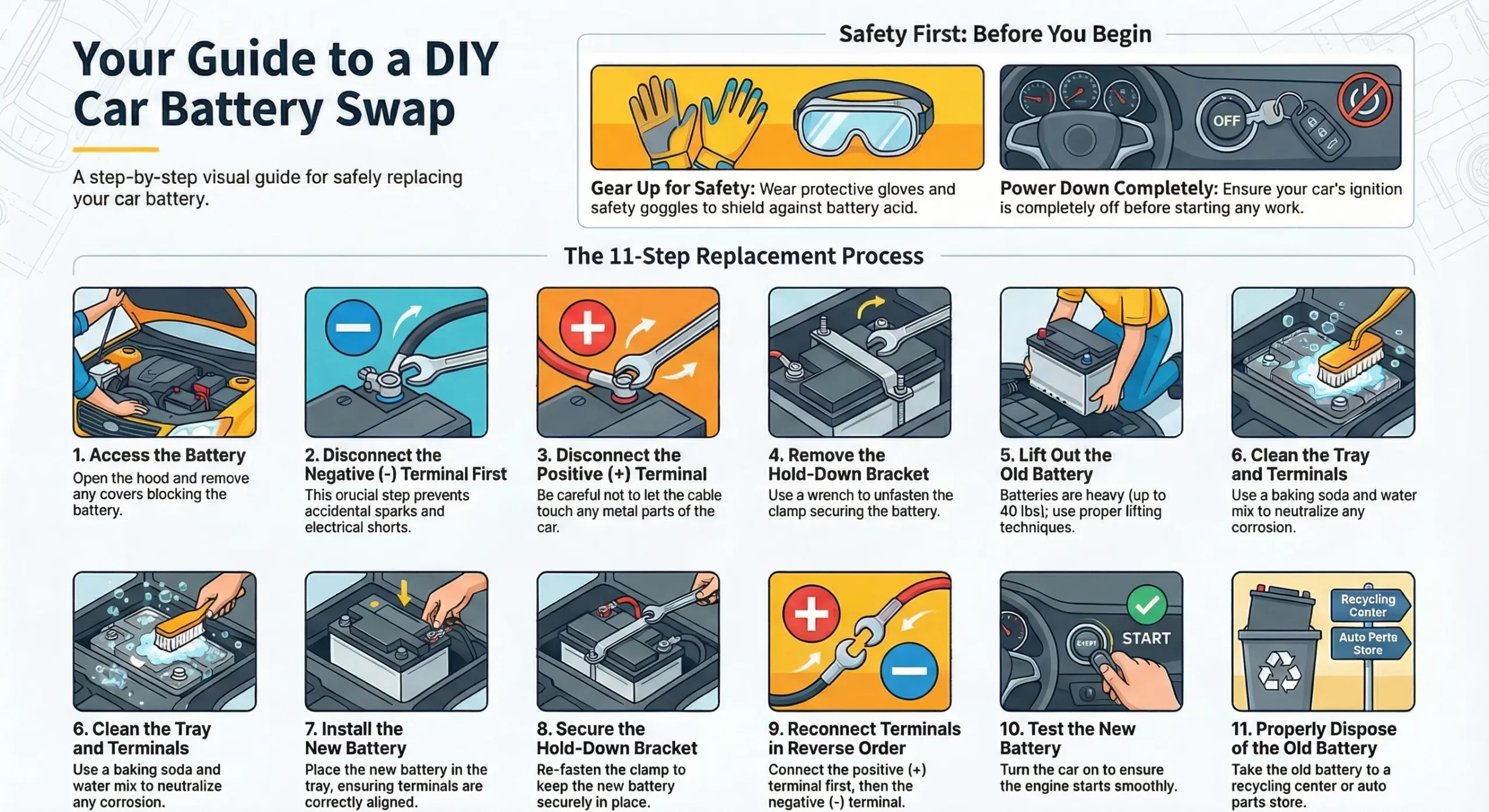
A typical removal and installation order is:
- Identify the positive and negative terminals.
- Disconnect the negative cable first.
- Disconnect the positive cable.
- Remove the hold-down bracket.
- Lift out the old battery with care.
- Clean corrosion from the tray and terminals.
- Place the new battery in the correct position.
- Secure the hold-down bracket.
- Connect the positive cable.
- Connect the negative cable.
- Start the vehicle and check for warning lights.
The negative cable is removed first because it reduces the risk of a tool causing a short between the positive terminal and the car body.
Some vehicles have battery sensors attached to the negative cable. Do not force or damage these sensors. After installation, follow the vehicle’s battery reset or registration procedure if required.
Signs You Have the Wrong Battery
Your car may show several warning signs after an incompatible battery is installed:
• The engine cranks slowly
• The battery tray does not hold the battery firmly
• Cable ends do not reach the terminals
• The positive terminal faces the wrong direction
• The start-stop system stops working
• Battery or charging warnings appear
• The battery repeatedly loses charge
• Electrical accessories behave strangely
A wrong battery may work for a short time. That does not prove it is safe or suitable. Starting the engine once only shows that the battery had enough power at that moment.
If the battery does not sit securely or the cables do not fit naturally, stop and check the application. Never stretch, twist, or modify battery cables to force a connection.
Frequently Asked Questions About Can You Use Any Battery in a Car
Can I put any 12-volt battery in my car?
No. The battery must also have the correct group size, terminal layout, CCA, capacity, and battery technology for your vehicle.
Can I use a higher CCA battery?
Often, yes, if it fits correctly and matches the vehicle’s required voltage and battery type. A higher CCA rating usually does not harm the starter, but the owner’s manual should remain your guide.
Can I replace an AGM battery with a regular battery?
Usually, you should not do this unless the vehicle manufacturer specifically approves it. Many vehicles designed for AGM batteries need their cycling strength and charging settings.
Can a bigger battery damage my car?
A larger battery can cause problems if it does not fit, cannot be secured, or has the wrong terminal position. If it is an approved size and type, a higher-capacity battery is often acceptable.
Do electric cars use regular car batteries?
Electric cars often use a smaller auxiliary battery, commonly 12 volts, but they also have a high-voltage traction battery. The auxiliary battery must match the vehicle, while high-voltage battery work should be handled by trained professionals.
Does every new battery need to be registered?
No, but many modern vehicles require battery registration or reset procedures. Check the owner’s manual, especially if the car has start-stop technology or a battery monitoring sensor.
How long does a car battery usually last?
Many car batteries last about three to five years, but climate, driving habits, vehicle design, and charging health affect service life. Extreme heat, deep discharge, and short trips can shorten battery life.
Conclusion
You cannot use any battery in a car. The correct battery must match the vehicle’s voltage, group size, terminal layout, CCA, capacity, and battery technology. Start-stop, hybrid, and electric vehicles may need special batteries and service procedures.
Before buying, check the owner’s manual and compare the old battery with the approved replacement. A few minutes of research can prevent poor starting, electrical faults, and wasted money. If you are unsure, ask a trusted parts specialist or technician to confirm the fit, then share your vehicle details or questions for more guidance.