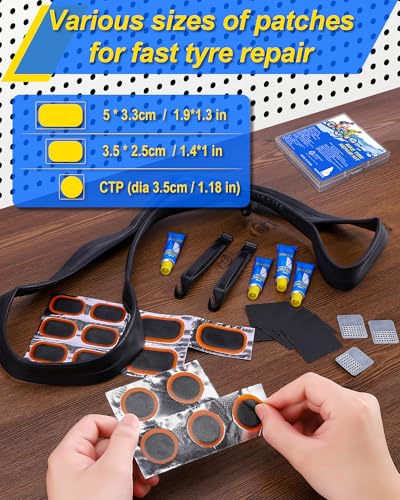
The best digital tire air pressure gauge combines accurate readings, easy handling, a clear display, and strong build quality.
Have you ever checked your tires before a road trip and found that one tire looked low, but you could not tell how low? A good digital tire pressure gauge removes that guesswork in seconds. I tested the features that matter most, including accuracy, pressure range, chuck design, display quality, and ease of use. I also looked at models for daily drivers, trucks, RVs, bikes, and home garages. The right gauge can help protect your tires, improve fuel use, and make every drive feel more secure.
AstroAI Digital Tire Pressure Gauge 150 PSI
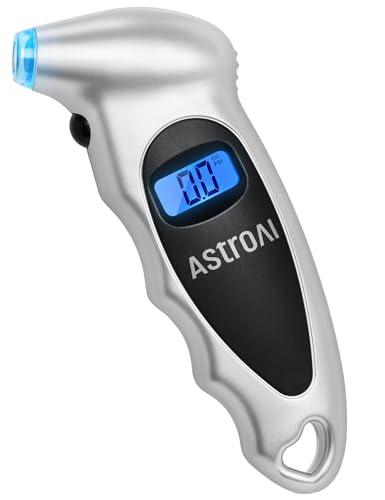
The AstroAI 150 PSI digital tire pressure gauge is a simple tool for drivers who want quick and clear readings. Its stated accuracy of plus or minus 1 PSI is suitable for most cars, SUVs, light trucks, and motorcycles. The digital screen removes the guesswork that often comes with a small pencil gauge. I also like the compact shape because it fits easily in a glove box or door pocket.
This gauge is made for checking pressure, not inflating tires. That makes it a good match for people who already own an air compressor or use a gas station air pump. The 150 PSI range gives plenty of room for normal passenger tires and many trailer or light-truck tires. For the best reading, check your tires when they are cold and compare the result with the pressure listed on the driver-door placard.
Pros:
- Clear digital readout for quick checks
- Useful 150 PSI maximum range
- Compact design stores easily in a vehicle
- Simple operation for new users
- Good choice for cars, SUVs, and light trucks
- Helps reduce errors from hard-to-read analog scales
Cons:
- It does not inflate tires by itself
- The display and buttons may feel small for some users
- It may not be the best choice for very high-pressure commercial tires
My Recommendation
I recommend this AstroAI model to everyday drivers who want a dependable pressure checker without paying for a full inflator. It works well for routine checks before commuting, towing, or a long highway trip. The simple design also suits older drivers who prefer a large digital number over a narrow analog needle. If your main need is fast pressure measurement, this is a strong value pick.
Among the options in this guide, it is one of the easiest gauges to keep in the car. It does not offer the all-in-one function of an inflator gauge, but that keeps the tool light and less complex. For drivers seeking the best digital tire air pressure gauge for basic vehicle care, this AstroAI is a practical starting point. Its value is strongest when you want a small tool that is ready whenever a warning light appears.
| Best for | Why |
|---|---|
| Daily car checks | Simple controls and a readable digital result |
| Glove-box storage | Compact size takes up very little room |
| Drivers on a budget | Measures pressure without adding extra features or cost |
AstroAI Digital Tire Inflator Gauge 250 PSI
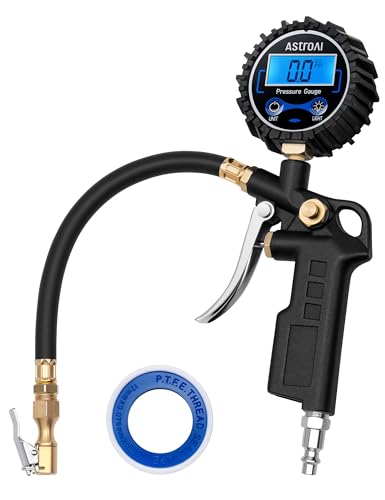
The AstroAI digital tire inflator gauge adds inflation control to pressure measurement. It supports a broad 3 to 250 PSI range, so it can handle common cars, trucks, RVs, trailers, and many bikes. The 0.1 PSI display resolution lets you watch pressure changes in small steps. I find that useful when setting tires close to a recommended target.
This model connects to an air compressor through its quick-connect system and uses a hose with an air chuck. That means you can measure, add air, and check again without changing tools. The heavy-duty design feels more at home in a garage than a glove box. Still, its wider body and hose make it less convenient for a quick roadside check than a small handheld gauge.
Pros:
- Measures and inflates with one tool
- Wide 3 to 250 PSI range
- Fine 0.1 PSI display resolution
- Quick-connect coupler supports garage use
- Useful for cars, trucks, RVs, and trailers
- Hose keeps the display away from the valve stem
Cons:
- Requires an air compressor to inflate
- Bulkier than a basic handheld gauge
- More parts require storage and care
My Recommendation
This AstroAI inflator gauge is best for a home mechanic, tire hobbyist, or driver who already owns a compressor. It saves time because I can attach it once, read the pressure, add air, and confirm the final number. That process feels much more controlled than using a noisy station pump with a loose analog gauge. The long pressure range also gives it room to grow with your vehicle needs.
I would choose this model over a simple gauge for regular maintenance or a household with several vehicles. It is especially helpful for people who rotate between a car, pickup, RV, and trailer. As a candidate for the best digital tire air pressure gauge, it stands out because it combines measurement with inflation. The main trade-off is size, so it is better for a garage shelf than a tiny emergency kit.
| Best for | Why |
|---|---|
| Home garages | Connects to a compressor and handles repeated tire work |
| Mixed vehicle owners | The 250 PSI range suits many vehicle types |
| Accurate top-offs | The digital display shows small pressure changes |
ETENWOLF T300 Digital Tire Gauge 200 PSI

The ETENWOLF T300 is a versatile digital tire gauge with a 200 PSI maximum reading. Its range makes it useful for passenger cars, trucks, RVs, bicycles, and some specialty tires. I like this kind of flexibility because one tool can serve several jobs around the home. The digital display also makes it easier to see the result in a dim garage or driveway.
The T300 focuses on measurement rather than inflation. That makes it less complicated and easier to carry than an inflator with a long hose. It is a good fit for drivers who want to check tire pressure often but do not need to connect to a compressor. As with any gauge, I suggest checking its reading against a trusted reference from time to time, especially before a major trip.
Pros:
- 200 PSI range covers many cars, trucks, RVs, and bikes
- Portable design works well in an emergency kit
- Digital screen is easier to read than many analog gauges
- Useful for several types of tires
- Simple pressure-checking process
- Good choice for drivers who do not need inflation features
Cons:
- Does not include an air hose or compressor connection
- Its higher range is more than most passenger cars need
- Small digital tools still need careful handling around wet areas
My Recommendation
I recommend the ETENWOLF T300 for people who want one portable gauge for several kinds of tires. It is a smart pick for a family with a car, pickup, bicycles, or an RV. The 200 PSI capacity gives extra headroom, while the handheld format keeps the tool easy to carry. It also works well for cyclists who want a quick check before a ride.
This model earns attention as one of the best digital tire air pressure gauge options for versatile use. It does not try to be a compressor accessory, so the design stays focused on reading pressure. That makes it less suitable for someone who wants to fill a flat tire at home. For simple checks across many vehicles, however, it offers useful range and everyday convenience.
| Best for | Why |
|---|---|
| Multiple tire types | Its 200 PSI range supports cars, trucks, RVs, and bikes |
| Portable emergency kits | The handheld format is easy to carry |
| Frequent pressure checks | Fast digital readings reduce guesswork |
JACO ElitePro Digital Tire Gauge 100 PSI

The JACO ElitePro is designed for drivers who care about a solid feel and a professional-style reading. Its 100 PSI limit fits most cars, SUVs, motorcycles, and light trucks. The lower maximum is not a weakness for normal road vehicles because most passenger tires operate far below that level. Its sturdy body also gives the tool a reassuring garage-quality feel.
I see this gauge as a focused maintenance tool. It does not include an inflator, so it is quick to grab when I only need to inspect pressure. The JACO name is known among automotive tool buyers, and the ElitePro design aims to provide stable readings with a comfortable grip. It is best used on cold tires, before driving has warmed the air inside.
Pros:
- 100 PSI range suits most road vehicles
- Professional-style construction feels durable
- Easy to use for routine tire maintenance
- Compact enough for vehicle storage
- Good fit for cars, SUVs, and motorcycles
- Focused design avoids unnecessary controls
Cons:
- Not intended for very high-pressure specialty tires
- Does not inflate tires
- May cost more than basic entry-level gauges
My Recommendation
The JACO ElitePro 100 PSI model is best for the driver who values build quality and wants a dedicated pressure tool. It is a strong option for a daily commuter, motorcycle owner, or careful road-trip planner. The 100 PSI ceiling covers the pressure needs of most passenger vehicles, so I would not reject it simply because other models list a higher number. A gauge should match the job, and this one matches ordinary road use well.
If you want the best digital tire air pressure gauge for a personal car and prefer a more substantial tool, this JACO deserves a close look. It is not the best match for RV owners with high-pressure requirements or users who need inflation. For regular checks and long-term garage use, its focused design and sturdy feel offer good overall value.
| Best for | Why |
|---|---|
| Passenger vehicles | The 100 PSI range covers common car and SUV tires |
| Motorcycle owners | A dedicated gauge gives quick, controlled checks |
| Tool-conscious users | Solid construction suits regular maintenance work |
DigitPro Digital Tire Inflator Gauge 250 PSI
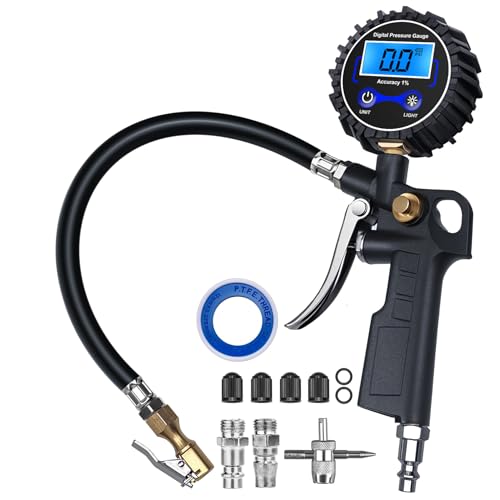
The DigitPro digital tire inflator gauge is built for users who want a heavy-duty compressor accessory. It offers a 3 to 250 PSI range, which gives it broad use across cars, trucks, RVs, trailers, and equipment. The inflator format lets you add air while watching the pressure on the digital display. That is far more useful than guessing how long to run a compressor.
This type of gauge works best in a home workshop or service area. The hose and chuck add reach around large wheels, while the quick-connect design helps reduce setup time when paired with a compatible compressor. I would keep the tool clean and protect it from drops, oil, and water to support long service. It is a practical choice for people who maintain more than one vehicle.
Pros:
- Wide 3 to 250 PSI operating range
- Combines pressure checking and tire inflation
- Heavy-duty format suits garage work
- Useful for cars, trucks, RVs, and trailers
- Hose provides better reach around large wheels
- Digital reading supports more controlled filling
Cons:
- Needs a separate compressor
- Less portable than a handheld gauge
- Hose and fittings need organized storage
My Recommendation
I recommend DigitPro to home mechanics and owners of larger vehicles. It is especially useful when you check several tires in one session because it removes the need to switch between a gauge and an inflator. The broad pressure range gives you room for truck, trailer, and RV work. For someone who already has an air compressor, this tool can become a regular part of the maintenance bench.
It is a strong candidate for the best digital tire air pressure gauge when “best” means a garage-ready inflator. It is not the right choice for someone who only wants a tiny tool for the glove box. Still, the combination of range, hose reach, and digital control gives it excellent practical value. I would choose it for frequent tire service rather than occasional checks.
| Best for | Why |
|---|---|
| Garage tire service | The inflator format works well with a compressor |
| Large vehicles | The 250 PSI rating provides broad pressure capacity |
| Repeated top-offs | One tool measures pressure and adds air |
ETENWOLF T300 Two-Pack Digital Gauges

The ETENWOLF T300 two-pack gives you two matching digital tire gauges instead of one. That simple idea can be useful in a busy home, where one gauge can stay in the car and the other can remain in the garage. Each gauge offers a 200 PSI range for broad coverage. The pair also gives you a convenient backup if one tool is misplaced.
I like two-packs for families because tire checks often happen in more than one place. You can keep one unit with a road-trip kit and give the other to a spouse or new driver. These gauges focus on measurement, so they do not replace an air compressor or inflator. They are best for fast readings before travel, after a temperature change, or when a tire pressure warning appears.
Pros:
- Two gauges provide convenient backup coverage
- 200 PSI range supports many vehicles and bikes
- One unit can stay in the car and one at home
- Digital results are easy to read
- Useful for families with more than one driver
- Good value when multiple gauges are needed
Cons:
- Neither gauge inflates tires
- A two-pack may be unnecessary for one driver
- Two battery-powered tools require battery care
My Recommendation
This ETENWOLF two-pack is best for families, multiple vehicles, and people who often lend tools to others. I would place one gauge in an emergency kit and keep the second near the air compressor or garage door. That setup makes regular checks easier because the tool is usually close at hand. It also reduces the frustration of searching for one small gauge before a trip.
For shoppers comparing the best digital tire air pressure gauge options, this package wins on convenience rather than advanced functions. It offers the same basic benefit twice, which can be more useful than extra features. It is not the best fit for a user who wants inflation or a premium workshop tool. For shared use and backup value, however, it is a smart and practical package.
| Best for | Why |
|---|---|
| Families | Two people can keep a gauge in separate vehicles |
| Emergency backups | A second unit remains available if one is lost |
| Home and travel use | One gauge can stay in each location |
AZUNO Digital Tire Inflator Gauge 200 PSI

The AZUNO digital tire inflator gauge is a heavy-duty compressor accessory with a 200 PSI rating. It includes a rubber hose, a lock-on air chuck, and a quick-connect coupler. Those parts help create a stable connection while you fill a tire. The included carrying box is also helpful because it keeps the gauge, hose, and fittings together.
This tool makes sense for a garage where an air compressor is already available. The lock-on chuck can leave your hands free while air moves into the tire, and the digital gauge lets you watch the result. I find that layout easier than holding a loose chuck against the valve stem. The kit is larger than a handheld gauge, but the case makes it easier to keep everything ready for the next job.
Pros:
- 200 PSI range handles many vehicle applications
- Lock-on air chuck supports a steady connection
- Quick-connect coupler speeds up setup
- Carrying box keeps parts organized
- Rubber hose improves reach and handling
- Measures and inflates with one compressor tool
Cons:
- Requires an air compressor
- Case and hose take more storage space
- Not as convenient for a quick roadside pressure check
My Recommendation
I recommend the AZUNO to a hands-on vehicle owner who wants an organized tire service kit. It is a good match for a home garage, small workshop, or person who maintains several cars. The lock-on chuck can make inflation less tiring, especially when a valve stem sits in an awkward position. The storage box is a small feature, but it keeps the setup from becoming a pile of loose parts.
This model belongs on a shortlist of the best digital tire air pressure gauge choices for compressor users. It offers more than a reading because it helps complete the full top-off job. I would not buy it if I lacked a compressor, since the gauge alone cannot add air. For garage owners who want reach, organization, and a broad range, it offers strong value.
| Best for | Why |
|---|---|
| Organized garages | The carrying box stores the gauge and accessories together |
| Hard-to-reach valves | The hose and lock-on chuck improve access |
| Compressor owners | It measures and inflates in one setup |
JACO FlowPro Digital Inflator Gauge 200 PSI
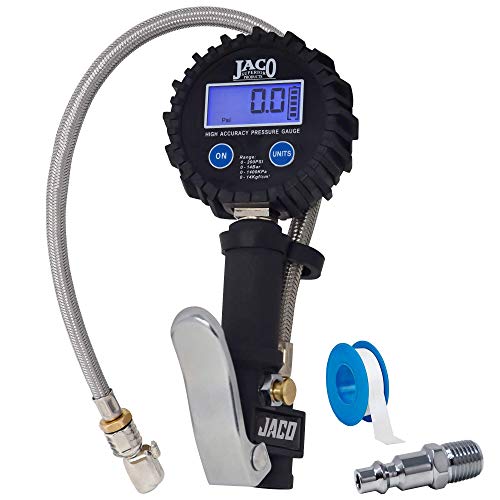
The JACO FlowPro is a 200 PSI digital tire inflator gauge for users who want a durable tool for regular tire work. It connects to an air compressor and lets you monitor pressure while adding air. The inflator format is useful when a tire needs a small adjustment rather than a full service visit. Its design is aimed at people who prefer a dedicated automotive tool over a compact emergency gauge.
The biggest advantage is workflow. I can connect the chuck, read the current pressure, open the compressor line, and stop when the tire reaches its target. That keeps the process simple and helps prevent overfilling. It is a better fit for a garage or workshop than for a pocket, but the extra reach can make large wheels easier to service.
Pros:
- 200 PSI capacity covers many vehicle types
- Combines inflation and digital measurement
- Useful for routine garage maintenance
- Hose design improves access to wheel valves
- Helps reduce overfilling during top-offs
- JACO build quality appeals to serious tool users
Cons:
- Needs a separate compressor
- Less compact than a basic pressure gauge
- May offer more capability than a casual driver needs
My Recommendation
The JACO FlowPro is best for people who inflate their own tires and want a smooth, repeatable process. I would choose it for a home garage, a truck owner, or anyone who checks tire pressure often. The 200 PSI rating gives useful flexibility without making the tool feel aimed only at extreme applications. It can also be a good choice for a small workshop that needs a practical inflator gauge.
If the best digital tire air pressure gauge for you must also fill tires, the FlowPro is worth considering. It does not replace a compressor, so that requirement matters before you buy. Once connected, though, it reduces the number of tools needed for a pressure adjustment. Its overall value comes from convenience, reach, and a clear reading during inflation.
| Best for | Why |
|---|---|
| Frequent DIY maintenance | It makes repeated pressure adjustments easier |
| Truck owners | The 200 PSI rating offers broad use |
| Garage work | The hose and inflator format suit a compressor setup |
JACO ElitePro Digital Tire Gauge 200 PSI

The JACO ElitePro 200 PSI is a dedicated digital gauge for users who want more pressure range than the 100 PSI version. The added capacity makes it more suitable for trucks, RVs, trailers, and some high-pressure tires. It keeps the basic job simple: connect to the valve, read the pressure, and decide whether the tire needs air. That focused approach makes it easy to use during a pre-trip inspection.
This gauge does not inflate tires, so it works best beside an air compressor or portable inflator. I see that as a benefit for users who want a separate, accurate check rather than relying only on the gauge built into an inflator. The 200 PSI range also gives peace of mind when checking larger tires. Even so, users should follow the vehicle maker’s recommended pressure rather than filling to the gauge’s maximum.
Pros:
- 200 PSI range suits cars, trucks, RVs, and trailers
- Dedicated design is quick to operate
- Useful as a second check beside an inflator
- Professional-style construction
- Easy to store in a garage or vehicle kit
- Good fit for users who need extra pressure headroom
Cons:
- Does not inflate tires
- May be more gauge than a small car owner needs
- Requires a separate air source for adjustments
My Recommendation
I recommend the JACO ElitePro 200 PSI for pickup, RV, trailer, and mixed-vehicle owners. It gives those users more useful range than a 100 PSI gauge while keeping the operation straightforward. It is also a sensible choice for someone who wants a dedicated check after using a compressor. The design feels more like a long-term garage tool than a disposable emergency item.
For shoppers looking for the best digital tire air pressure gauge with broad capacity, this JACO is one of the strongest dedicated options. It is not an inflator, so you need another tool to add air. That limitation is easy to accept if you value a separate pressure check and already own a compressor. Its combination of range, focus, and sturdy construction makes it a reliable choice for larger vehicles.
| Best for | Why |
|---|---|
| RVs and trailers | The 200 PSI capacity provides extra pressure range |
| Pickup owners | It handles larger tires without inflator bulk |
| Independent checks | A dedicated gauge verifies pressure after inflation |
HYVOHEX Digital Tire Pressure Gauge 200 PSI

The HYVOHEX digital tire pressure gauge offers a 200 PSI range for cars, RVs, trucks, and bikes. It is designed as a portable measuring tool, so it does not add the weight and bulk of a compressor inflator. That makes it easy to keep in an emergency kit or carry from one vehicle to another. A digital screen also gives a clear result when the tire valve sits in a shadow.
This model is a good match for drivers who want broad use without a complex setup. I would use it before a long trip, after a major temperature change, or whenever a tire appears low. It cannot fix low pressure on its own, so pair it with a portable pump or compressor. Used that way, it becomes a simple first step in a safe tire-care routine.
Pros:
- 200 PSI range supports cars, trucks, RVs, and bikes
- Portable format fits vehicle emergency kits
- Digital display is quick to read
- Simple operation suits beginners
- Works as a check beside a portable inflator
- Broad range adds flexibility for mixed use
Cons:
- Does not inflate tires
- May need careful storage to protect the display
- High-pressure capability is unnecessary for some car owners
My Recommendation
The HYVOHEX is best for drivers who want a flexible, portable gauge for several types of tires. It is a good companion for an RV trip, a truck, a bike ride, or a family car. The 200 PSI rating gives more room than most basic car gauges, while the handheld shape stays easy to carry. I would keep it with a portable air pump so I could measure and correct pressure anywhere.
As one of the best digital tire air pressure gauge candidates, it offers a useful balance of range and simplicity. It does not have the garage power of an inflator gauge, but that also makes it easier to store. If you want one small tool for different vehicles, it deserves attention. Its overall value is strongest for mobile tire checks and mixed household use.
| Best for | Why |
|---|---|
| RV and truck travel | The 200 PSI range handles larger vehicle needs |
| Bike and car owners | One portable gauge supports different tire types |
| Emergency kits | The handheld design is easy to carry with a pump |
How to Choose the Best Digital Tire Air Pressure Gauge
Choosing a tire gauge is easier when you focus on the job first. A daily driver may need only a compact pressure checker. A truck or RV owner may need a higher pressure range. Someone with a garage compressor may prefer an inflator gauge that can measure and add air without changing tools.
Before buying, check the recommended tire pressure on your vehicle’s door-jamb label or owner’s manual. Do not use the maximum PSI printed on the tire sidewall as your normal target. That number describes a limit, not the pressure your vehicle needs for everyday driving. Tire makers and vehicle makers use different specifications, so the vehicle placard should guide your routine checks.
Pressure Range
Most passenger cars use pressures in the 30 to 40 PSI area, though some vehicles differ. A gauge rated to 100 PSI is enough for many cars and motorcycles. A 150 or 200 PSI model adds useful flexibility for trucks, trailers, RVs, and bikes. A 250 PSI inflator gauge is often best for garage users who want one tool for many applications.
Accuracy and Resolution
Accuracy tells you how close the reading should be to the true pressure. Resolution tells you how finely the screen displays the reading. A display that changes by 0.1 PSI can look precise, but the stated accuracy matters more. I prefer a gauge with clear accuracy information and a stable chuck over one that simply prints many digits on the screen.
Gauge or Inflator?
A handheld gauge checks pressure only. It is small, fast, and easy to store. An inflator gauge connects to an air compressor and lets you fill the tire while watching the reading. The inflator style is larger, but it can save time if you maintain your own tires.
Chuck and Hose Design
The air chuck should attach firmly to the valve stem without excessive air loss. A hose helps when the valve is behind a spoke or deep inside a wheel. A lock-on chuck can reduce hand strain during inflation. For a quick check, a compact chuck may be all you need.
Display and Controls
A clear display matters when you check tires outdoors. Large numbers help in low light and reduce the need to bend close to the wheel. Simple controls are often better than a crowded panel. Some models may offer different pressure units, such as PSI, BAR, kPa, or kg/cm², which can help users with different equipment.
Power and Storage
Digital gauges use batteries, so check the battery type and keep a spare set nearby. Remove batteries if you store the gauge for a long time and want to reduce the risk of leakage. Keep the tool dry and avoid leaving it in extreme heat. A small case or dedicated vehicle pouch can protect the display and chuck.
How I Use a Digital Tire Pressure Gauge
I start with cold tires. Driving warms the air inside the tire and can raise the reading, so a cold check gives a more useful baseline. I remove the valve cap, press the chuck straight onto the valve, and wait for the reading to settle. Then I compare the number with the recommended pressure on the driver-door label.
If the pressure is low, I add air in short bursts. I check the pressure again after each burst because a small tire can gain several PSI quickly. If the pressure is high, I release a little air and measure again. Finally, I replace the valve cap and repeat the process on the other tires, including the spare when possible.
The National Highway Traffic Safety Administration advises drivers to check tire pressure regularly and before long trips. Tire pressure can change with temperature, and an underinflated tire can affect handling, wear, and fuel use. A pressure gauge does not replace a tire inspection, so I also look for cracks, cuts, bulges, and uneven tread wear. When a tire keeps losing air, I have it checked for a puncture or valve problem.
FAQs Of best digital tire air pressure gauge
What is the best digital tire air pressure gauge for most cars?
The AstroAI 150 PSI gauge is a strong choice for most daily drivers. It is compact, simple, and offers a useful pressure range. The JACO ElitePro 100 PSI is another good option for users who prefer a sturdy dedicated tool.
Are digital tire gauges more accurate than analog gauges?
Not always. A well-made analog gauge can be accurate, and a cheap digital gauge can drift. Digital models are often easier to read because they show a clear number. Look for stated accuracy, a firm chuck, and consistent readings.
Should I buy a tire gauge with an inflator?
Buy an inflator gauge if you own an air compressor and want to fill tires at home. A basic digital gauge is better if you only need to check pressure. An inflator is larger but combines two tasks in one tool.
What PSI should I put in my tires?
Use the pressure listed on the vehicle’s driver-door placard or in the owner’s manual. Do not use the maximum number on the tire sidewall as your normal setting. Check pressure when the tires are cold for the most useful result.
How often should I check tire pressure?
Check it at least once a month and before long trips. Check sooner after a sharp temperature drop, a puncture, or a tire pressure warning. Regular checks can catch a slow leak before it becomes a larger problem.
Final Verdict: Which Should You Buy?
For most drivers, the AstroAI 150 PSI is the best digital tire air pressure gauge because it is simple, compact, and practical. Choose the AstroAI or DigitPro inflator models if you own a compressor and want to add air while measuring.
Pick a 200 PSI handheld model for trucks, RVs, bikes, or mixed use. Check cold tires often, follow the vehicle placard, and keep your gauge ready for every trip.