
The best jack stands for car lifting combine strong steel, stable bases, secure locks, and the right height range.
Most home mechanics know the moment: the car is on a floor jack, but the real work still cannot begin. You need a safe, steady place to support the vehicle while changing brakes, rotating tires, inspecting suspension parts, or working under the chassis. I reviewed these jack stands with weight rating, height, base width, locking design, portability, and vehicle fit in mind. The goal is simple: help you choose the best jack stands for car lifting without guessing.
Amazon Basics 3-Ton Steel Jack Stands

The Amazon Basics 3-Ton Steel Jack Stands are a practical choice for common sedans and many urban SUVs. This pair supports up to 6,000 pounds as a set, giving many home users a useful safety margin for routine service. The steel body feels suited to garage work, while the adjustable height helps the stands meet different factory lift points. I also like the clear, familiar design because it does not make setup feel complicated.
The ratcheting height post makes quick adjustments easy after you raise the vehicle with a floor jack. A broad base helps spread the load across a smooth garage floor, and the red-and-black finish makes the stands easy to spot. Still, you must check the actual curb weight of your vehicle and use the stands as a pair. These stands are not a substitute for a properly rated jack, wheel chocks, or a level work area.
Pros:
- 3-ton capacity suits many cars and small SUVs
- Adjustable height supports different lift points
- Steel construction provides a solid garage feel
- Wide base helps improve stability on hard floors
- Pair format supports the front or rear of a vehicle
- Simple ratchet design allows fast height changes
Cons:
- Not the best match for heavy-duty trucks or large RVs
- May not fit vehicles with very low lift points
- Steel construction makes them heavier than some compact stands
My Recommendation
I recommend these stands to a new DIY mechanic who wants a familiar, affordable setup for a sedan, crossover, or smaller SUV. They are especially useful for brake jobs, tire service, oil checks, and underbody inspections where a stable support point matters. For many drivers, this pair offers the balance expected from the best jack stands for car lifting without adding features they may never use. Confirm vehicle weight and lift height before ordering.
Powerbuilt 3-Ton All-in-One Unijack
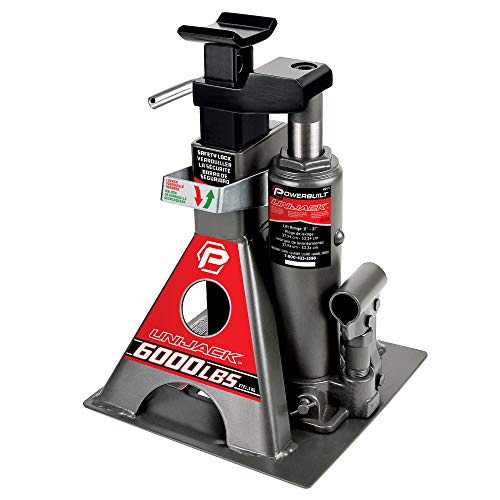
The Powerbuilt Unijack combines a bottle jack and a jack stand in one compact tool. Its 3-ton, or 6,000-pound, rating makes it useful for many cars, crossovers, and lighter trucks. The wide base gives it a planted feel, and the integrated stand can reduce the number of separate tools in a small garage. I see this design as a smart option for drivers who value storage space and quick roadside use.
The saddle and support structure help hold the vehicle after lifting, but careful placement remains essential. You still need to use the correct manufacturer lift point and keep the vehicle on a firm, level surface. The all-in-one format can feel more convenient than carrying a floor jack and separate stands. However, its shape and lifting method may not suit every vehicle, especially one with unusual clearance or a low frame.
Pros:
- Combines lifting and support in one unit
- 3-ton capacity works for many everyday vehicles
- Wide base improves contact with the floor
- Compact design saves garage and trunk space
- Useful for emergency roadside support
- Reduces the need to carry separate lifting tools
Cons:
- One unit does not lift an entire vehicle by itself
- Bottle-jack shape may not fit all factory lift points
- Less convenient than a pair of stands for many two-wheel jobs
My Recommendation
I would choose the Powerbuilt Unijack for a driver who wants a compact backup tool or works on one corner at a time. It makes sense for limited garage storage, roadside kits, and basic repairs on compatible vehicles. Its wide base and combined design make it one of the more flexible options among the best jack stands for car lifting. Before use, measure the available clearance and confirm that the saddle contacts a strong, approved point.
Jack Boss 2-Ton Low-Profile Stands
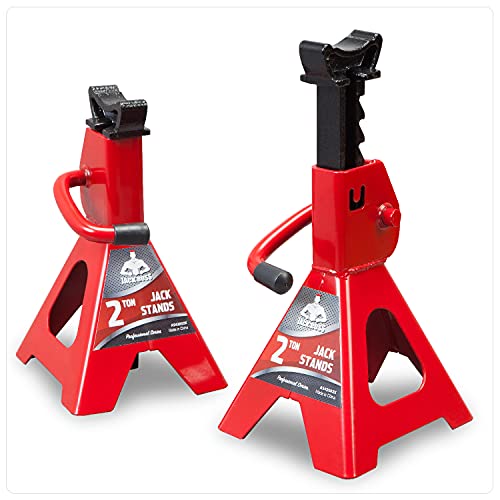
The Jack Boss low-profile stands target small cars and vehicles with limited ground clearance. Their 2-ton, or 4,000-pound, rating is aimed at lighter applications rather than large trucks. The lower profile can make placement easier when a normal stand will not slide beneath the side of a vehicle. I find that feature valuable for compact cars, sports cars, and some lowered vehicles.
These stands arrive as a two-pack, which helps support one end of a car during brake or suspension work. Their smaller size should also make them easier to move and store than heavy-duty stands. The trade-off is capacity, so you must not use them for a vehicle that exceeds the rated load. Always consider the total vehicle weight, the portion supported by the stands, and the effect of uneven loading.
Pros:
- Low profile suits cars with limited clearance
- 2-ton capacity fits many small vehicles
- Sold as a pair for balanced support
- Compact shape is easy to store
- Useful for brake, tire, and suspension work
- More convenient than tall stands for low cars
Cons:
- Not designed for large SUVs, trucks, or RVs
- Lower capacity leaves less margin for heavy vehicles
- Low height may not reach some taller factory lift points
My Recommendation
The Jack Boss pair is best for owners of compact cars, small sedans, and low-clearance vehicles. I would not select it for a full-size pickup, but it can be a good fit when height is the main problem. For the right vehicle, this design delivers the low entry point many shoppers want from the best jack stands for car lifting. Check your vehicle manual and measure the stand height before purchase.
DNA Motoring 2-Ton Jack and Stand Kit

The DNA Motoring kit combines a 2-ton jack with matching stands in a convenient red-and-black package. This approach can help a first-time owner buy the main support tools together instead of mixing parts from several brands. The 4,000-pound capacity is best suited to smaller cars and light repair tasks. I like this kit for basic maintenance where simple lifting and support are more important than extreme height.
A complete kit can also make it easier to keep your tools organized in a small garage. It may work well for seasonal tire changes, pad checks, and simple underbody inspections. Even with a kit, never work beneath a vehicle supported only by the jack. Use the stands on approved points, chock the wheels that remain on the ground, and test stability before beginning work.
Pros:
- Includes a jack and stands in one package
- Useful starter set for basic home maintenance
- 2-ton rating fits many compact and midsize cars
- Matching tools simplify storage and setup
- Bright finish makes the equipment easy to see
- Practical for tire and brake service
Cons:
- Capacity is too low for many trucks and large SUVs
- Kit components may offer less flexibility than separate tools
- Users must inspect all parts before every lift
My Recommendation
I recommend this kit for a new car owner who needs a basic lifting setup at home. It suits light vehicles and occasional work, such as swapping wheels or checking brakes. It may be a convenient entry into the best jack stands for car lifting, but it is not a universal heavy-duty solution. If your vehicle is close to the weight limit, choose a higher-rated pair instead.
SENKEYFE 6-Ton Heavy-Duty Jack Stands
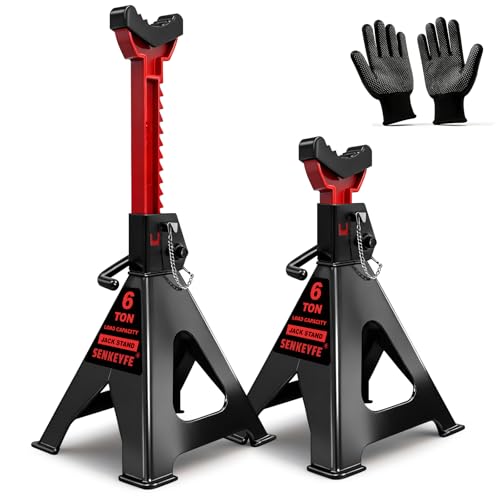
The SENKEYFE 6-ton stands are made for users who need more capacity and more height than a typical passenger-car stand provides. The pair is rated for a combined 13,200 pounds, according to the product listing, and the 15-to-23-inch adjustment range targets SUVs, pickups, vans, and some recreational vehicles. A large foot base can help distribute force on a solid floor. This is the kind of stand that feels more at home in a serious garage.
Double-pin locking adds a second layer of mechanical retention beyond the main height adjustment. The rubber covers can help protect certain contact areas and reduce metal-to-metal contact, though they should not hide damaged welds or poor positioning. The tall range is helpful, but it also raises the need for a level surface and careful setup. I would use these only on a floor strong enough to handle the load and never on soft soil without suitable rated support.
Pros:
- High 6-ton pair capacity suits heavier vehicles
- 15-to-23-inch height range supports taller chassis
- Double-pin locking adds mechanical security
- Large base helps improve load distribution
- Rubber covers may protect contact points
- Suitable for many SUVs, pickups, vans, and utility vehicles
Cons:
- Large size takes more storage space
- May be too tall for low passenger cars
- Heavy-duty stands are harder to carry and position
- Requires extra care on uneven or weak floors
My Recommendation
The SENKEYFE pair is best for owners of heavy SUVs, pickups, vans, and similar vehicles that need a tall support range. I would pick it when capacity and height matter more than portability. Its double-pin design and broad base give it strong appeal for experienced DIY users searching for the best jack stands for car lifting. It is not the right size for every garage, so measure both your vehicle and storage area first.
VEVOR 3/4-Ton Underhoist Support Stand

The VEVOR Underhoist Support Stand serves a different job from a normal pair of axle stands. It is designed to support an underhoist point, such as a raised component or vehicle structure, during repair work. Its 3/4-ton capacity is far below the rating needed to support a whole vehicle. I consider it a supplemental shop tool, not a replacement for properly rated jack stands.
The adjustable support can help hold exhaust parts, suspension components, transmissions, or other assemblies while you work. This can reduce strain on your arms and help keep a part aligned during removal or installation. The stand must sit on a firm, level surface and contact only a strong support point. Read the capacity carefully because confusing an underhoist stand with a vehicle support stand can create a serious safety risk.
Pros:
- Useful for supporting raised vehicle components
- Helps hold parts during installation or removal
- Compact design fits many shop spaces
- Adjustable support improves positioning
- Helpful for exhaust and suspension work
- Can complement a floor jack and axle stands
Cons:
- Not a replacement for full vehicle jack stands
- 3/4-ton capacity limits the supported load
- Requires careful placement under a strong component
- Not intended to support a complete car
My Recommendation
I recommend the VEVOR stand only as an extra support tool for experienced mechanics. It is a good choice when a raised component needs temporary support, but it should never carry the entire vehicle. If you are shopping for the best jack stands for car lifting, choose a conventional pair first and consider this stand later. Its value comes from its special role, not from replacing standard axle stands.
BIG RED Torin 3-Ton Steel Jack Stands

The BIG RED Torin T43202 is a familiar style of steel jack stand rated at 3 tons, or 6,000 pounds, as a pair. It offers a straightforward design for passenger cars and similar light vehicles. The steel frame and broad feet give it the traditional shop-tool look many home mechanics trust. For routine work, simple parts can be a benefit because there are fewer unusual features to learn.
The adjustable saddle lets you set a useful support height after lifting the car. The product listing notes that this model is not suitable for SUVs or trucks, and I take that limitation seriously. It is better to match the stand to the vehicle than to rely on a large-looking number printed on the label. Use both stands together, keep the vehicle level, and lower the load slowly onto the saddles.
Pros:
- 3-ton capacity suits many passenger vehicles
- Traditional steel design is easy to understand
- Adjustable height supports common service tasks
- Pair provides stable end-of-vehicle support
- Broad feet help create a firm stance
- Useful for home garages and routine maintenance
Cons:
- Not suitable for SUVs or trucks according to the listing
- May not provide enough height for taller vehicles
- Steel body can be heavy to move around
My Recommendation
The BIG RED Torin pair is a sensible fit for owners of regular sedans and other light passenger vehicles. I would choose it for a home garage that values a plain, proven stand design over special features. It can serve as one of the best jack stands for car lifting when the vehicle matches its stated use. Do not stretch its rating to cover a truck or SUV.
Pro-Lift 6-Ton Double-Lock Stands
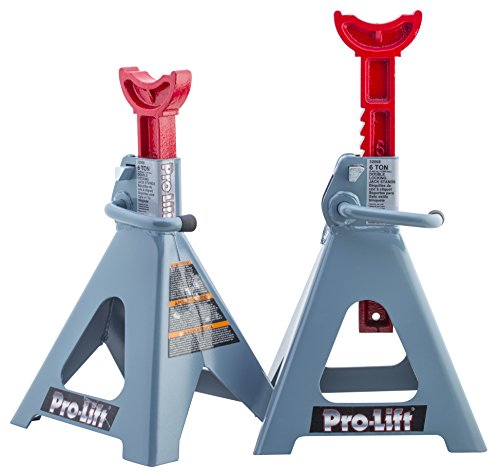
The Pro-Lift 6-ton jack stands target heavier vehicles and frequent garage work. Their double-locking pins add a second retention method, while the handle lock can make height adjustment easier to control. A mobility pin helps with positioning before the load is placed on the stand. Together, these features give the pair a more professional feel than a basic light-duty stand.
The higher capacity is useful for pickups, SUVs, and other vehicles when the stand height also fits the chassis. Even so, a 6-ton pair does not mean every vehicle can be lifted at every point. You must follow the vehicle maker’s lift instructions and keep the stands on a firm, level surface. I also suggest checking pins, welds, feet, and saddle condition before each use.
Pros:
- 6-ton rating supports many heavier vehicles
- Double-locking pins add another safety feature
- Handle lock helps with adjustment and carrying
- Mobility pin makes positioning more convenient
- Pair format supports balanced vehicle loading
- Well suited to regular home-shop use
Cons:
- Heavier and bulkier than light-duty stands
- May not fit low cars without enough clearance
- Higher capacity does not correct poor lift-point placement
My Recommendation
I recommend the Pro-Lift pair to experienced home mechanics who work on trucks, SUVs, or heavier vehicles. The double-lock system and handling features are useful when you move the stands often or use them for longer repair sessions. For shoppers who want the best jack stands for car lifting with extra retention features, this is a strong option. Confirm the height range and vehicle weight before relying on it.
Best-For Comparison
| Best for | Why |
|---|---|
| Everyday cars and small SUVs | The Amazon Basics 3-ton pair offers simple adjustment, useful capacity, and easy home-garage use. |
| Heavy trucks, SUVs, and vans | The SENKEYFE and Pro-Lift 6-ton options provide higher capacity and taller support ranges. |
| Low cars or special repair tasks | Jack Boss suits low-clearance cars, while VEVOR supports individual components during repair. |
How to Choose the Best Jack Stands for Car Lifting
Choosing jack stands starts with vehicle weight, not color, price, or a large number on the box. Find the curb weight in the owner’s manual, door label, or a reliable vehicle database. Then consider how the load will sit on the stands. A pair supports only the part of the vehicle placed on it, but I still prefer a generous rating margin for real-world use.
For many cars, a 2-ton or 3-ton pair may be enough when used correctly. Heavy pickups, large SUVs, vans, and motorhomes need stands designed for their size. Never assume that a 6-ton rating means one stand can safely support 6 tons unless the manufacturer clearly explains whether the rating applies to one stand or the pair. Product listings often use different wording, so read the capacity details closely.
Check the Height Range
Height matters just as much as weight. A low-profile stand must slide beneath the vehicle before lifting, while a tall stand must reach the approved support point. Measure the gap between the floor and lift point with the vehicle on the ground. Then check the minimum and maximum stand height.
A stand that is too short may leave little room to work. A stand that is too tall may not fit under the car at all. This simple measurement can prevent a frustrating return and helps you find the best jack stands for car lifting for your exact vehicle.
Look for a Stable Base
A wide base helps spread the load and can reduce the chance of sinking or tipping on a suitable hard floor. The base should sit flat, with no rocking or bent feet. A large base does not make an unsafe surface safe. Avoid lifting on loose gravel, soft soil, wet grass, or sloped ground unless you have a properly engineered support system.
For a home garage, a clean concrete floor is usually the best choice. Remove oil, tools, and debris before placing the stands. A tiny object beneath one foot can tilt the stand and change the load path. Good preparation often matters more than a small difference between two similar models.
Understand Locking Systems
Most adjustable stands use a ratchet bar, a pin, or both. A ratchet allows fast height changes. A pin gives a clear mechanical stop. Double-lock systems may use a main pin plus a secondary handle or lock. I prefer a design that lets me see and confirm the lock before lowering the vehicle.
Never rely on a hydraulic floor jack to hold a vehicle while you work underneath. Hydraulic pressure can change over time. Lower the vehicle gently onto the stands, then give the car a careful stability check. Keep the jack in place as a backup only when the setup allows it and does not interfere with the work.
Protect the Vehicle’s Lift Points
Many cars have pinch welds, reinforced frame areas, or marked lift points. A bare steel saddle can damage thin metal or scrape protective coatings. Rubber saddle covers may help, but they do not replace correct placement. The stand must contact a strong structural area, not a plastic panel, exhaust pipe, oil pan, or suspension arm unless the manual approves it.
Some vehicles need a special adapter or block to protect a pinch weld. Use only a support accessory that fits securely and does not allow the vehicle to slide. If you are unsure, stop and check the service manual. A few minutes of research is cheaper than repairing a bent rocker panel.
Use Two Stands as a Pair
When lifting one end of a vehicle, use two matching stands at approved points. Set both stands to the same height. Keep the vehicle centered, and make sure the wheels on the ground are chocked. If you lift all four corners, use four properly rated stands and raise the vehicle in controlled steps.
Do not place one stand under a random point just to gain more room. Uneven support can twist the body or shift the load. The best jack stands for car lifting are only safe when the whole setup is safe. The stand, floor, vehicle, jack, and lift points all work as one system.
Safe Jack Stand Use: A Practical Checklist
Before lifting, park on a level surface and turn off the engine. Set the parking brake unless the service procedure requires a different approach. Place wheel chocks on the wheels that stay on the ground. Remove loose tools and people from the work area.
Inspect each stand for cracks, bent metal, damaged welds, missing pins, worn teeth, and loose parts. Confirm that the capacity and height match the vehicle. Raise the vehicle with a properly rated floor jack at the correct lift point. Position the stands, adjust them evenly, and lower the vehicle slowly.
Once the load rests on the stands, do not rush underneath. Watch for movement and use a firm push at a safe body point to test stability. Never crawl beneath a vehicle that rocks, leans, or has a stand that is not fully locked. If anything looks wrong, raise the vehicle, reset the stands, and start again.
Keep body parts away from pinch points while lowering. Do not make sudden movements inside the vehicle. Avoid heavy pulling or hammering unless the support setup can handle that force. A stand may support a stationary load yet shift when you apply a strong sideways force.
After the repair, remove tools and people from beneath the car. Raise the vehicle slightly with the floor jack, remove the stands, and lower it in a controlled way. Store the stands indoors, away from rain and corrosive chemicals. A clean inspection before storage helps you find damage before the next job.
Common Mistakes to Avoid
The most common mistake is choosing stands by price alone. A low price is not a bargain if the height does not fit or the capacity is too low. Another mistake is using a pair rated for cars under a heavy SUV. Match the product to the actual vehicle, not the vehicle you hope to service someday.
Some users also place stands on wood blocks, bricks, or improvised supports. These materials can split, slide, or crush under load. Use equipment made for vehicle support and follow its instructions. Never stack one jack stand on another or extend a stand beyond its marked adjustment range.
Rust is another warning sign. Surface discoloration may need attention, but deep rust, cracked welds, bent posts, or damaged teeth mean the stand should leave service. Jack stands are not the place to gamble. If you cannot trust the lock or structure, replace the pair.
FAQs Of best jack stands for car lifting
How many jack stands do I need?
For most work on one end of a vehicle, use two matching stands. For all four wheels, use four properly rated stands. Keep a suitable floor jack available for lifting, but never use the jack alone as the long-term support.
What weight rating should jack stands have?
Choose a rating that comfortably exceeds the vehicle and the load on the supported end. Check whether the maker lists capacity per stand or per pair. Heavy trucks and SUVs usually need a higher-rated set than compact cars.
Are 3-ton jack stands safe for an SUV?
They may be safe for some smaller SUVs, but not all. Check the vehicle’s weight, the stand’s exact rating, and its height range. The product listing may also limit use to cars, so follow those stated limits.
Can I use jack stands on gravel?
I do not recommend placing ordinary jack stands directly on loose gravel. The feet can sink or shift. Use a firm, level, properly rated surface designed to distribute the load.
Should I buy ratchet or pin-lock jack stands?
Both can work when correctly made and fully locked. Ratchets offer quick adjustment, while pins give a clear mechanical stop. Double-lock designs can add another layer of retention, but correct placement and a level surface still matter most.
Final Verdict: Which Should You Buy?
For most car owners, the Amazon Basics 3-ton pair is the best jack stands for car lifting because it offers useful capacity, simple adjustment, and practical value. Choose SENKEYFE or Pro-Lift for heavy trucks and SUVs, or Jack Boss for low cars.
Always match the rating and height to your vehicle. Use level ground, approved lift points, wheel chocks, and a properly rated jack. Safe setup turns good equipment into dependable support.