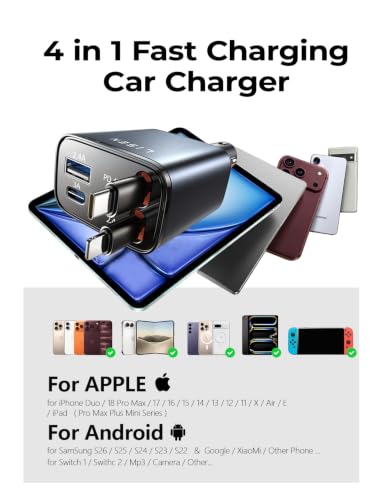
The best car chargers USB-C deliver safe, fast power for phones, tablets, laptops, and more on every drive.
You leave home with a low phone battery, then traffic slows you down. A weak car adapter may take hours to help, while a poor fit can fall out of the socket. I tested the key features that matter most, including USB-C Power Delivery, port layout, heat control, size, and real-world ease of use. These best car chargers USB-C picks cover daily commutes, family trips, road work, and emergency charging without making your console feel crowded.
Anker 167.5W 3-Port USB-C Car Charger

Anker’s 167.5W car charger is made for drivers who carry more than one device. Its three-port design can power several phones, tablets, or other USB devices during the same trip. The compact body keeps the adapter from taking over the center console. I also like how its high total output gives it room for busy family travel.
This model is a strong fit for modern USB-C users who want one charger instead of a pile of small adapters. The exact charging speed depends on the port, cable, device, and vehicle power system, so I would check the manual before expecting laptop-level charging. Still, the large power budget makes it one of the most capable best car chargers USB-C options here. Its small shape also helps reduce clutter around the 12-volt socket.
Pros:
- High 167.5W total power rating
- Three ports support several devices
- Compact body fits neatly in most consoles
- Useful for families and passengers
- Strong choice for phones, tablets, and USB-C gear
- Reduces the need for multiple car adapters
Cons:
- High output may cost more than a basic phone charger
- Actual speed varies by port and device
- Some older cars may not support the full power level
My Recommendation
I recommend this Anker charger for drivers who often charge three devices at once. It suits families, rideshare drivers, road trippers, and people who carry a tablet beside a phone. It is also a smart pick when you want a compact build with plenty of power overhead. For many users, it offers excellent value and should remain easy to find through Amazon.
67W 3-Port USB-C Charger for Samsung

This 67W three-port charger targets Samsung users who want quick power in the car. It combines USB-C ports with a layout that can serve more than one passenger. The power rating is high enough for fast phone charging when the phone and cable support the needed standard. Its broad device focus also makes it useful beyond one Samsung model.
I would choose this adapter for a mixed household with Galaxy phones, earbuds, tablets, and older USB devices. Samsung’s fastest charging modes can depend on the phone, charger protocol, cable quality, and temperature. That means the charger can provide strong performance, but it cannot force a device to accept power faster than the device allows. In my view, it is among the best car chargers USB-C for Samsung-focused households that still need flexible ports.
Pros:
- 67W power rating for quick charging
- Three ports help serve multiple passengers
- Well suited to Samsung Galaxy users
- Useful for newer and older USB devices
- Good choice for family cars
- Offers more flexibility than a single-port adapter
Cons:
- Fastest Samsung mode may need a compatible cable
- Power divides when several devices charge together
- Large output is unnecessary for users with one phone
My Recommendation
This model is best for Samsung owners who want one small charger for the whole car. It fits families with several Galaxy devices and commuters who carry a phone plus accessories. I also like it for mixed devices because three ports make sharing easy. It offers good everyday value if your devices support USB-C fast charging and you use suitable cables.
LISEN 90W USB-C Car Charger with 45W PD
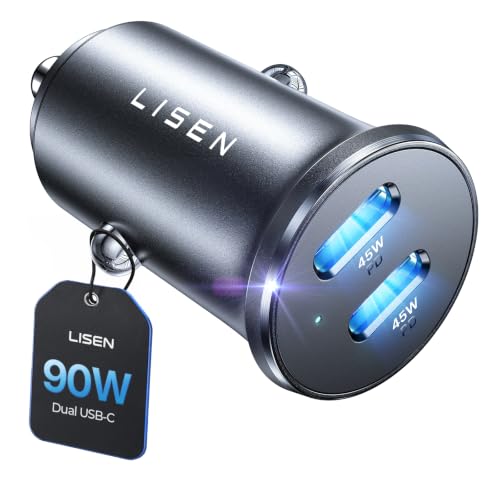
The LISEN 90W charger offers a useful blend of USB-C Power Delivery and Quick Charge support. Its 45W PD output can suit many phones, tablets, handheld game systems, and smaller USB-C devices. A second charging option adds flexibility when a passenger uses a different cable. The design is practical for daily use and does not demand much space.
Power Delivery works through an agreed exchange between the charger and device. The device asks for a safe power level, then the charger supplies an available level that both support. This is why a 45W port does not make every phone charge at 45W. Among the best car chargers USB-C, this LISEN model stands out for users who want useful power without moving to a very large multi-port unit.
Pros:
- Supports USB-C PD and QC3.0 devices
- 45W PD output suits many modern devices
- 90W total rating gives useful headroom
- Good for phones, tablets, and game systems
- Flexible port setup for passengers
- Compact enough for regular commuting
Cons:
- Actual output depends on device compatibility
- Power may split between ports
- Some cables may limit charging speed
My Recommendation
I recommend the LISEN 90W charger for people who want a balanced USB-C setup. It is best for a phone owner who sometimes charges a tablet, gaming device, or passenger’s phone. The combination of PD and QC support gives it broad appeal. It is a sensible value pick among the best car chargers USB-C, especially when one port needs more power than a basic adapter can provide.
LISEN 90W USB-C Charger for iPhone

This LISEN 90W car charger is aimed at iPhone users who want fast USB-C charging on the road. It gives you a higher-power option for newer iPhones and can also serve another device. The simple car adapter shape keeps installation easy. You plug it into the 12-volt outlet, connect a suitable USB-C cable, and let the phone manage the charging process.
For iPhone owners, the cable matters as much as the adapter. A compatible USB-C cable helps the phone reach its best supported charging rate. The charger may also work well with iPads, AirPods cases, Android phones, and other USB-C products. I see this as one of the best car chargers USB-C for Apple-focused drivers who want extra power for long navigation sessions, video use, or travel.
Pros:
- 90W total power rating
- Strong fit for newer USB-C iPhones
- Can charge a second device
- Useful during navigation and long trips
- Simple plug-and-use design
- Works with more than Apple devices
Cons:
- Requires a suitable USB-C cable for best results
- High total rating may exceed one iPhone’s needs
- Output can change when two devices share power
My Recommendation
This LISEN model is best for iPhone users who want a fast USB-C car charger with room for another device. It works well for commuters, delivery drivers, and travelers who use navigation for hours. I would pair it with a quality cable from a trusted brand. It gives good value when you want more power than a small single-port iPhone adapter.
Anker 30W 2-Port USB-C iPhone Charger

Anker’s 30W two-port charger is a practical choice for normal phone charging. It uses USB-C alongside another port, so you can charge a newer phone and a second device in the same car. The 30W class fits most daily phone needs without paying for extreme output. Its small size also makes it easy to leave plugged in.
I like this type of charger for drivers who value simplicity over maximum wattage. A phone that supports fast charging can gain useful battery power during a short commute, while a second device can charge at the same time. The final speed still depends on the connected device and cable. For ordinary phone use, this is one of the best car chargers USB-C because it avoids unnecessary bulk and cost.
Pros:
- Compact and easy to keep in the car
- Two ports support two devices
- 30W output fits many phone charging needs
- Good choice for iPhone commuters
- Anker brand offers a familiar support network
- Uses less space than high-output multi-port models
Cons:
- Not designed for high-power laptops
- Lower total output than premium multi-port chargers
- Charging speed may drop with two devices connected
My Recommendation
I recommend this Anker model for one or two phone users who want a clean, compact setup. It is best for daily commuting, school runs, and short trips. Choose it when you do not need to power a laptop or several tablets. Its simple design and sensible output make it a strong value option among the best car chargers USB-C.
67W Dual USB-C and USB-A Car Charger

This 67W car charger solves a common problem: one passenger has USB-C, while another still uses USB-A. It includes two USB-C ports and one USB-A port, giving the car a useful mix of connections. The total output suits phones, tablets, earbuds, and other travel devices. It is a good bridge between older accessories and newer gear.
I find mixed-port chargers especially useful in family cars. You can connect a modern iPhone or Android phone without forcing an older cable into a new port. As with all multi-port chargers, the power share changes when several devices connect. Still, this is one of the best car chargers USB-C for households that have not fully moved away from USB-A.
Pros:
- Two USB-C ports and one USB-A port
- 67W total output for flexible charging
- Works with new and older cables
- Useful for families and shared vehicles
- Supports several devices at once
- Helps reduce cable and adapter swapping
Cons:
- Power divides across connected ports
- USB-A cannot provide the same USB-C features
- Full speed requires compatible cables and devices
My Recommendation
This charger is best for families, carpools, and drivers with mixed cable types. It gives you the freedom to connect newer USB-C devices and older accessories together. I would pick it over a two-port model when several passengers share one socket. It offers strong everyday value and broad usefulness without the size of a very high-power charger.
LISEN 69W USB-C Car Charger Two-Pack
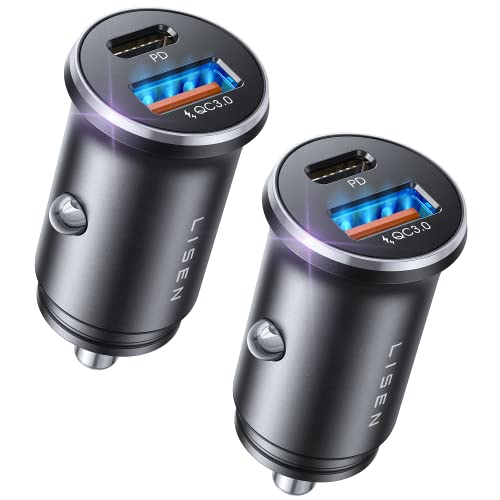
The LISEN 69W two-pack gives you two car chargers for two vehicles or two sockets. That simple benefit can save time in a household with more than one driver. Each adapter can serve a phone, GPS unit, earbuds, or another USB device. The small format also works well in a spare car, work truck, or travel bag.
A two-pack makes sense when you want charging ready at all times. You can keep one adapter in your main car and place the other in a partner’s vehicle or emergency kit. The 69W rating offers more room than a basic low-power adapter, but I would still confirm the port layout and device support before buying. This is one of the best car chargers USB-C for people who value coverage and backup more than a single giant output number.
Pros:
- Two chargers cover two vehicles
- 69W rating offers useful charging power
- Good backup for travel and emergencies
- Compact design fits most 12-volt outlets
- Useful for phones and small USB-C devices
- Good value for households with multiple cars
Cons:
- Two-pack may be unnecessary for one vehicle
- One adapter does not equal 138W in one socket
- Device and cable limits still affect actual speed
My Recommendation
I recommend this two-pack for couples, families, and people who keep a backup vehicle. It is also useful for drivers who travel often and want one charger in a luggage pouch. Choose it when convenience matters more than having three ports in one adapter. It gives practical value because the second unit is ready when the first one is not nearby.
130W 3-Port USB-C Charger with Voltage Display

This 130W charger adds a feature many basic adapters lack: a voltage display. The screen can help you see the vehicle’s electrical voltage at a glance. It also offers three ports for passengers and devices. The high total rating makes it suitable for busy trips with several phones, tablets, or compatible USB-C equipment.
The voltage reading should be treated as a quick reference, not a replacement for professional vehicle testing. Readings can change with the engine state and the car’s electrical system. I appreciate the display because it adds useful awareness without needing another tool. If you want one of the best car chargers USB-C with extra information on the socket, this model deserves attention.
Pros:
- High 130W total power rating
- Three ports support several devices
- Voltage display adds useful information
- Good fit for long trips and family use
- Can help monitor basic socket voltage trends
- Useful for drivers who prefer extra visibility
Cons:
- Voltage display is not a diagnostic instrument
- Actual power depends on the vehicle and devices
- May be more feature-rich than casual users need
My Recommendation
This charger is best for road trippers, families, and drivers who like to watch vehicle voltage. It suits people who regularly use several devices and want a quick view of the socket’s electrical state. I would choose it when three ports matter as much as fast charging. It offers useful value, but buyers should use the display as a guide rather than a full car test.
200W Dual 100W USB-C Car Charger

This 200W model is the power-focused choice in the group. Its dual USB-C design aims to deliver up to 100W per port when the vehicle, charger, cables, and devices support those levels. That makes it attractive for users who charge a laptop, tablet, or other high-demand USB-C device in the car. It can also power two demanding devices more comfortably than a basic phone adapter.
High wattage does not guarantee high charging speed in every vehicle. Many cars limit the 12-volt socket, and some laptops need a particular USB-C PD profile. I would check both the vehicle manual and device charger requirements before using this as a laptop solution. For the right setup, it is one of the best car chargers USB-C for mobile workers and creators who need serious power away from a wall outlet.
Pros:
- Up to 200W total power rating
- Two USB-C ports support high-demand devices
- Useful for compatible laptops and tablets
- Better power sharing than low-output adapters
- Strong choice for mobile work
- Can serve two power-hungry devices
Cons:
- Many vehicles cannot provide the full rated output
- Requires suitable high-wattage USB-C cables
- More power than most phone users need
- May cost more than a simple car adapter
My Recommendation
I recommend this charger for mobile professionals, photographers, students, and travelers who carry USB-C laptops or tablets. It is best when your vehicle socket can support the needed power and your devices accept USB-C PD. For phone-only charging, it is likely more than necessary. For serious road work, though, it offers some of the most useful power among the best car chargers USB-C.
LISEN 90W USB-C Fast Car Charger
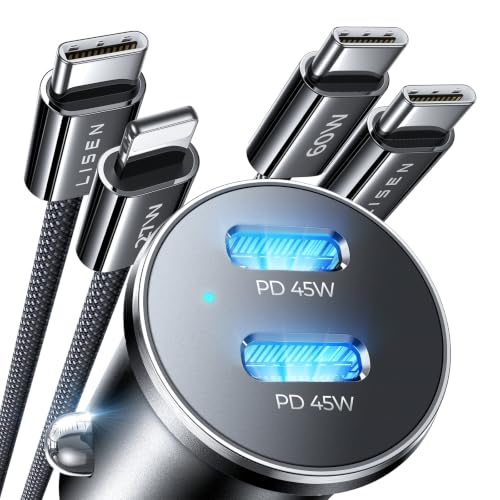
This LISEN 90W car charger is a flexible option for drivers who want fast USB-C charging without choosing a huge 200W unit. It can serve newer iPhones, Android phones, tablets, and other USB-C accessories. The higher power rating gives useful room for navigation, streaming, and long work trips. Its design also keeps the setup simple for everyday drivers.
I see this as a middle-ground product. It gives more ability than a basic 20W or 30W adapter, but it does not focus only on extreme laptop power. Charging performance depends on the connected device, cable, port, and vehicle socket. For many people, this balance makes it one of the best car chargers USB-C for daily use, travel, and shared passenger charging.
Pros:
- 90W rating offers strong overall capacity
- Useful for iPhone and Android devices
- Can handle phones and tablets with ease
- Good middle ground between basic and extreme chargers
- Supports long navigation and travel sessions
- Simple design works well for daily use
Cons:
- Full 90W output may not suit every vehicle
- Fast charging requires compatible cables
- Power distribution can change with multiple devices
My Recommendation
This charger is best for drivers who want one capable adapter for many kinds of devices. It suits commuters, travelers, and families who need more than basic phone charging. I would choose it when you want a strong middle option without paying for a dual-100W charger. It provides good overall value and broad compatibility when matched with the right cables.
Best Features at a Glance
| Best for | Why |
|---|---|
| Multiple devices and families | Three-port chargers make it easier to power phones, tablets, and accessories together. |
| USB-C laptops and mobile work | High-output models offer more room for compatible laptops and demanding USB-C gear. |
| Simple daily phone charging | Compact 30W and 69W options provide useful power without extra bulk or cost. |
How I Chose the Best Car Chargers USB-C
I looked beyond the largest wattage number. A charger must match the car, device, cable, and driving need. I focused on port type, USB-C Power Delivery support, total output, size, ease of use, and the way power may change when several ports are active.
Safety also matters. A quality car charger should include basic protection against issues such as overcurrent, overvoltage, overheating, and short circuits. Buyers should still use an undamaged cable and keep the adapter clear of liquids and extreme heat. No charger can make an unsafe socket safe.
I also considered daily comfort. A charger that sticks out too far may get bumped by a knee or block nearby controls. A tiny model may be perfect for one phone but poor for a family. The best car chargers USB-C should fit the way you drive, not just look impressive on a product page.
USB-C Car Charger Buying Guide
Check the port and power rating
USB-C describes the connector shape, not one fixed charging speed. A USB-C port may support basic power, USB Power Delivery, or another charging mode. Read the product details and compare them with your phone or tablet requirements. If you need a laptop charger, look for a stated PD output that meets the laptop’s needs.
Understand total watts versus single-port watts
A charger may list 90W, 130W, or 200W as its total output. That number may cover every port combined. The most important figure is often the output of the port you plan to use. If two devices connect, the charger may divide power between them. I always check the port-by-port chart before buying.
Use a cable that can handle the power
A weak or damaged cable can slow charging and create heat. For higher USB-C outputs, use a cable rated for the intended wattage. Some cables also need electronic markers for higher power levels. A premium adapter paired with a poor cable is like putting a wide road behind a narrow gate.
Consider your vehicle’s socket
Most car chargers use a 12-volt accessory socket, but the socket’s fuse and limits vary by vehicle. Some sockets stay on after the engine stops. That can drain the battery if a device remains connected for a long time. Review the owner’s manual and unplug the charger if your vehicle maker recommends it.
Think about heat
Fast charging creates heat, and a hot dashboard can add more. Keep the adapter away from direct sun when possible. Do not cover it with clothing or place it near water. If the charger, cable, or phone becomes unusually hot, disconnect it and inspect the setup.
Pick the right number of ports
One port keeps the design small. Two ports work well for a driver and passenger. Three ports help families and road trips. More ports do not always mean more speed, because the power must be shared. Choose the layout that matches your real use.
Do you need a voltage display?
A display can show a quick voltage reading while the car is running. It may help you notice broad changes, but it cannot replace a multimeter or mechanic’s test. If you enjoy monitoring the car, it is a helpful extra. If you want a silent, clean console, a display may add little value.
USB-C PD, QC, and Fast Charging Explained
USB Power Delivery, often called USB-C PD, lets a charger and device agree on a power level. The device does not simply receive the maximum number printed on the adapter. It requests a supported level, and the charger responds within its limits. This design helps different products share one charging standard.
Quick Charge is another charging system used by some devices. Certain chargers support both PD and QC, which can improve compatibility across a mixed group of phones. Still, the phone maker, cable, charger, and software all affect the final result. A “fast” label should be treated as a starting point, not a promise of one fixed time.
Battery level also changes charging speed. A phone often charges quickly when the battery is low, then slows as it gets close to full. Heat can reduce speed as well. That behavior protects the battery and is normal, even with the best car chargers USB-C.
Tips for Safe Car Charging
- Use a charger and cable with clear specifications.
- Keep the phone out of direct hot sunlight while charging.
- Do not use cracked cables or loose adapters.
- Unplug the charger if it becomes unusually hot.
- Check that the adapter fits firmly in the socket.
- Do not overload a socket with an unsafe splitter.
- Keep charging devices away from water and spills.
- Follow the vehicle maker’s socket limits.
- Do not leave high-power devices connected when the car is off unless appropriate.
Which Type of Buyer Should Choose Each Charger?
Choose the Anker 167.5W model if you want high total output and three ports in a compact body. It is the broadest fit for busy households. Choose the 67W Samsung-focused charger if your car carries several Galaxy devices and you want flexible charging. Choose the LISEN 90W PD and QC model if you want a balanced adapter for mixed devices.
The Anker 30W charger makes more sense for one or two phones. The three-port 67W mixed charger is better for older USB-A cables. The LISEN two-pack is ideal for two vehicles. The 130W model adds a voltage display, while the 200W model targets high-demand laptop and tablet users.
Finally, the LISEN 90W general model sits between basic and extreme choices. It is a good fit when you want extra power for travel but do not need the highest possible output. Matching the charger to your routine saves money and avoids unused features.
FAQs Of best car chargers usb-c
What is the best wattage for a USB-C car charger?
For most phones, 30W to 45W is enough. A 60W to 100W model suits tablets and some laptops. Higher ratings help only when the vehicle, cable, charger port, and device support that power.
Can a USB-C car charger fast charge an iPhone?
Yes, if the charger supports the iPhone’s charging standard and you use a suitable USB-C cable. The iPhone controls the power it accepts, so a higher-watt charger does not force unsafe charging.
Can I charge a laptop with a car charger?
Some laptops can charge from a USB-C PD car charger. Check the laptop’s required wattage and the vehicle socket limit first. The 200W dual USB-C model is better suited to this task than a small phone adapter.
Does more wattage mean faster charging?
Not always. The device, cable, port, temperature, and battery level all affect speed. A high-watt charger gives more capacity, but the device accepts only the level it supports.
Is it safe to leave a car charger plugged in?
It depends on the vehicle. Some sockets turn off with the ignition, while others stay active. Check the owner’s manual and unplug the adapter if it remains powered and may drain the battery.
Final Verdict: Which Should You Buy?
The Anker 167.5W three-port charger is my top overall choice for power, ports, and compact size. For laptops, choose the 200W model. For simple phone use, the Anker 30W is enough.
The best car chargers USB-C match your devices, cables, and vehicle. Pick the output you need, use safe cables, and enjoy easier charging on every trip.