The best car chargers deliver fast, safe power without cluttering your vehicle’s cabin.
A dead phone can turn a simple drive into a stressful trip, especially when you rely on GPS, calls, music, or roadside apps. I tested the key features that matter most in modern car chargers, including USB-C Power Delivery, port count, cable design, heat control, and fit. The models below suit different needs, from one phone to several devices or even a laptop. I also checked their real-world strengths and limits so you can choose with confidence.
LISEN 84W Retractable Car Charger

The LISEN retractable car charger is made for drivers who dislike loose cords across the center console. Its built-in cable pulls out when needed and retracts when the trip ends. The 84-watt rating gives this charger enough headroom for phones, tablets, and some smaller USB-C devices. Its dual-cable setup also helps when passengers use different charging ports.
I like the clean design for daily commuting because there is less cable to wind and store. The retractable system can make a busy cabin feel calmer, much like putting a hose back on its reel after use. Still, the total output depends on the device, cable, and vehicle power socket. Check your phone’s charging standard before expecting the highest speed.
Pros:
- Retractable design helps reduce cable clutter
- High 84-watt rating for several device types
- Dual-cable layout supports mixed devices
- Convenient for family trips and shared vehicles
- Compact form keeps the front cabin more tidy
Cons:
- Retractable cables may not suit every mounting position
- Maximum speed depends on the connected device
- Built-in cables cannot be replaced like separate cables
My Recommendation
This LISEN model is best for drivers who want one neat charger for personal use and passenger use. It makes sense for commuters, rideshare drivers, and families that carry both USB-C and older devices. Among the best car chargers, it stands out for cable control and easy storage. It offers strong value when a tidy dashboard matters as much as charging speed.
130W 3-Port USB-C Car Charger

This 130-watt charger targets Samsung users and other devices that support fast USB-C charging. It has three ports, so a driver can power a phone, tablet, earbuds, or another accessory at the same time. The built-in voltage display adds a useful glance check for the vehicle’s electrical system. That feature can be helpful on long drives or in older vehicles.
The main appeal is flexibility. You can use one high-power port for a fast phone charge while the other ports handle lighter loads. Keep in mind that the 130-watt figure is a maximum total rating, not a promise that every port supplies 130 watts at once. Actual results vary with the vehicle socket, cable quality, charging protocol, and number of devices connected.
Pros:
- Three ports support several devices at once
- High total power suits demanding USB-C devices
- Voltage display adds useful vehicle information
- Good match for Samsung fast-charge users
- Helpful choice for road trips and shared cars
Cons:
- Voltage readings may not replace a professional electrical test
- Output is shared when multiple ports are in use
- May be more charger than a single-phone user needs
My Recommendation
I recommend this charger for Samsung owners, families, and drivers who often charge three devices together. The display makes it more informative than a basic adapter, while the three-port layout adds useful room for passengers. It belongs on a shortlist of the best car chargers for multi-device travel. Buyers should use certified cables and confirm their phone supports the advertised fast-charge mode.
USB-C 4-Port 90W Car Charger

This four-port USB-C car charger is built for a full vehicle. It can serve a driver, front passenger, and rear passengers without forcing anyone to take turns. Its 90-watt total rating gives it more power than a simple phone adapter. The compact cigarette-lighter format also leaves more room than a bulky power inverter.
I see this as a practical family-trip charger rather than a specialist laptop power station. Four ports are useful when several people need maps, games, or video during a long ride. As with any multi-port charger, available power is divided among connected devices. For best results, place the most demanding device on the highest-output port and use strong USB-C cables.
Pros:
- Four ports serve a busy car with fewer arguments
- 90-watt total output handles several common devices
- USB-C layout fits newer phones and tablets
- Useful for families and group travel
- Reduces the need for extra adapters
Cons:
- Power is shared across all active ports
- Four connected cables can still create cabin clutter
- Not every port may provide the same charging speed
My Recommendation
This is one of the best car chargers for large families, carpools, and road-trip groups. I would choose it when four people may need power at the same time. It is less compelling for a solo driver who only charges one phone, but its flexible port count can prevent future upgrades. Its value is strongest when several devices matter more than the smallest possible size.
SUPERONE 99W Retractable Car Charger

The SUPERONE retractable car charger focuses on high output and simple cable storage. Its 99-watt rating gives it plenty of capacity for phones, tablets, and compatible USB-C gear. Dual built-in cables make it convenient for two devices or two people. The retractable body keeps the cords from falling into the footwell when you park.
This design works well for drivers who want speed without carrying a cable pouch. I would still check the connector type before ordering, since built-in cable ends limit what you can plug in. The top power figure applies under suitable conditions and may be shared between devices. Good airflow and a firm vehicle socket can also help maintain steady performance.
Pros:
- 99-watt maximum rating offers useful power headroom
- Retractable cables keep the cabin organized
- Dual cables help charge two devices
- Good fit for commuters and frequent travelers
- Less loose cable to snag on the console
Cons:
- Built-in cables limit connector choices
- Maximum output may be shared between cables
- Retracting parts need careful handling over time
My Recommendation
The SUPERONE is best for people who value both fast charging and a clean cabin. It suits rideshare drivers, sales workers, and commuters who spend many hours in a vehicle. Among the best car chargers, its strongest feature is the balance between high rated power and built-in cable storage. It is a smart buy if its cable ends match the devices you carry every day.
Anker 75W Retractable USB-C Charger

Anker’s 75-watt retractable USB-C car charger offers a neat solution for drivers who want fewer accessories. The built-in cable is ready to use, so you do not need to remember a separate cord. Its power rating is suitable for many phones and smaller personal devices. The compact design should also work well in vehicles where the 12-volt outlet sits near the gear area.
Anker has a strong reputation for charging accessories, but the connected device still controls the final charging rate. A phone that accepts only a modest input will not charge at 75 watts simply because the adapter can provide it. I like the single-cable approach for solo drivers who prefer less bulk. Buyers with several passengers may want a model with more ports.
Pros:
- Built-in retractable cable improves convenience
- 75-watt rating fits many daily charging needs
- Compact design works well in small cabins
- Recognized Anker accessory brand
- Good choice for drivers who carry one main device
Cons:
- Single built-in cable may not suit passengers
- Not the best option for four-device charging
- Device and cable limits still affect actual speed
My Recommendation
I would pick this Anker model for a solo driver who wants a clean, dependable setup. It is especially useful for daily commutes, rental cars, and work vehicles where loose cables become annoying. It may not be the most powerful option here, but it is one of the best car chargers for simple, low-clutter use. Its value comes from trusted design and ease of use rather than a large port count.
67W 3-Port USB-C Charger for Samsung

This 67-watt three-port charger is aimed at Samsung Galaxy users, including newer S-series phones listed by the maker. It gives you three USB-C connections in a small vehicle adapter. That makes it useful for charging a phone, earbuds, and a tablet during the same drive. The layout also gives a passenger access without adding a second car adapter.
The lower total rating compared with 90W or 130W models is not a weakness for ordinary phone use. Most drivers mainly need enough power to maintain navigation and refill a battery during a trip. The key is to use a cable and phone that support the desired fast-charge mode. When all three ports are active, expect power to be divided rather than delivered at the maximum to each port.
Pros:
- Three USB-C ports support shared charging
- Good fit for Samsung Galaxy owners
- 67 watts is ample for many phones and tablets
- Compact alternative to carrying several adapters
- Useful for front and rear passengers
Cons:
- Fast charging depends on Samsung and cable compatibility
- Power output is shared among connected devices
- Less suitable for high-demand laptop charging
My Recommendation
This charger is best for Samsung households and drivers who need three USB-C ports without extreme power. I like it for couples, small families, and people who carry several compact devices. It earns a place among the best car chargers for practical Galaxy-focused charging. Choose a higher-output model if you plan to power a laptop or other demanding equipment.
200W Dual 100W USB-C Car Charger

This dual USB-C charger is the high-power choice in the group. Its headline rating reaches 200 watts, with two USB-C ports rated up to 100 watts each under suitable conditions. That makes it attractive for drivers who want to charge two demanding devices, such as a laptop and a phone. It can also provide plenty of headroom for tablets and handheld game systems.
High numbers need careful context. The vehicle’s 12-volt system, fuse rating, cable, device protocol, and port-sharing rules all affect real output. I would not assume every car can safely provide the full advertised load without checking the owner’s manual. This model makes the most sense for work travel and mobile offices, not for someone who only needs to top up a phone.
Pros:
- Very high total power rating
- Two USB-C ports can suit demanding devices
- Useful for laptops, tablets, and phones together
- Good option for mobile work and long travel
- Leaves room for future high-power devices
Cons:
- Full output may exceed some vehicle socket limits
- Requires suitable cables and compatible devices
- Overkill for basic phone charging
My Recommendation
I recommend this charger for mobile professionals, remote workers, and drivers who carry a USB-C laptop. It is one of the best car chargers for high-demand gear, but it needs a careful setup. Check your vehicle manual and use quality cables before pushing high loads. For ordinary phone use, a smaller model will cost less and take up less space.
LISEN Retractable USB-C Charger for iPhone
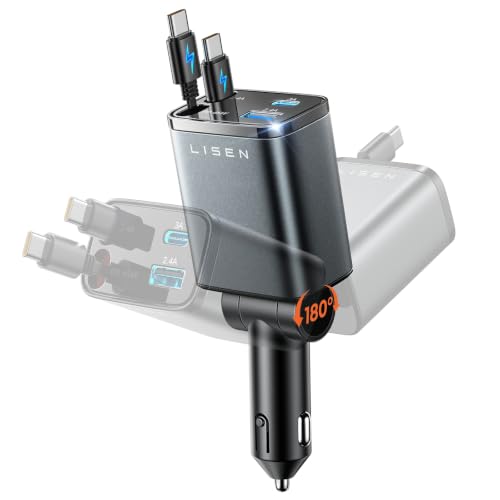
This LISEN retractable charger is designed around USB-C fast charging for newer iPhone models and other compatible devices. Its built-in cable removes the need to keep a separate cord in the glove box. The retractable format is handy for navigation because the cable can reach the phone without hanging across the console. It also stores neatly after you unplug.
I see this as a clean choice for Apple-focused drivers who want a simple setup. A USB-C connector does not automatically guarantee the same result on every iPhone, so confirm the phone model and charging requirement before buying. The adapter can also work with other compatible USB-C gear, but its main appeal is daily phone use. Treat the cable gently and avoid sharp bends near the retracting housing.
Pros:
- Built-in cable is convenient for newer iPhone users
- Retractable design helps prevent loose cords
- Useful for navigation and daily commuting
- Simple setup suits Apple-focused households
- Compact storage keeps the glove box less crowded
Cons:
- Connector compatibility needs checking before purchase
- Built-in cable is not easily swapped
- Less flexible for cars with several passengers
My Recommendation
This is best for iPhone owners who want a tidy, ready-to-use USB-C cable in the car. It suits commuters, parents, and anyone who dislikes searching for a charging cord. Among the best car chargers, this model focuses on convenience instead of a large port count. It offers good value when one main phone is the center of your charging routine.
Anker 40W 2-Port PowerIQ Charger

The Anker 40W PowerIQ 3.0 charger is a straightforward two-port option for everyday drivers. Its 40-watt total output is enough for many phones, earbuds, and smaller accessories. Two ports let a driver and passenger charge together without using a splitter. The small adapter is also easy to move between cars.
This charger does not chase the biggest number, and that can be a benefit. Lower power often matches the needs of people who only charge phones during short trips. PowerIQ technology is designed to help compatible devices receive an appropriate charge, but it does not turn an unsupported phone into a high-speed device. I would choose this model when brand trust and simple use matter more than laptop charging.
Pros:
- Two ports cover basic driver and passenger use
- 40 watts suits many phones and accessories
- Compact design fits most vehicle interiors
- Anker brand offers familiar accessory support
- Good value for simple daily charging
Cons:
- Lower output than newer high-power models
- Not intended for serious laptop charging
- Actual speed still depends on the connected device
My Recommendation
I recommend this Anker charger for couples, commuters, and anyone who wants a small two-port adapter. It is one of the best car chargers for basic phone charging because it avoids unnecessary bulk and power claims. It may not satisfy a mobile worker with a laptop, but it handles the normal needs of many drivers. Its compact size and simple design support long-term everyday use.
Anker 167.5W 3-Port Car Charger

Anker’s 167.5-watt charger is built for drivers who need several high-speed charging options in a small adapter. It provides three ports and a high maximum output, making it suitable for a phone, tablet, and compatible laptop or accessory. The ultra-compact design helps keep that power from taking over the center console. It is a strong fit for modern vehicles filled with USB-C devices.
The high rating gives you flexibility, but it does not remove the limits of the car’s electrical system. Check the vehicle socket specification, especially before connecting multiple high-power devices. A good USB-C cable also matters because cable quality and power rating can affect performance. I like this option for work travel because it offers more headroom than a basic phone charger without needing an inverter.
Pros:
- 167.5-watt maximum rating supports demanding gear
- Three ports allow flexible device charging
- Ultra-compact body saves valuable console space
- Strong choice for phones, tablets, and laptops
- Useful for frequent business and road travel
Cons:
- Full output depends on vehicle and device limits
- Premium power may cost more than a basic adapter
- Requires high-quality USB-C cables for best results
My Recommendation
This Anker model is best for professionals and families with several demanding devices. It is among the best car chargers for drivers who want high output in a compact body. I would choose it for long trips, work commutes, and vehicles with several USB-C users. If you only charge one phone, its extra capacity may be unnecessary, but its flexibility gives strong long-term value.
How to Choose the Best Car Chargers
Choosing a car charger is not just about finding the largest watt number. A good match depends on your phone, vehicle, cable, travel habits, and number of passengers. I start with the device because the device sets the real charging limit. A charger can offer 200 watts, but a phone that accepts 25 watts will still charge near its own limit.
Check the charging port type
USB-C is now common on newer phones, tablets, headphones, and laptops. USB-A still appears on older cables and accessories. If your devices use different connectors, choose a charger with the right mix of ports or carry a reliable cable. A USB-C port alone does not prove that the charger supports every fast-charge standard.
Understand watts, volts, and amps
Watts describe power. In simple terms, watts equal volts multiplied by amps. A higher watt rating can support faster charging, but only when the charger, cable, device, and car socket work together. Many product listings show the highest possible total output, so read how that power is shared across ports.
For a single phone, a modest 20W to 40W charger may be enough. For several phones and tablets, 60W to 100W gives more room. Laptop users should look for a USB-C Power Delivery port with suitable output. The 200W model in this guide is powerful, but not every vehicle socket can safely provide its full rating.
Look for USB-C Power Delivery
USB-C Power Delivery, often called USB PD, helps compatible chargers and devices agree on a safe power level. It is common in modern phones, tablets, handheld consoles, and laptops. A charger that supports PD can be a better choice for newer devices than an old low-power adapter.
Still, do not confuse a USB-C shape with USB-C PD. The product specifications should clearly list the charging protocol and output. Use a cable rated for the power you want. A weak or damaged cable can slow charging and create heat.
Count the ports you really need
One port keeps things simple. Two ports work well for a driver and passenger. Three or four ports make more sense for families, carpools, and road trips. More ports can also mean more shared power, so check the output table before buying.
I suggest planning for your normal trip, not the rare maximum case. If one person drives alone most days, a compact two-port charger may be the most comfortable choice. If children use tablets in the back seat, four ports can save time and frustration.
Consider built-in and retractable cables
Retractable cables solve a real problem: loose cords. They are handy for navigation and easy to store after a trip. They can also limit connector choice and may be harder to replace if damaged. Treat the cable gently, pull it straight, and avoid yanking it from the housing.
Separate cables offer more freedom. You can replace one, choose a longer length, or switch from Lightning to USB-C later. The trade-off is more clutter. The best car chargers use either approach well, but your own habits should decide which design feels better.
Think about heat and safety
Charging creates heat, and a hot dashboard or closed vehicle can make the problem worse. A quality charger should include basic safeguards such as over-current, over-voltage, short-circuit, and temperature protection. These features do not make a product immune to misuse, so keep vents clear and stop using any charger that smells burnt or becomes unusually hot.
Use the vehicle’s 12-volt socket within the limits listed in the owner’s manual. Do not force a loose adapter into the outlet. Remove the charger before servicing the vehicle’s electrical system. Safety agencies and vehicle makers commonly stress the use of compatible, undamaged accessories for this reason.
Do you need a voltage display?
A voltage display can offer a quick view of the car’s electrical system. It may help you notice an unusual reading, but it is not a full diagnostic tool. Readings can vary by outlet location, vehicle design, and whether the engine is running. Use a qualified technician for a real battery or alternator test.
Use reliable cables
The cable is the bridge between the charger and your device. A low-quality cable can create a bottleneck even when the adapter is powerful. For USB-C charging, look for a cable with a stated power rating that matches your needs. Replace cables with split insulation, bent connectors, or loose ends.
Compatibility with Apple and Samsung devices
Apple and Samsung devices may use different fast-charging requirements across models and generations. An iPhone may need a USB-C cable and a compatible PD charger. A Samsung phone may benefit from a charger that supports the required Samsung fast-charge mode. The safest choice is to check the phone maker’s current specification and compare it with the charger listing.
Do not buy only because a product title names your phone. Titles can be broad, and future model names may appear in listings. Confirm the port, protocol, watt level, and included cable. This small check can prevent a disappointing purchase.
What I would avoid
I would avoid chargers with unclear output tables, vague safety claims, or no clear brand information. I would also avoid adapters that fit loosely or block nearby controls. A huge watt figure means little if the product cannot explain how it reaches that number. Clear specifications are a sign that the maker expects informed buyers.
Best Car Chargers Comparison Table
| Best for | Why |
|---|---|
| Solo commuters | Anker 75W or Anker 40W models offer neat, simple charging without excess bulk. |
| Families and passengers | The 90W four-port charger and 130W three-port charger support several devices at once. |
| Laptops and high-power gear | The 200W dual 100W model and Anker 167.5W charger provide the most power headroom. |
FAQs Of best car chargers
What wattage is best for a car charger?
For one phone, 20W to 40W is often enough. Choose 60W or more when charging several devices or a compatible tablet. Laptop users should check the laptop’s required USB-C PD input and the vehicle socket limit.
Are high-watt car chargers safe?
They can be safe when the charger, cable, device, and vehicle socket support the load. Check the owner’s manual and use a reputable charger with protection features. Do not assume the highest product rating works in every car.
Can a car charger drain the battery?
It can draw power when the vehicle is off, depending on how the 12-volt outlet is wired. Most modern outlets switch off with the ignition, but not all do. Unplug accessories when parked for long periods if you are unsure.
Do USB-C car chargers charge faster?
USB-C can support faster charging, especially with USB Power Delivery. Speed still depends on the phone, cable, charger, and charging protocol. The USB-C shape alone does not guarantee fast charging.
How many ports should a car charger have?
One port suits a solo driver. Two ports cover a driver and passenger. Choose three or four ports for families, carpools, or several devices, while checking how the charger shares its total power.
Final Verdict: Which Should You Buy?
For most drivers, the Anker 167.5W 3-port model offers the best balance of power, size, and flexibility. Families may prefer the four-port 90W charger, while laptop users should consider the dual 100W model.
The best car chargers match your devices and vehicle, not just the biggest number. Check ports, protocols, cable ratings, and socket limits before buying for safe, fast travel power.