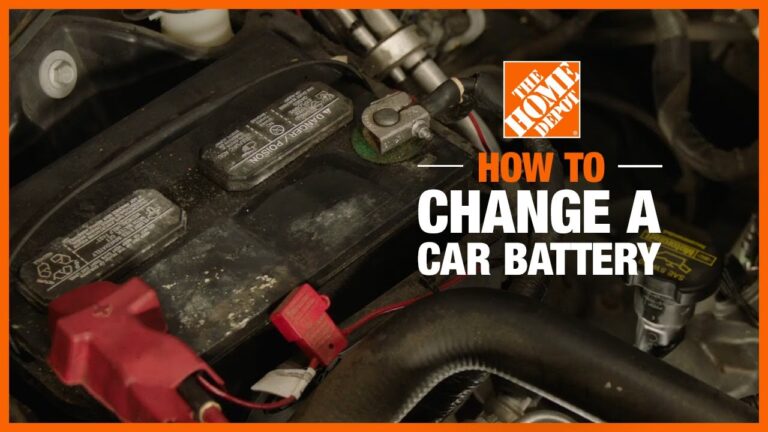
The best way to charge a car battery is with a smart charger set to the battery’s correct type and voltage.
A healthy battery should charge slowly and safely, not be forced back to life with repeated jump-starts. The best way to charge a car battery depends on the battery type, its condition, and the charger you use. This guide explains each step, common mistakes, safety rules, charging times, and signs that the battery may need replacement.
What Is the Best Way to Charge a Car Battery?
The best way to charge a car battery is to use an automatic smart battery charger. A smart charger checks the battery’s voltage and adjusts the current as the charge rises. This helps prevent overcharging, heat, and damage.
Most gasoline and diesel cars use a 12-volt lead-acid battery. Some vehicles use an AGM battery, while newer cars may use lithium auxiliary batteries. Always check the label and the vehicle owner’s manual before choosing a charging mode.
A smart charger is usually better than relying on the alternator. The alternator is designed to maintain a charged battery while driving. It may not fully recharge a deeply discharged battery, especially during short trips.
The best way to charge a car battery usually follows these steps:
- Park the vehicle in a safe, well-ventilated place.
- Turn off the engine, lights, radio, and other electrical devices.
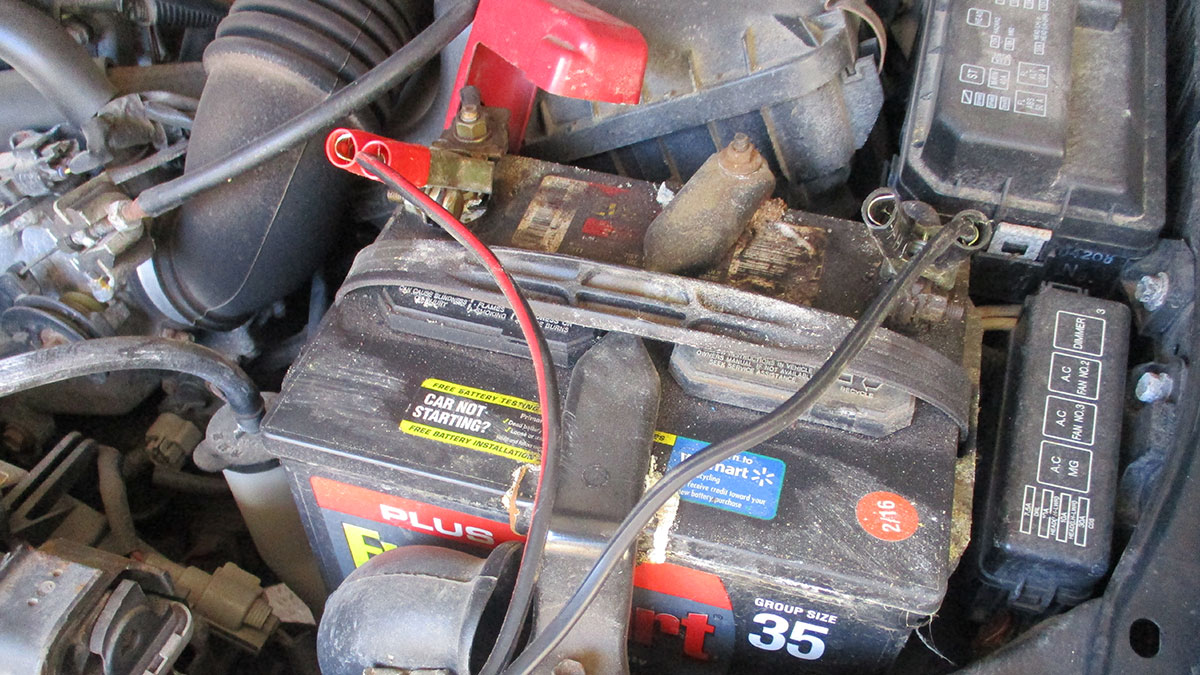
- Inspect the battery for cracks, leaks, swelling, or frost.
- Select the correct charger setting.
- Connect the positive clamp first.
- Connect the negative clamp to the correct ground point.
- Start the charger and allow it to complete its cycle.
- Turn off and unplug the charger before removing the clamps.

How a Car Battery Charger Works
A car battery charger sends electrical current into the battery through a controlled circuit. The battery stores that energy through a chemical reaction between its plates and electrolyte.
A basic charger may keep sending power even after the battery is full. This can cause overheating, water loss, or internal damage if it stays connected too long. A smart charger reduces or stops the current when the battery reaches a safe level.
Most smart chargers use several stages:
• Bulk charging sends a higher current to restore most of the battery’s power.
• Absorption charging lowers the current as the battery nears full capacity.
• Float charging provides a small maintenance current when needed.
• Maintenance mode monitors the battery and prevents unnecessary overcharging.
Think of charging like filling a glass of water. Bulk charging fills the glass quickly, while absorption charging slows down near the top. Float mode keeps the level steady without spilling over.
The best way to charge a car battery is not always the fastest way. A slower charge is often safer, especially for an older battery or one that has been deeply discharged.

What You Need Before Charging
You do not need a large tool kit to charge a car battery. The right charger and a safe work area matter more than expensive equipment.
Prepare these items:
• A smart charger that supports 12-volt batteries
• Safety glasses
• Protective gloves
• A clean, dry work area
• The vehicle owner’s manual
• A voltmeter or multimeter, if available
• A wire brush for light corrosion
Choose a charger with the correct battery setting. Common choices include standard flooded lead-acid, AGM, gel, and lithium. Do not use a lithium charging mode on a regular lead-acid battery.
A charger rated between 4 and 10 amps works well for many passenger cars. A low-amp charger may take longer, but it puts less stress on the battery. High-amperage chargers can be useful in professional settings, but they require more care.
Before using the best way to charge a car battery, check the charger cables. Do not use a charger with cracked insulation, bent plugs, loose clamps, or signs of heat damage.
How to Charge a Car Battery Step by Step
1. Inspect the battery
Look for cracks, leaks, bulges, loose posts, or a strong rotten-egg smell. Do not charge a battery that is damaged, frozen, or badly swollen.
A frozen battery can crack or explode when charging. If temperatures have been very low, let the battery warm naturally before testing it. Never use a flame, heat gun, or hair dryer to thaw it.
2. Position the vehicle safely
Park on a flat surface with good airflow. Open the garage door if you work inside a garage, and keep cigarettes, flames, and sparks away from the battery.
Turn the ignition off and remove the key. Switch off headlights, climate controls, interior lights, and accessories.
3. Set up the charger
Place the charger on a stable surface away from the battery. Select 12 volts and choose the battery type shown on the battery label.
If the battery is installed in the vehicle, use the recommended charging connection in the owner’s manual. Some modern vehicles have special grounding points or battery monitoring sensors.
4. Connect the clamps
For a typical negative-ground vehicle:
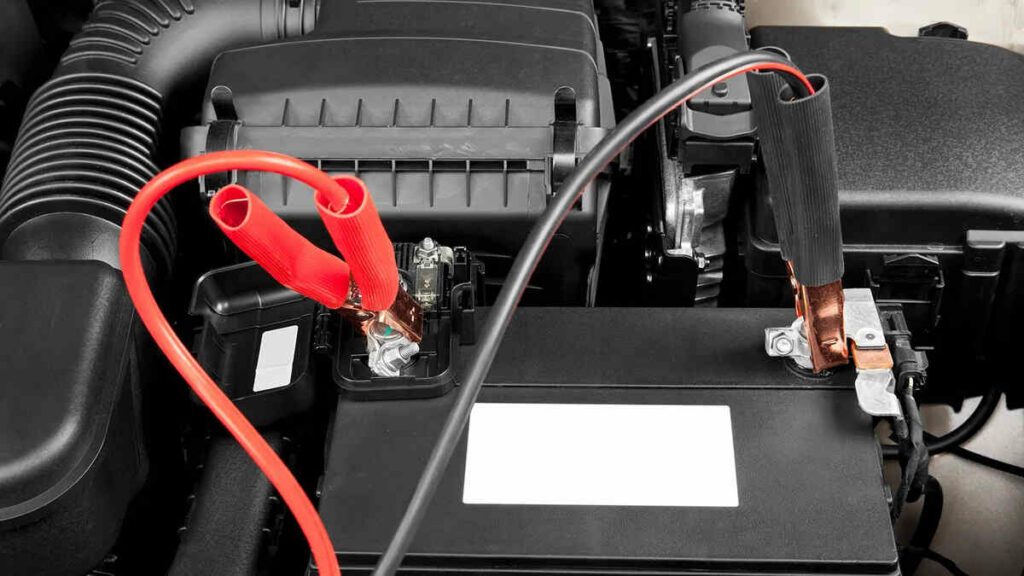
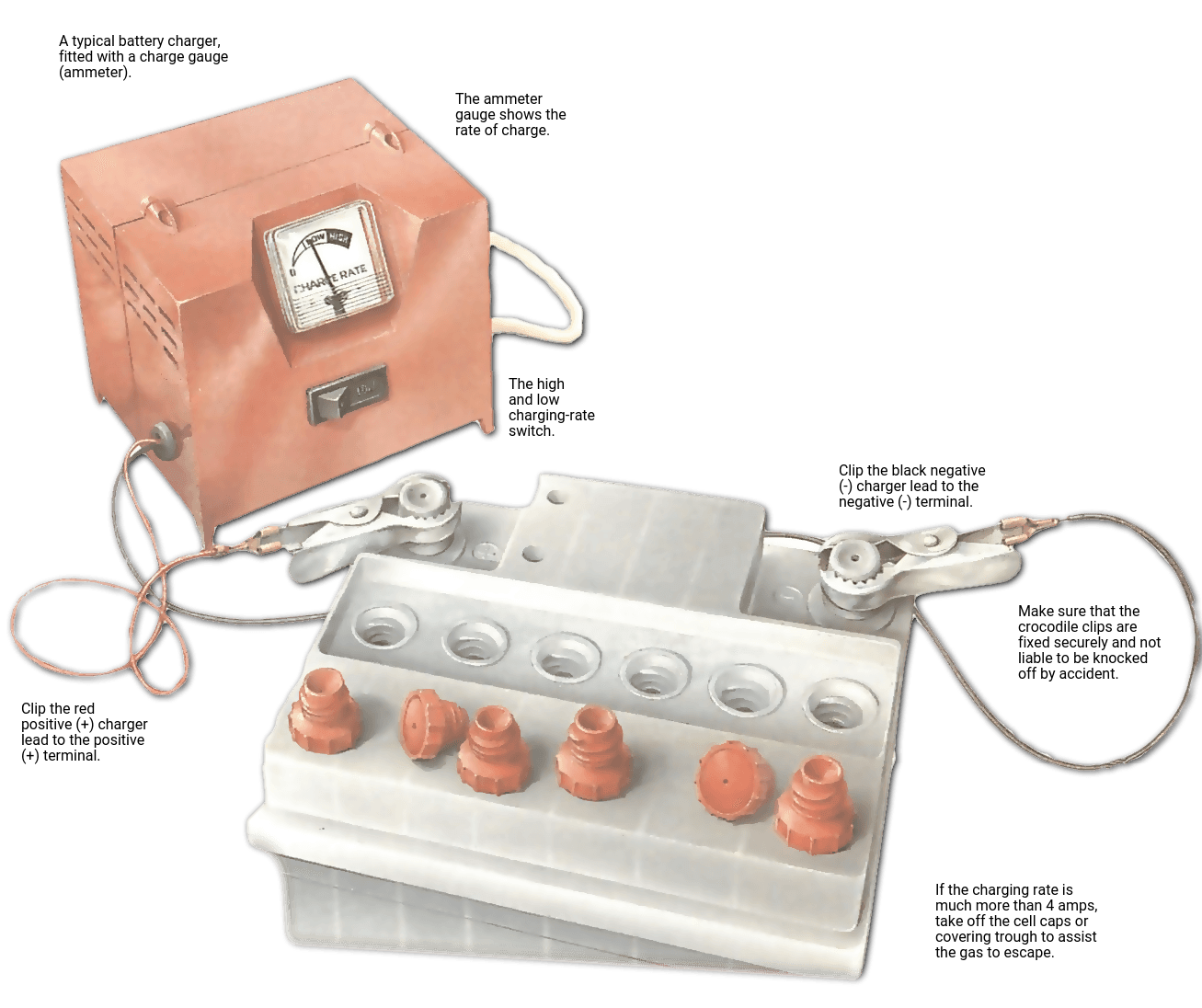
- Connect the red positive clamp to the battery’s positive terminal.
- Connect the black negative clamp to a clean, unpainted metal point on the engine or chassis.
- Keep the black clamp away from the battery when possible to reduce the chance of sparks near battery gases.
Some chargers allow the negative clamp to connect directly to the negative terminal. Follow the charger and vehicle instructions if they differ.
5. Start the charging cycle
Plug in the charger after the clamps are secure. Turn on the charger if it has a power switch.
The charger may show the battery’s voltage, charging level, or estimated time. Leave it connected until the charger indicates a full charge or switches to maintenance mode.
6. Disconnect safely
Turn off the charger and unplug it from the wall. Remove the negative clamp first, then remove the positive clamp.
This order helps reduce the chance of an accidental short. Keep the clamps from touching each other while the charger is connected.
How Long Does It Take to Charge a Car Battery?
Charging time depends on the battery size, charger output, battery condition, and starting charge level. A small charger may need overnight to charge a weak battery.
A simple estimate uses this formula:
Charging time = battery capacity in amp-hours ÷ charger output in amps
For example, a 60 amp-hour battery charged at 6 amps may take about 10 hours in ideal conditions. In real use, allow extra time because charging slows near full capacity and some energy is lost.
Typical charging times may look like this:
• A lightly discharged battery with a 10-amp charger may take 2 to 4 hours.
• A half-discharged battery with a 6-amp charger may take 6 to 10 hours.
• A deeply discharged battery with a 2-amp charger may take 24 hours or more.
• A maintenance charger may need several days because it uses a very low current.
Do not judge the charge only by time. Use the charger’s full indicator or test the battery after it rests. A battery can show a temporary surface charge soon after charging, so a resting test gives a better result.

Should You Remove the Battery Before Charging?
You usually do not need to remove a healthy battery before charging it. Many smart chargers are designed to charge a battery while it remains installed in the vehicle.
Removing the battery may be useful when:
• The battery is in a hard-to-reach location.
• The manufacturer requires removal.
• You need to clean heavy corrosion.
• The vehicle has sensitive electronics and the manual recommends isolation.
• You need to charge the battery in a warmer, safer area.
Modern vehicles can lose radio presets, clock settings, window calibration, and other stored data when the battery is disconnected. Some vehicles may also need battery registration after replacement.
The best way to charge a car battery installed in a vehicle is to follow the vehicle manual. Special charging posts may protect battery sensors and electronic systems.

Charging Different Types of Car Batteries
Flooded lead-acid batteries
Flooded lead-acid batteries are common in older and standard vehicles. They may have removable caps, although many modern versions are sealed.
Use the standard lead-acid setting. Never add tap water. If the battery is serviceable and the electrolyte level is low, use only distilled water and follow the battery maker’s instructions.
AGM batteries
AGM means absorbed glass mat. These batteries are common in vehicles with start-stop systems and high electrical demand.
Use an AGM setting when available. AGM batteries can be damaged by incorrect charging voltage, so avoid using an old manual charger without checking its specifications.
Gel batteries
Gel batteries use a silica-based electrolyte. They need a charger that supports gel batteries because excessive voltage can create permanent damage.
Do not assume that a gel battery can use the same setting as a standard flooded battery.
Lithium batteries
Some vehicles use lithium batteries for auxiliary power or special applications. Lithium batteries require a compatible charger and often have a battery management system.
Do not charge a lithium battery with a standard lead-acid charger unless the manufacturer specifically allows it. Stop immediately if the battery becomes hot, swollen, or smells unusual.
Can You Charge a Car Battery With Jumper Cables?
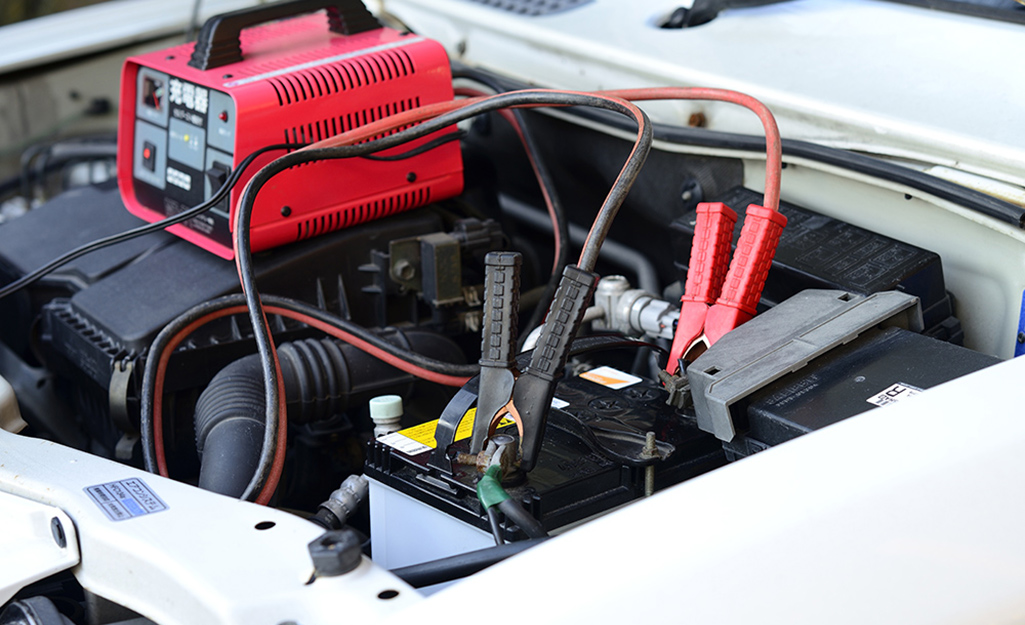
Jumper cables can start a car, but they do not properly charge a weak battery. They provide a short burst of power from another battery or jump starter.
After a jump-start, driving for a long time may restore some energy. However, the alternator may not fully charge a deeply discharged battery. Short trips with lights, climate control, and heated seats can leave the battery weak.
The best way to charge a car battery after a jump-start is to use a battery charger as soon as possible. This gives the battery a controlled charge and lets you check whether it can hold that charge.
If the battery repeatedly needs a jump, the cause may be:
• An aging battery
• A failing alternator
• Corroded or loose battery connections
• A parasitic electrical drain
• Lights or accessories left on
• A damaged charging cable or ground strap

How to Check Whether the Battery Is Fully Charged
A digital multimeter can provide a useful first check. Turn off the vehicle and let the battery rest for several hours before measuring it.
A healthy 12-volt battery often shows these approximate readings at rest:
• 12.6 to 12.8 volts means fully charged.
• 12.4 volts means roughly 75 percent charged.
• 12.2 volts means roughly 50 percent charged.
• 12.0 volts means heavily discharged.
These numbers are general guides, not a final diagnosis. Temperature, battery age, surface charge, and battery design can affect the reading.
With the engine running, many vehicles show about 13.7 to 14.7 volts at the battery. Some newer vehicles use smart charging systems and may show a wider range. A low or unstable reading can point to an alternator, belt, wiring, or control problem.
A load test is more useful than voltage alone. A battery may show 12.6 volts and still fail when asked to start the engine.
Common Mistakes to Avoid
Charging a car battery is simple when the process is controlled. Most problems come from using the wrong setting or ignoring warning signs.
Avoid these mistakes:
• Connecting the clamps backward
• Charging a damaged or frozen battery
• Using a 24-volt setting on a 12-volt vehicle
• Using a lithium setting on a lead-acid battery
• Charging in a closed room with poor airflow
• Leaving a basic charger connected for too long
• Placing the charger where it can get wet
• Letting the clamps touch each other
• Starting the engine while the charger is not designed for engine starting
• Cleaning corrosion without wearing eye protection
One mistake I see often is assuming that a fast charge is always better. A high-current boost can get a vehicle moving, but a slow, complete charge is usually kinder to the battery and gives you more useful information about its condition.
Another common mistake is replacing the battery before checking the charging system. A new battery will also go flat if the alternator is weak or an electrical drain remains active.
Battery Charging Safety Tips
Lead-acid batteries can release hydrogen gas while charging. Hydrogen is highly flammable, so even a small spark can create danger.
Follow these safety rules:
• Wear safety glasses and gloves.
• Charge in a well-ventilated area.
• Keep flames, cigarettes, and sparks away.
• Do not place metal tools across the battery terminals.
• Stop charging if the battery becomes very hot.
• Stop if you hear strong bubbling, hissing, or popping.
• Keep children and pets away from the work area.
• Do not charge a swollen, cracked, leaking, or frozen battery.
• Follow the charger’s instructions instead of guessing.
If battery acid touches your skin, rinse the area with plenty of clean water. If it reaches your eyes, flush them with water and seek urgent medical care.
When Charging Will Not Fix the Battery
A charger cannot repair every battery. Lead-acid batteries lose capacity as they age, and deep discharge can cause sulfation on the plates.
Charging may not solve the problem if:
• The battery will not accept current.
• The charger reports a fault.
• The battery loses voltage soon after charging.
• The engine still cranks slowly with a full battery.
• The case is swollen or cracked.
• The battery is several years old and has poor test results.
• The vehicle has a persistent electrical drain.
Some chargers include a repair or desulfation mode. This mode may help a lightly sulfated battery, but it is not a guaranteed repair. It cannot restore a battery with broken plates, severe corrosion, or physical damage.
Before buying a new battery, test the alternator and inspect the terminals. A clean, tight connection can solve a surprising number of starting problems.
How to Keep a Car Battery Charged
Good charging habits help extend battery life. Start by taking regular drives long enough for the alternator to replace the energy used during starting.
If the vehicle sits for weeks, use a smart maintenance charger. This is useful for seasonal cars, motorcycles, classic vehicles, and cars stored during travel.
You can also reduce battery strain by:
• Turning off lights and accessories before switching off the engine.
• Cleaning corrosion from the terminals.
• Checking that the battery hold-down is tight.
• Inspecting the serpentine belt when service is due.
• Testing the battery before winter.
• Avoiding repeated short trips when possible.
Cold weather reduces battery performance, while hot weather speeds up internal wear. A battery that starts well in summer may struggle in winter if it is already weak.
The best way to charge a car battery is only part of good battery care. Regular testing and correct vehicle maintenance matter just as much.
Frequently Asked Questions About the Best Way to Charge a Car Battery
What is the safest way to charge a car battery?
The safest way to charge a car battery is to use a smart charger with the correct voltage and battery type setting. Charge in a ventilated area and inspect the battery first for damage.
Can I charge a car battery without disconnecting it?
Yes, many smart chargers can charge a battery while it remains installed. Check the vehicle manual because some modern cars use battery sensors or special charging points.
Is it better to charge a car battery slowly or quickly?
A slow charge is usually safer and gentler, especially for an older or deeply discharged battery. A fast charger can save time, but it must match the battery and should not cause excessive heat.
Can driving fully charge a dead car battery?
Driving may restore some power, but it may not fully charge a deeply discharged battery. A smart charger is more reliable and can also show whether the battery accepts and holds a charge.
How do I know when a car battery is fully charged?
The charger may show a full or maintenance indication. After the battery rests, a healthy 12-volt battery often measures about 12.6 to 12.8 volts, but a load test gives a more dependable health check.
Can I charge a frozen car battery?
No. Do not charge a frozen battery because it can crack or explode. Allow it to thaw naturally, inspect it carefully, and replace it if there is swelling or damage.
What charger size is best for a car battery?
A 4- to 10-amp smart charger suits many passenger vehicles. A lower-amperage charger takes longer but is often a good choice for safe overnight charging and battery maintenance.
Conclusion
The best way to charge a car battery is to use a smart charger matched to the battery’s voltage and chemistry. Inspect the battery, connect the clamps in the correct order, charge in a ventilated space, and let the charger complete its cycle.
Do not rely on repeated jump-starts or short drives to repair a deeply discharged battery. Test the battery and charging system if it keeps going flat, and replace it when it cannot hold a charge safely. Use these steps the next time your battery needs help, and explore your vehicle manual for model-specific charging guidance.