
The best OBD2 scanner for electric cars is a capable code reader that supports 12-volt systems and clear live data.
Buying an EV scan tool can feel confusing. Most electric cars still use a standard diagnostic port, yet many basic OBD2 readers only check limited systems. They may read the 12-volt battery, charging faults, ABS codes, and general powertrain data, but they often cannot access high-voltage battery data or every manufacturer module. I tested the key features that matter most for EV owners, including live data, battery testing, code clearing, system coverage, ease of use, and value.
See the differences between my top picks at a glance.
| Scanner | Best For | Key Functions | EV Note | Buy |
|---|---|---|---|---|
| Bluetooth 5.4 Scanner | Phone-based checks | Codes, live data, clearing | Good for basic 12V data | View on Amazon |
| A-Premium AD200 | Simple home diagnosis | OBDII/EOBD code reading | Useful for standard systems | View on Amazon |
| FOXWELL NT604 Elite | Multi-system scanning | ABS, SRS, transmission, live data | Better module coverage | View on Amazon |
| MOTOPOWER MP69033 | Low-cost code checks | Engine fault codes, CAN scan | Limited EV depth | View on Amazon |
| 3-in-1 Scanner | Code and battery checks | 12V battery, cranking, live data | Helpful for accessory battery | View on Amazon |
| Innova 5210 | Guided home testing | Codes, live data, battery test | Strong 12V support | View on Amazon |
| UMEIJA Battery Tester | Basic maintenance | Codes, emissions, battery test | Best for simple checks | View on Amazon |
| BLCKTEC 460T | Advanced service work | ABS, SRS, BMS, resets, live data | Most versatile pick here | View on Amazon |
Bluetooth 5.4 OBD2 Scanner
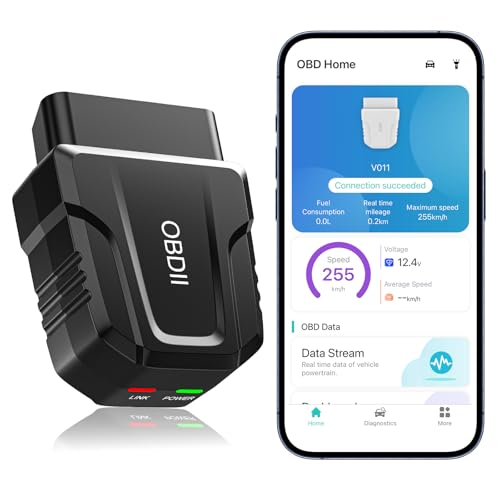
This compact Bluetooth scanner connects to a phone or tablet through its companion app. It focuses on common OBD2 jobs, such as reading trouble codes, viewing live data, clearing codes, and checking basic vehicle performance. Its Bluetooth 5.4 connection should appeal to drivers who prefer a wireless setup. It also avoids the small screen found on many low-cost handheld readers.
For an EV, this unit makes the most sense as a first-line tool for the 12-volt system and standard diagnostic data. It may show useful voltage, temperature, and sensor readings when the vehicle exposes them through the OBD port. Still, app and vehicle support can vary, so it should not replace a brand-specific EV scan tool for traction-battery faults. I like it most for quick checks at home or on the road.
Pros:
- Wireless phone-based operation
- Compact design for glove-box storage
- Reads and clears supported trouble codes
- Shows live data through the app
- Useful for quick 12-volt system checks
- No dedicated handheld screen to carry
Cons:
- Requires a compatible phone and app
- Vehicle coverage may vary by make and model
- Usually cannot perform full high-voltage battery diagnosis
What Amazon Buyers Are Saying
Buyer feedback for Bluetooth scanners often centers on easy setup, small size, and the convenience of using a phone screen. Users who want a quick check tend to value wireless access and live data. Common concerns include app permissions, connection steps, and uneven access to advanced manufacturer codes. Check the current app details and vehicle compatibility before ordering.
My Recommendation
This is a good choice for an EV owner who wants a low-cost wireless reader for basic information. It is not the best OBD2 scanner for electric cars if you need battery-pack service data. I recommend it for simple checks, warning-light research, and 12-volt monitoring.
A-Premium AD200 Code Reader

The A-Premium AD200 is a straightforward wired diagnostic tool for OBDII and EOBD vehicles. It targets the main job most drivers need: finding the reason behind a check-engine light. A wired connection removes Bluetooth pairing issues and lets you begin a scan as soon as you plug it in. Its broad vehicle-year claim makes it useful for many cars, trucks, hybrids, and EVs with standard OBD access.
This scanner can help identify faults in systems that report standard codes through the diagnostic connector. On an electric car, that may include the 12-volt system, emissions-related readiness data where fitted, and some general vehicle modules. The key limit is system depth. It should not be treated as a complete electric vehicle battery analyzer or a tool for safely testing high-voltage circuits.
Pros:
- Simple plug-in operation
- No wireless setup or app subscription required
- Suitable for basic code reading
- Useful for home troubleshooting
- Works across many standard OBDII vehicles
- Easy choice for first-time users
Cons:
- Less advanced than a multi-system scanner
- Screen and functions may feel basic
- Limited access to EV-specific control units
What Amazon Buyers Are Saying
Amazon buyers commonly look for a reader that starts quickly and explains a warning light without a repair-shop visit. Basic wired scanners often earn praise for their simple controls and dependable connection. The usual trade-off is limited code detail and fewer service functions. Buyers who expect ABS, airbag, or battery-management access should confirm those features before purchase.
My Recommendation
The AD200 is worth considering when your goal is simple fault-code reading. It is a sensible budget option for a second household vehicle or an EV owner who wants basic OBD access. I would choose a more advanced model for detailed electric-car diagnostics.
FOXWELL NT604 Elite Scanner

The FOXWELL NT604 Elite moves beyond basic engine-code work. It is designed to scan key systems such as ABS, SRS, transmission, and check-engine functions, while also showing live data. That wider coverage matters in an EV because a warning may come from braking, restraint, charging, or body control systems rather than an engine. The dedicated handheld design also works without a phone.
I see this as one of the stronger choices for owners who want more than a generic powertrain scan. It can help separate a simple 12-volt fault from a broader module issue, although exact functions depend on the vehicle. It still does not guarantee access to every EV battery-management parameter. Always check the current Foxwell coverage list for your exact model.
Pros:
- Scans more than the basic engine system
- Includes ABS and SRS functions
- Provides live-data viewing
- Wired connection stays stable during use
- Dedicated screen works without a smartphone
- Useful for diagnosing several warning lights
Cons:
- Advanced functions vary by vehicle
- May require updates for newer models
- Not a substitute for an EV dealer tool
What Amazon Buyers Are Saying
Feedback around multi-system scanners often praises the wider coverage and the ability to view live data on a built-in display. Buyers also value having one tool for ABS, airbag, and transmission checks. Some users report that menu depth and supported functions differ by vehicle. That is normal for aftermarket scan tools, so model-specific coverage remains important.
My Recommendation
The NT604 Elite is one of my favorite balanced picks in this group. It offers more useful system coverage than a basic code reader without moving into expensive professional equipment. For many EV owners, it is a better choice than a simple engine scanner, provided the vehicle coverage matches.
MOTOPOWER MP69033 Code Reader

The MOTOPOWER MP69033 is a basic handheld OBD2 code reader with broad protocol support for many vehicles since 1996. Its yellow housing is easy to spot in a tool box, and its wired design keeps the process simple. It aims to read engine fault codes, clear supported codes, and provide basic diagnostic information. That makes it a practical low-cost choice for routine checks.
EV owners should set realistic expectations. This unit may read standard codes that the car makes available through the OBD connector, but it is not designed as a full electric drivetrain scanner. It will not replace a scan tool that can communicate with battery-management, inverter, or charging modules. I would use it to start a diagnosis, then seek a specialist tool when the code points to a high-voltage system.
Pros:
- Low-cost entry point
- Simple wired operation
- Compact and easy to store
- Supports common OBD2 protocols
- Useful for check-engine code checks
- No phone, app, or wireless pairing needed
Cons:
- Limited system coverage
- Not intended for deep EV diagnostics
- Basic display and data functions
What Amazon Buyers Are Saying
Buyers who want a simple code reader often like the quick plug-in setup and low price. This type of scanner can help confirm whether a warning deserves immediate attention. The most common limitation is that it gives a code but not a full repair plan. Users seeking live graphs, module scans, or service resets may find it too basic.
My Recommendation
The MP69033 is worth buying as a backup reader or a first tool for basic codes. It is not my top pick for an EV owner who wants broad system access. Choose it when price and simplicity matter more than advanced functions.
3-in-1 OBD2 and Battery Tester

This 3-in-1 tool combines an OBD2 reader with a 12-volt battery tester and cranking test. That mix fits electric cars well because EVs still depend on a small accessory battery for computers, locks, displays, and control systems. A weak 12-volt battery can create strange warnings even when the high-voltage pack is healthy. The tool also offers live data and supported code clearing.
I like the focus on practical ownership. Instead of only reading a fault, you can check whether the accessory battery has enough voltage and starting strength for its role. The cranking feature matters more for combustion cars, but the battery test remains useful for many EVs. As with every generic OBD2 reader, it cannot safely diagnose the high-voltage pack itself.
Pros:
- Combines code reading and 12-volt testing
- Useful for finding weak accessory batteries
- Includes cranking-test capability
- Offers live-data functions
- Can clear supported engine faults
- Good fit for mixed vehicle households
Cons:
- High-voltage battery data is not guaranteed
- Some functions may target gasoline vehicles
- Vehicle compatibility should be checked first
What Amazon Buyers Are Saying
Buyers usually value the convenience of combining several tests in one device. Battery readings can help explain hard-to-trace electrical warnings and starting problems. Some users may expect the word “battery” to mean the main EV traction pack, but this type of tester mainly supports the low-voltage battery. Read the product details carefully before use.
My Recommendation
This is a smart pick for an EV driver who wants to monitor the 12-volt battery as well as scan codes. It offers more daily value than a code-only reader. I recommend it for preventive maintenance, but not for high-voltage repair work.
Innova 5210 OBD2 Scanner

The Innova 5210 combines code reading, live data, battery testing, and an oil-reset function in a familiar handheld format. Its Bluetooth compatibility with a repair app adds another way to view information and research faults. The built-in tool remains useful when you do not want to depend on a phone. This makes it appealing to drivers who want both quick scans and more guided help.
For EV use, the battery tester is mainly relevant to the 12-volt accessory battery. The scanner may also display standard data from the car, but the depth depends on the vehicle maker and model year. I would not assume that an OBD2 label means full access to the traction battery or charging controller. Still, the 5210 offers a strong set of practical functions for home maintenance.
Pros:
- Reads codes and displays live data
- Includes battery-test capability
- Supports an optional repair app experience
- Handheld design works without a phone
- Oil-reset feature helps compatible vehicles
- Useful for routine vehicle maintenance
Cons:
- Oil reset has little value on many EVs
- Advanced coverage varies by vehicle
- May cost more than a basic code reader
What Amazon Buyers Are Saying
Amazon buyers often appreciate the mix of handheld controls and app support. Live data and battery checks are useful for people who want more than a code number. Some buyers may find that the app or vehicle coverage does not match their expectations. I suggest checking supported functions for your exact EV before relying on the scanner for a specific repair.
My Recommendation
The Innova 5210 is a good all-around option for EV owners who also maintain gasoline or hybrid vehicles. It gives useful 12-volt information and simple code access. Its oil-reset feature adds value for other cars, but it does not make the tool a complete EV service scanner.
UMEIJA OBD2 Battery Tester

The UMEIJA scanner focuses on essential OBD2 work and battery testing. It can read and clear supported vehicle codes and check emissions-readiness information on compatible vehicles. The battery function adds a useful layer for EV owners who want to watch the low-voltage system. Its simple design suits drivers who prefer a direct tool instead of a complex professional interface.
This scanner can help answer an important question: is a warning caused by a weak accessory battery or by another system? It cannot answer every EV question, especially when the fault sits inside the high-voltage battery, inverter, or onboard charger. I view it as a maintenance tool rather than a specialist diagnostic platform. That distinction keeps expectations realistic.
Pros:
- Includes an upgraded battery-test function
- Reads and clears supported codes
- Checks emissions readiness where applicable
- Simple interface for home use
- Useful for basic 12-volt checks
- Works with many standard OBDII vehicles
Cons:
- Limited advanced module access
- Emissions functions matter less for many pure EVs
- Not designed for high-voltage battery repair
What Amazon Buyers Are Saying
Buyers who choose this style of scanner tend to value its combination of code reading and battery checks. The straightforward design can help new users avoid a steep learning curve. The main concern is the difference between testing a 12-volt battery and testing an EV traction battery. Clear product expectations are important before purchase.
My Recommendation
The UMEIJA is a reasonable value for simple maintenance. It suits an EV owner who wants a basic code reader with extra 12-volt testing. I would select the FOXWELL or BLCKTEC instead if you need wider system coverage.
BLCKTEC 460T Professional Scanner

The BLCKTEC 460T is the most feature-rich scanner in this review. It covers engine, ABS, SRS, and transmission systems, and it lists service functions such as oil, TPMS, EPB, BMS, SAS, DPF, and throttle resets. It also includes ABS bleeding, battery testing, automatic VIN recognition, live data, and free updates. That broad tool set gives it the best chance of helping with several vehicle modules.
For EV owners, the battery-management and battery-test references deserve careful attention. They do not mean that the tool can safely open or repair a high-voltage battery pack. They do mean that the scanner may offer more useful access to supported electronic systems than a basic OBD2 reader. Always confirm the exact functions for your make and model before performing a reset.
Pros:
- Broad system coverage
- Includes ABS and SRS diagnostics
- Offers BMS and battery-related functions
- Provides several reset and service functions
- Supports automatic VIN recognition
- Includes live data and battery testing
- Free updates add long-term value
Cons:
- More complex for a first-time user
- Not every service function works on every vehicle
- Still cannot replace brand-specific EV equipment
What Amazon Buyers Are Saying
Buyers looking at advanced scanners usually value wide system coverage, automatic VIN features, and the ability to perform service resets. Users also tend to like having one tool for several cars. The most important complaint with this product class is that advertised functions can vary by vehicle. Read the current compatibility details and update terms before buying.
My Recommendation
The BLCKTEC 460T is my top overall pick from this list. It offers the widest range of useful functions and the best chance of reaching systems beyond basic engine data. It is worth the higher price for hands-on owners, technicians, and families with several vehicle types. I still advise professional help for high-voltage work.
How to Choose the Best OBD2 Scanner for Electric Cars
Choosing the best OBD2 scanner for electric cars takes more care than buying a basic check-engine reader. An EV has no traditional engine, but it still has many electronic control units. These may include the battery-management system, inverter, onboard charger, thermal system, ABS, airbag, steering, and body modules. A generic scanner may reach only some of them.
1. Separate 12-Volt Testing From High-Voltage Testing
Every EV buyer should understand this difference. A 12-volt battery tester checks the small accessory battery. That battery powers many control systems and can cause warning lights when its voltage drops. It does not measure the main traction battery in the same way.
High-voltage battery work needs proper training and safety gear. A standard OBD2 scanner cannot make a dangerous battery pack safe. Look for a tool that clearly states which battery-management functions it supports. Never remove covers, probe orange cables, or reset a serious battery fault without following the vehicle maker’s service steps.
2. Check System Coverage for Your Exact EV
OBD2 is a communication standard, not a promise of full vehicle access. A reader may work well on generic powertrain codes but fail to read ABS, charging, or battery modules. Coverage can also change by brand, model, year, and software version.
Before you buy, search the product’s current coverage list for your exact vehicle. Check for the functions you need, such as live data, ABS scans, SRS scans, BMS access, battery tests, or service resets. This step matters more than a long feature list on the box.
3. Match the Tool to Your Repair Skill and Budget
A basic scanner works well if you only want to read a warning and decide whether to call a shop. A mid-level scanner makes more sense if you want live data and access to several modules. An advanced model may pay for itself if you maintain more than one car or perform service work at home.
Also check update rules, app needs, screen quality, cable length, and return support. Choose a tool that explains codes clearly and saves time. For most home users, the FOXWELL NT604 Elite, Innova 5210, or 3-in-1 battery tester offers a useful balance. For wider service coverage, the BLCKTEC 460T is the stronger choice.
Final Verdict: Which Should You Buy?
The BLCKTEC 460T is my top pick and the best OBD2 scanner for electric cars in this group. It offers the widest system coverage, battery-related functions, live data, and useful resets.
For basic 12-volt checks, choose the 3-in-1 tester or Innova 5210. Always confirm vehicle coverage, and leave high-voltage repairs to trained professionals.
FAQs Of best obd2 scanner for electric cars
Can a normal OBD2 scanner diagnose an electric car?
Yes, it can read some standard codes and data. However, many basic scanners cannot access every EV module, including the traction battery and charging system.
What is the best OBD2 scanner for electric cars?
The BLCKTEC 460T is the strongest overall choice here because it offers broad system coverage, live data, battery functions, and several service resets.
Can an OBD2 scanner test an EV high-voltage battery?
Most generic scanners cannot provide a complete high-voltage battery health test. They may read selected battery-management data, but coverage depends on the vehicle and tool.
Do electric cars still need a 12-volt battery tester?
Yes. EVs still use a 12-volt accessory battery for many controls and electrical functions. A weak battery can cause several confusing warning messages.
Is it safe to clear an EV trouble code?
Clearing a code does not fix the cause. Read and record the code first, then follow the vehicle manual or seek qualified service, especially when the warning involves charging or high voltage.
Should I buy a Bluetooth or wired OBD2 scanner?
Bluetooth models offer phone convenience and larger displays. Wired models start quickly and avoid pairing or app problems. Choose based on your preferred workflow and vehicle support.