The best battery testers make battery checks fast, clear, and far less wasteful.
Have you ever replaced a battery, only to find the old one still had some life left? Or turned the key and heard nothing but a weak click? A good battery tester removes that guesswork. It can help you sort household cells, check a car battery, and spot charging trouble before it leaves you stranded. I tested these choices by looking at ease of use, readout clarity, battery type support, build quality, and value. This guide covers the best battery testers for cars, homes, workshops, boats, RVs, and everyday storage drawers.
ANCEL BA101 Car Battery Tester

The ANCEL BA101 is a strong choice for drivers who want more than a simple voltage reading. It tests 12-volt batteries and checks cranking, charging, and alternator performance. Its stated 100–2,000 CCA range covers many cars, trucks, boats, RVs, and marine vehicles. I like that it gives useful system clues without asking you to remove the battery.
The tester uses a wired connection with clear digital results. It can help show whether a weak start comes from the battery or the charging system. That distinction can save money because a new battery will not fix a failing alternator. As with any tester, enter the battery rating correctly and test with clean terminals for the most useful result.
Pros:
- Checks battery, cranking, and charging systems
- Supports a broad 100–2,000 CCA range
- Works with many 12V automotive applications
- Helpful for cars, trucks, boats, and RVs
- Digital results are easy to read
- Can reduce guesswork before buying a battery
Cons:
- Designed mainly for 12V systems
- Not intended for testing small household cells
- Requires careful clamp placement and rating entry
My Recommendation
The ANCEL BA101 suits home mechanics, fleet owners, and drivers who want a practical automotive diagnostic tool. It is especially useful when a vehicle cranks slowly or the dashboard battery light appears. Among the best battery testers, this model stands out for combining battery and alternator checks in one compact unit. It offers good value for anyone who wants more detail than a basic voltmeter.
VTECHOLOGY Two-Pack Battery Tester

The VTECHOLOGY two-pack keeps battery testing simple. Each tester is made for common household sizes, including AA, AAA, C, D, and 9V batteries. Its compact shape fits well in a kitchen drawer, desk, tool box, or classroom supply area. The two-piece set also makes it easy to keep one tester at home and another in a workshop.
This type of tester uses a small load to show whether a battery is good, weak, or nearly empty. That is more useful than judging a cell by its age or by shaking it. The display is simple, so even children under adult guidance can understand the basic result. It does not replace a professional meter, but it handles everyday battery sorting with very little effort.
Pros:
- Includes two testers for separate locations
- Supports AA, AAA, C, D, and 9V cells
- Small and easy to store
- Simple results suit routine home use
- Useful for toys, remotes, clocks, and flashlights
- Does not require advanced electrical knowledge
Cons:
- Not suitable for automotive batteries
- Does not provide detailed voltage or capacity data
- Plastic construction may not suit heavy shop use
My Recommendation
I recommend the VTECHOLOGY set for families, teachers, renters, and anyone with a drawer full of mixed batteries. The two-pack is handy when one tester stays in the house and one travels with camping gear. It is not one of the best battery testers for a car, but it is a convenient pick for common household cells. Its strongest benefit is speed: place the battery in the tester and sort it in seconds.
TOPDON BT100 12V Battery Tester

The TOPDON BT100 is a straightforward 12V automotive load tester. It helps check battery condition and can provide insight into starting performance. Its simple design makes it a natural fit for a home garage or a small repair kit. I find it useful for drivers who want a quick answer before a long trip or a cold-weather morning.
The wired leads connect directly to the battery terminals, and the screen presents the result without a complex menu. This is a load tester, so it places demand on the battery instead of only reading resting voltage. That matters because a battery can show a normal voltage and still fail under starting load. Use it in a ventilated area and follow the instructions for safe connection.
Pros:
- Designed for common 12V vehicle batteries
- Tests performance under load
- Compact design works well in a garage
- Simple screen helps beginners read results
- Useful before road trips and seasonal storage
- Does not need a separate internal battery for basic operation
Cons:
- Only supports 12V systems
- Not made for AA, AAA, or button cells
- Load testing can warm the device during use
My Recommendation
The TOPDON BT100 is best for everyday vehicle owners who want a simple automotive battery checker. It makes sense for a second car, an older truck, a motorcycle battery setup that uses 12V, or a weekend garage. It gives more practical information than a basic household tester, while keeping operation easy. In the best battery testers category, this is a sensible value pick for basic 12V checks.
Dlyfull Universal Battery Tester

The Dlyfull universal tester covers many of the batteries found around a home. It accepts AA, AAA, C, D, and 9V cells, making it useful for remotes, toys, smoke alarms, and portable lights. Its analog-style indicator gives a quick view of remaining power. I appreciate this format because it avoids menus, settings, and extra cables.
The tester is small enough to keep near a battery drawer. It helps separate fresh, usable, and spent cells before they reach the recycling bin. The reading is a general charge check, not a laboratory capacity test, so I would use it for sorting rather than exact measurements. For simple household jobs, that tradeoff keeps the tool affordable and easy to use.
Pros:
- Handles five popular household battery sizes
- Fast testing with no complicated controls
- Compact and lightweight for drawer storage
- Useful for toys, remotes, clocks, and alarms
- Simple indicator suits first-time users
- Helps prevent premature battery disposal
Cons:
- Does not test automotive batteries
- Indicator is less exact than a digital meter
- May not cover every specialty button-cell size
My Recommendation
I would choose this Dlyfull model for a home that uses many AA and AAA batteries. It is also a good fit for older users who prefer a clear gauge over a digital menu. The tool does not try to do too much, and that is part of its appeal. If you need one of the best battery testers for fast household sorting, this model is easy to recommend.
TOPDON BT200 12V/24V Battery Tester

The TOPDON BT200 brings wider vehicle coverage to battery testing. It supports 12V and 24V systems and covers a stated 100–2,000 CCA range. That makes it more flexible than a basic 12V tester for larger vehicles, work equipment, and some commercial applications. Its design fits drivers who need a stronger tool but do not need a full professional scan platform.
The unit focuses on battery load and starting performance. It can help identify a battery that looks fine at rest but drops too far when the vehicle starts. The 24V support is useful for certain trucks and equipment, but users must select the correct system before testing. I also recommend checking the battery label and keeping the clamps firmly attached for a stable result.
Pros:
- Works with both 12V and 24V systems
- Supports a broad 100–2,000 CCA range
- Useful for cars, trucks, and selected equipment
- Provides practical load-test information
- Good choice for mixed vehicle ownership
- Digital operation is accessible to new users
Cons:
- More tool than many small-car owners need
- Not designed for household battery cells
- Users must choose 12V or 24V carefully
My Recommendation
The TOPDON BT200 is best for owners of cars and larger vehicles who want one tester with wider system support. It is a strong choice for small fleets, farm equipment, RV owners, and serious DIY users. I would pick it over a 12V-only model when 24V testing may matter later. Among the best battery testers, it offers strong flexibility without forcing a professional-level learning curve.
Dlyfull Button Cell Battery Checker

This Dlyfull tester adds button-cell support to the usual household battery sizes. It can check AA, AAA, C, D, 9V, and selected 1.5V or 3V button batteries. That mix makes it useful for watches, small lights, calculators, remotes, toys, and safety devices. A tester like this can save time when several tiny cells look nearly identical.
The unit gives a quick charge-level indication rather than a detailed electrical report. It is best for deciding whether a battery is usable, weak, or ready for recycling. The compact body takes little space, and the simple operation suits occasional users. I suggest storing button cells away from children and pets, even when using a tester.
Pros:
- Supports common household and button-cell types
- Useful for both 1.5V and selected 3V cells
- Simple reading requires little training
- Compact enough for a desk or drawer
- Helpful for watches, calculators, and small devices
- Quickly separates weak cells from good ones
Cons:
- Does not test car or deep-cycle batteries
- Button-cell compatibility is not universal
- Provides an approximate charge indication
My Recommendation
I recommend this Dlyfull model to households with mixed battery types. It is particularly useful if you often replace watch batteries, calculator cells, or small electronic batteries. It fills a gap that many basic AA and AAA testers leave open. For shoppers seeking the best battery testers for general home use, its button-cell support gives it extra value.
MOTOPOWER MP0515A Car Battery Tester

The MOTOPOWER MP0515A is built for drivers who want a focused 12V automotive tester. It covers a 100–2,000 CCA range and checks battery load, cranking, and charging behavior. That gives you more context than a single voltage number. I see it as a useful middle ground between a simple test light and a larger professional diagnostic tool.
The tester connects through battery clamps and displays the result in a clear format. It can help reveal a tired battery, a weak starting system, or charging trouble. I like that this approach supports preventive checks before winter, travel, or vehicle storage. It still requires basic care, such as avoiding reversed polarity and testing in a suitable work area.
Pros:
- Tests battery, cranking, and charging functions
- Supports 100–2,000 CCA batteries
- Made for common 12V automotive systems
- Useful for preventive vehicle maintenance
- Compact enough for a personal tool kit
- Helps separate battery faults from alternator faults
Cons:
- Does not support household battery sizes
- Limited to 12V applications
- Results depend on clean clamps and correct inputs
My Recommendation
The MOTOPOWER MP0515A suits DIY mechanics, used-car buyers, and owners of vehicles that have shown slow starts. It is also useful for checking a stored vehicle before putting it back on the road. I value its focus on both starting and charging systems. If you want one of the best battery testers for regular 12V vehicle care, this is a capable and practical option.
Tenergy T-333 Universal Battery Tester
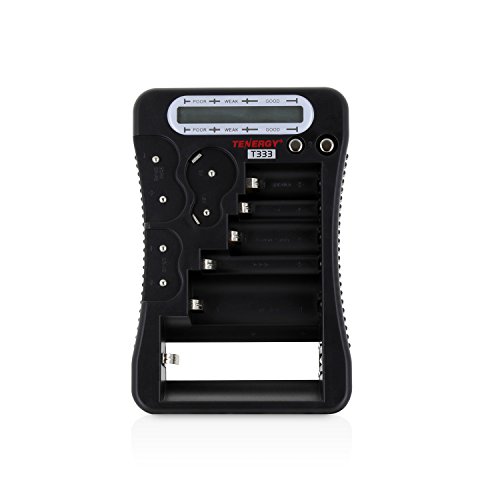
The Tenergy T-333 is a versatile household battery tester with an LCD display. It supports AA, AAA, C, D, 9V, CR123A, CR2, CRV3, 2CR5, CRP2, and button-cell batteries. That broad list makes it appealing to photographers, campers, parents, and people with older electronics. Instead of keeping several small testers, you can use one tool for many cell formats.
The LCD gives a more direct reading than a basic needle gauge. It is still a checker, not a full battery analyzer, so the result should guide a replacement decision rather than promise exact runtime. The tester is small and easy to keep near chargers and spare cells. I recommend checking polarity and seating each battery correctly, especially with small button cells.
Pros:
- Supports many household and specialty battery sizes
- LCD display is clear and easy to read
- Useful for cameras, lights, toys, and remotes
- Reduces the need for several separate testers
- Compact design fits a drawer or camera bag
- Good option for mixed battery collections
Cons:
- Not suitable for automotive or deep-cycle batteries
- Does not perform a professional capacity test
- Some specialty cells require careful placement
My Recommendation
The Tenergy T-333 is my favorite style of household tester for people who use many battery formats. Photographers, campers, parents, and electronics hobbyists can benefit from its broad compatibility. The LCD screen also makes it easier to compare weak batteries without guessing at a pointer. For shoppers comparing the best battery testers for home use, this model offers especially good flexibility.
Two-Pack Universal Battery Checker

This two-pack universal battery checker is made for basic household sorting. It supports AA, AAA, C, D, 9V, and 1.5V button-cell batteries. The pair is useful for a home with more than one battery storage spot, such as a kitchen drawer and a garage shelf. It can also work well for classrooms, offices, and travel kits.
A key benefit is that the testers require no battery of their own for operation. You simply place the cell in position and read the level indicator. The design is basic, but it handles the most common question: is this battery still worth using? It will not tell you exact capacity or diagnose a vehicle, yet it offers useful value for everyday tasks.
Pros:
- Includes two separate battery checkers
- Works without its own internal battery
- Supports common household cell sizes
- Easy to keep in multiple rooms
- Helpful for offices, classrooms, and families
- Simple operation reduces setup time
Cons:
- Not intended for car batteries
- Readout is general rather than highly precise
- Does not cover every specialty battery type
My Recommendation
I recommend this two-pack to anyone who wants a low-cost battery checker in more than one place. It is a smart fit for large homes, classrooms, offices, and people who travel with spare cells. The no-battery design makes it ready when you need it. In a list of the best battery testers, this option wins on convenience and simple everyday value.
D-FantiX Universal Battery Tester
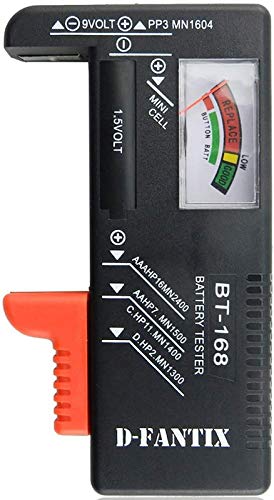
The D-FantiX universal battery tester is a compact tool for AA, AAA, C, D, and 9V batteries. It uses a clear charge-level gauge to show the general condition of each cell. This simple approach works well for toys, radios, clocks, remotes, and flashlights. It is the kind of tool that earns its place by solving one small problem again and again.
The tester does not need complicated setup or technical knowledge. I can see it helping families sort batteries before a trip or helping a workshop avoid mixing weak cells with fresh ones. The gauge is not a substitute for a multimeter when exact voltage matters. Still, for quick checks, it is light, affordable, and easy to store.
Pros:
- Checks five common household battery types
- Compact body fits small storage spaces
- Easy gauge is friendly for beginners
- Useful for toys, clocks, radios, and remotes
- Fast testing helps sort mixed batteries
- Good choice for occasional home use
Cons:
- Does not test automotive batteries
- Gauge gives an approximate condition only
- No support for many specialty button cells
My Recommendation
The D-FantiX tester is best for shoppers who want a basic, no-fuss household tool. It makes a good first battery tester for an apartment, family home, or small office. I would choose it when common AA, AAA, C, D, and 9V cells are the main concern. It remains a useful value pick among the best battery testers because it keeps the learning curve almost flat.
How to Choose the Best Battery Testers
The right tester depends on the battery types you use most. A household checker cannot test a car battery, and an automotive load tester will not accept a tiny button cell. Start by listing the batteries in your home, garage, boat, RV, or work vehicle. This one step prevents a frustrating mismatch.
Match the Tester to the Battery
For household use, look for support for AA, AAA, C, D, and 9V batteries. If you use cameras, watches, or small lights, check for CR123A, CR2, CRV3, and button-cell support. For a car, choose a 12V automotive tester with suitable CCA coverage. Owners of larger trucks or equipment may need a 24V model.
Understand Voltage and Load Testing
A voltage reading shows electrical pressure at a moment in time. It does not always show how well a battery will work under demand. A load tester applies a controlled load and watches how the battery responds. This makes load testing more useful for starting batteries, especially when a vehicle has slow cranking symptoms.
Household testers often provide a quick remaining-power estimate. That estimate helps with sorting, but it is not the same as a laboratory capacity test. Rechargeable batteries can also behave differently from single-use alkaline cells. For advanced charging work, use a quality multimeter, charger analyzer, or battery analyzer designed for that task.
Check Readout Clarity
A good display should be readable in the light where you normally work. Digital screens can show exact-looking values and status messages. Analog gauges are often faster for a simple good, weak, or bad decision. Neither format is automatically better; the best choice is the one you can read without squinting.
Think About Safety
Never force a battery into the wrong slot. Match the positive and negative ends, and inspect cells for leaks, swelling, cracks, or heat damage. Do not load-test a damaged battery. Automotive tests should take place in a ventilated area away from sparks, flames, and loose metal tools.
Follow the product instructions and the battery maker’s safety guidance. Remove jewelry when working near vehicle batteries, and wear eye protection when appropriate. A tester is a helpful guide, but it cannot make a damaged battery safe.
Look at Build Quality
For home use, a light plastic tester may be enough. A garage tester should have strong leads, secure clamps, and a case that can survive regular handling. Cable length matters too. Short leads can make testing awkward when the battery sits deep in an engine bay.
Consider Testing Speed
If you sort many batteries, quick placement and clear results matter. A basic tester can check a cell in seconds. Automotive testers may ask for battery type, rating, or system voltage before beginning. That extra step takes time, but it can produce a more useful vehicle diagnosis.
Why CCA Matters for Car Batteries
CCA means cold cranking amps. It describes a battery’s ability to deliver current during a cold start under a defined test condition. The rating appears on many automotive battery labels. When using a car battery tester, enter the correct rating and rating standard when the tester requests it.
A CCA result does not tell the whole story. Age, temperature, state of charge, terminal condition, and the vehicle’s electrical system all affect the result. I use a tester as one part of a diagnosis, not as the only voice in the room.
When to Replace a Battery
Replace a household battery when the tester shows it as spent, the device behaves poorly, or the cell leaks. Do not place damaged batteries back into a drawer. For vehicle batteries, compare the test result with starting symptoms and charging readings. A weak result after a proper charge may suggest the battery is near the end of its useful life.
Recycle batteries through an approved collection point. Keep loose cells in a safe container and cover exposed terminals on lithium or other high-energy batteries when recommended. Good storage protects both the batteries and the people around them.
Best Battery Testers: Quick Comparison
| Best for | Why |
|---|---|
| 12V car diagnosis | ANCEL BA101 checks battery, cranking, and charging systems. |
| Many household battery sizes | Tenergy T-333 covers common cells and several specialty types. |
| 12V and 24V vehicles | TOPDON BT200 offers wider system coverage and CCA support. |
FAQs Of best battery testers
What is the best battery tester for home use?
The Tenergy T-333 is a strong home choice because it supports many common and specialty battery sizes. For only AA, AAA, C, D, and 9V cells, a Dlyfull or VTECHOLOGY tester may offer simpler value.
Can a household battery tester test a car battery?
No. Most household testers are made for small cells and cannot handle a 12V automotive battery. Use a dedicated automotive load tester, such as the ANCEL BA101, TOPDON BT100, or MOTOPOWER MP0515A.
Is a battery tester better than a multimeter?
It depends on the task. A battery tester gives a quick condition check, while a multimeter measures voltage and other electrical values. For simple sorting, a tester is easier. For deeper electrical diagnosis, a multimeter offers more control.
Do battery testers work on rechargeable batteries?
Many testers can check rechargeable cells, but the result may not equal the battery’s true capacity. Use the correct setting when available, and remember that rechargeable batteries often have different voltage levels from alkaline cells.
How often should I test a car battery?
Test before winter, before a long trip, and after signs of slow cranking. A check is also wise after a vehicle sits unused for several weeks. Regular testing can reveal a weak battery before it becomes an emergency.
Final Verdict: Which Should You Buy?
For vehicle owners, I would choose the ANCEL BA101 for its useful battery, cranking, and charging checks. For household cells, the Tenergy T-333 offers the widest range. The TOPDON BT200 is the better pick when 24V support matters.
The best battery testers reduce waste, save time, and prevent surprise failures. Choose the model that matches your battery types, follow safe testing steps, and keep it ready before small problems become big ones.